

Download VEVOR App 

Get 5,00€ Off 99,00€+ Orders on Your First 3 App Orders
Scan the QR code to download
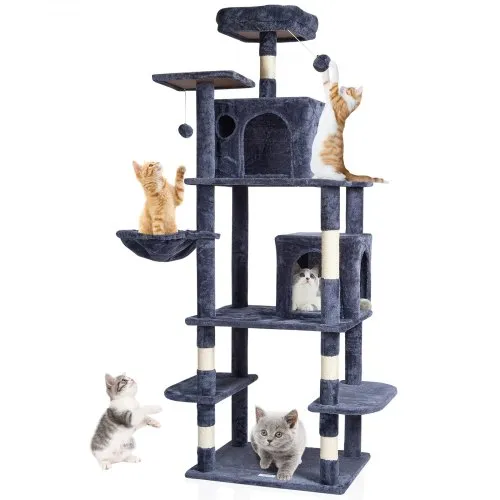
For cat owners who need secure, entertaining vertical areas that satisfy their felines' innate climbing drives and territorial tendencies, VEVOR offers a selection of indoor cat trees. Our indoor cat trees offer the height, stability, and features that basic cat furniture cannot equal, whether you have a single cat that needs exercise stimulus or several cats that need different resting areas. Examine indoor cat trees designed to provide true feline enrichment.
Are you looking for indoor cat trees that are tall enough for enjoyable climbs, can hold several cats at once without toppling, and have enough perches and hiding places to avoid territorial conflicts? Installing cat tree towers in the right vertical space helps indoor cats feel less stressed, gives them opportunities to exercise, and keeps your furniture safe from scratches. VEVOR's selection of indoor cat trees includes roomy, tall cat tree tower models with several platforms, sporty cat climbing tower designs for active cats, comprehensive cat climbing tower layouts that maximize vertical space, and cat tree tower solutions for multi-cat families.
The height and weight capacity of indoor cat trees determine whether they can securely hold the combined weight of your cats when they are using the tree at the same time and provide adequate vertical territory. If you meet both requirements, your cats will use the tree rather than ignore or topple it.
The height of indoor cat trees influences whether they fit within your available ceiling clearance and how well they satisfy cats' climbing drives. Although some designs exceed 240 cm for homes with high ceilings, most models range between 120 and 200 cm.
Indoor cat trees, cat tree towers, and tall cat towers measuring 150 to 180 centimeters offer significant climbing height while maintaining sufficient clearance for typical residential rooms with ceilings between 240 and 270 centimeters. Most cats' territorial needs are met by this height range, which also enables them to see their surroundings from higher vantage points.
When there are several perches available, cats will instinctively choose the highest one. Cats can claim territory well above human head height thanks to a multi level cat tree with a top platform that is 180 cm high, reducing stress and providing protection. The elevated position also satisfies cats' territorial surveillance tendencies, giving them visual control over activity areas and room entrances.
Shorter trees, measuring 120 to 140 centimeters, avoid ceiling contact while still offering significant vertical space in homes with lower ceilings. Even though these smaller models don't reach as high, they still look good in bedrooms, apartments, or as additional climbing structures in places where bigger trees are present.
Climbing challenges that engage athletic cats and make use of otherwise unused vertical space are created by designs taller than 200 centimeters for homes with high or cathedral ceilings. To keep them from toppling over, really tall trees need stronger stability elements. The height requirements for VEVOR's indoor cat trees help you match the tree to your ceiling clearance and your cats' activity level.
How many cats can use the tree at once, and whether it stays stable when cats jump onto higher platforms, are determined by the cat tower's weight capacity. Depending on structure, the majority of high-quality indoor cat trees can hold a combined weight of 15 to 40 kilograms.
A tree certified for 15 to 20 kg capacity provides sufficient support, with a safety buffer, for households with only one cat. Cats, on the other hand, hardly ever sit standing on perches; instead, they leap, jump, and fall with impact pressures that momentarily surpass their body weight. When a 5-kilogram cat jumps from the ground to a higher platform, it may produce an impact force of 15 kg.
Trees with a 30- to 40-kilogram capacity are required for families with many cats to support them at various levels simultaneously. Three 6-kg cats in a tree endure a static load of 18 kg in addition to impact pressures from jumping and level-changing. Cats may avoid undersized trees if they wobble or feel unstable under these dynamic pressures.
Base stability is just as critical as structural strength. A tall tree with a narrow base will quickly become top-heavy and fall over, even if it has a strong frame. Quality designs for trees up to 150 centimeters tall require base platforms at least 50 centimeters square. For taller models, the bases should be larger relative to the tree's height. Some trees come with brackets that attach the top to wall studs to prevent tipping. The basic size and weight specifications of VEVOR's indoor cat trees are good for more than one cat.
When designing cat climbing towers, platform spacing affects how comfortably cats of various ages and athletic abilities can use the tree. Climb difficulty and accessibility are determined by the distance between levels.
Indoor cat trees with platform spacing of 25 to 35 cm between levels are ideal for kittens, elderly cats, or cats with limited mobility since they offer comfortable climbing with little effort per jump. Additionally, close spacing increases the number of acceptable resting places inside a given tree height, which is advantageous for households with multiple cats, each of whom requires a separate perch.
Models with platform spacing of 40 to 50 centimeters provide young adult cats with fun climbing challenges that promote mental and physical activity. Cats are encouraged to use the tree actively rather than merely occupying the highest perch. However, because of the wider gaps between tiers, if the distance between trees exceeds 50 centimeters, fewer athletic cats might be able to reach the higher levels, thus wasting the tree's potential height.
Instead of needing cats to jump straight up, the platforms are spaced so the climbing paths zigzag up the tree. Cats with ordinary leaping ability can now scale tall buildings thanks to this staggered technique, which lowers the effective jump height while still utilizing the whole tree height. Platform spacing of VEVOR's indoor cat trees strikes a balance between usability and interaction.
The characteristics and components of indoor cat trees affect how well they endure years of clawing, climbing, and sleeping, as well as whether they satisfy your cat's behavioral needs. Cat tree tower choices that cats use every day are distinguished from those that end up as forgotten furniture by their high-quality materials and well-thought-out features.
Durability, stability, and how cats find different surfaces to rest and scratch are all influenced by the material construction. The majority of high-quality trees blend many elements selected for particular purposes.
Perches and hideaways are supported structurally by platforms made of particle board or plywood. Although particle board is less expensive, it may droop or break when repeatedly struck by jumping, especially on wide platforms. Plywood provides better strength and longevity, maintaining rigidity even on larger, frequently used platforms. Flexing that makes cats feel unsteady is avoided by using platforms at least 12 to 15 millimeters thick.
Cats' claw care needs are met by creating scratching surfaces with sisal rope wrapped around support posts. Natural sisal fiber rope with a minimum diameter of 6 millimeters is used in high-quality cat climbing tower models. It is securely wound around supports to avoid unraveling. Since cats frequently claw at different heights, the rope should completely cover posts from base to top. Cheap trees utilize carpet instead of sisal, which is less enjoyable to cats and wears out more quickly, or thin rope with spaces between wraps.
Platforms, perches, and hideaways with plush fabric coverings offer cozy places to rest. The fabric should be firmly attached to the platforms underneath, with no loose edges that cats may snag their claws on or rip off while trying to scratch. Cleaning without disassembling the tree is made possible by detachable, machine-washable platform covers, which is important for preserving cleanliness in homes with multiple cats.
High-end indoor cat trees feature natural materials such as woven seagrass surfaces and real wood pillars. Even though they cost more, some cats prefer the real textures and scents that these materials offer over artificial ones. Natural materials, however, require more upkeep and do not last as long as high-quality synthetic alternatives. The material combinations used in VEVOR's indoor cat trees strike a balance between affordability, durability, and feline appeal.
Whether a cat tree tower actually enriches the environment or merely takes up floor space depends on several features. A variety of feline behaviors are addressed by components found in effective plants.
A variety of perches at varying heights meet cats' need for a territorial hierarchy. Dominant cats usually occupy the top perches in multi-cat households, while submissive cats use the lower tiers. While cat tower models with three to five different resting locations spread throughout the height levels enable cats to dwell happily on the same structure, a tall cat tower with only one raised platform breeds competitiveness and stress.
Multi level cat tower models with enclosed hideaway boxes offer security for shy cats as well as secluded resting areas for cats who need breaks from home activities or from other animals. The hideaway should have an entrance that is both safe and spacious enough for easy access (at least 20 centimeters in diameter). Cats that wouldn't go to ground level when threatened can access the hideout if it is at least halfway up.
Some cat climbing tower products feature dangling toys that encourage independent play, though cats tend to ignore them as the novelty wears off. More useful features include perches placed next to windows for observing the surroundings, horizontal scratching surfaces for cats who prefer flat scratching to vertical, and integrated scratching posts at various heights. Features that encourage long-term use are given precedence over transient novelty factors in VEVOR's indoor cat trees.
From small versions for apartments to stunning tall cat tower installations for multi-cat houses, VEVOR's selection of indoor cat trees meets all feline needs. Our cat climbing tower, multi level cat tree, and cat tower alternatives provide the enrichment indoor cats need, thanks to their robust structures and entertaining features. Find the cat tree designs, tall cat tower options, and indoor cat trees that suit your environment by looking through the entire selection today.
Models between 150-180 cm offer good climbing height with sufficient headroom for typical ceilings of 240-270 cm. The majority of cats' territorial needs are met by cat tree and multi level cat tower designs at this height, which also fit easily in ordinary rooms without contacting the ceiling.
Indoor cat trees with a 15–20 kilogram capacity are necessary for houses with a single cat. To properly support several cats, taking into account impact forces from jumping and concurrent use, multi-cat homes need cat tree tower models rated for 30–40 kg.
With the right foundation measurements (50+ cm square for 150 cm height), high-quality multi level cat tree and multi level cat tower products stay sturdy during typical cat use. For added security in busy homes, very tall indoor cat trees may come with wall-mounting brackets.
Make securing sisal scratching posts, several perches of varying heights, and at least one enclosed hiding place a priority. Compared to trees with novelty features like dangling toys, which rapidly lose their appeal, cat climbing tower models with these features engage cats more effectively. Cats of all ages can be accommodated with a platform spacing of 25–35 cm.
Every week, vacuum platforms and hideaways are used to remove trash and shed fur. Every month, inspect the sisal wrapping and rewrap any areas where the rope has come loose. Any loose hardware connections should be tightened. To keep your indoor cat trees fresh, wash them every 2 to 3 months if they have detachable fabric covers.