



- Supports full-body strength training with barbell squats, bench presses, pull-ups, and landmine rows.
- Space-saving foldable design occupies 10 sq.ft open, 2.7 sq.ft folded.
- Heavy-duty carbon steel frame supports up to 1000lbs for stable, safe workouts.
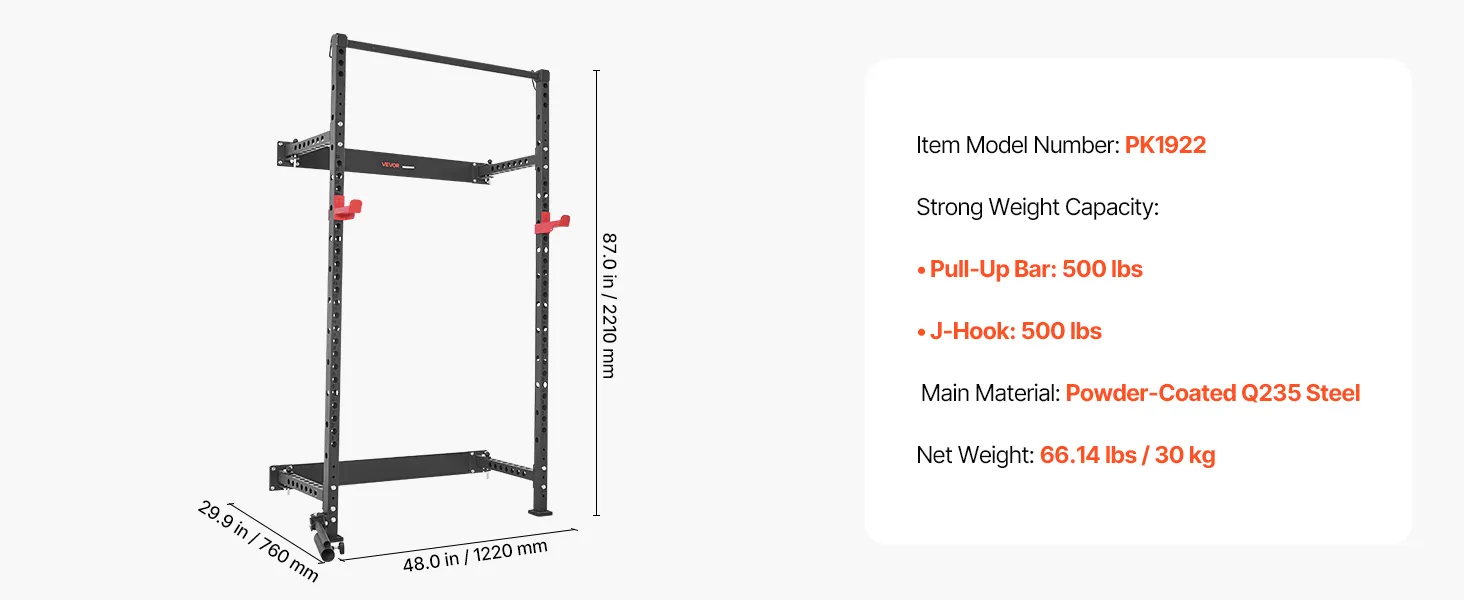
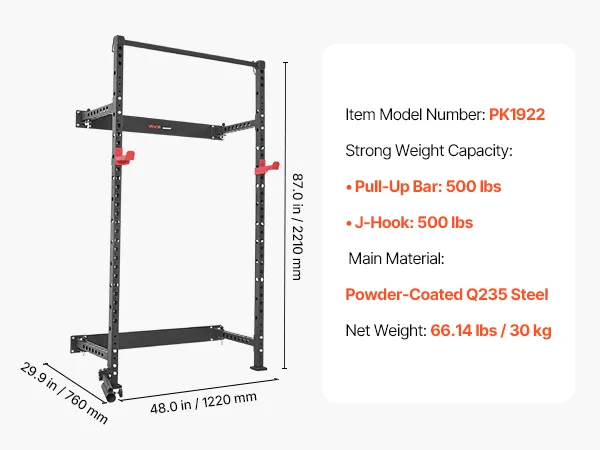
- Item Model Number PK1922
- Product Type Foldable & Wall-Mounted Power Cage
- Net Weight 66.14 lbs / 30.00 kg
- Product Dimensions 48.03 x 29.92 x 87 in / 1220 x 760 x 2210 mm

About this item
VEVOR Wall Mounted Power Rack with 1000 Lbs Capacity on 2"×2" Carbon Steel Frame
The VEVOR wall mounted power rack is made of carbon steel that won't rust. The main frame tube is 2 inches by 2 inches and is reinforced. The walls of the main structural members are 1.5 mm thick. This material specification guarantees a static load capacity of 1000 pounds, providing the structure with the extra strength it needs for heavy compound lifts like loaded barbell squats, bench presses, and rack pulls with serious training weights.
The carbon-steel construction can withstand oxidation and surface corrosion that accelerate structural fatigue in garage and basement gyms, where humidity levels change with the seasons. The 1.5mm wall thickness helps resist deformation when the load is unevenly distributed, which is very important for safety during unilateral exercises or when spotting contact puts lateral force on the rack structure.
Foldable Design Collapses from 10 Sq Ft to 2.7 Sq Ft for Compact Home Gym Storage
When fully set up for training, this power rack takes up 10 square feet of floor space, enough room for common barbell movements such as the overhead press and the wide-stance squat. When the training is over, the folding mechanism brings the whole rack down to just 2.7 square feet of floor space, which is a 73% reduction in space used.
The ability to fold flat is what sets the wall mounted power rack format apart from freestanding cage options. No matter how often you train, freestanding racks permanently take up 20 to 30 square feet of usable floor space. The VEVOR folding system frees up that space for parking, storage, or other household uses between workouts.
23-Level J-Hook Adjustment from 14.8 to 62.6 Inches Accommodates All Lift Heights
The J-hook system on this wall mounted power rack offers 23 height settings, from 14.8 inches at the lowest to 62.6 inches at the highest. Each position is linked to a numbered receiver hole, making it easy to remember the height between exercises without measuring or guessing. The 23-position range is wide enough that athletes of very different heights can use the same rack installation.
This rack is useful for shared household gym use because it lets both a 5'2" lifter and a 6'4" lifter find biomechanically correct barbell unrack positions within the range of adjustments. Placing the J-hook in the right place also saves energy by avoiding the need to lift the barbell from nonideal heights, which helps protect the joints over time as training volume increases.
Wall Mounted Power Rack 4-Level Pull-Up Bar Adjusts from 80.7 to 86.6 Inches for Overhead Grip Training
This power rack has a built-in pull-up bar that can be adjusted to four different heights, from 80.7 inches to 86.6 inches from the floor. This feature allows people of different heights to use it while still being able to hang fully, with enough space above the ground. Pull-up training at the right bar height allows the scapula to drop fully and the shoulder joint to move through the full range of motion.
Installing a separate pull-up bar as a stand-alone unit usually means adding extra wall anchors, figuring out how much ceiling space is needed, and getting hardware that doesn't come with most home gym setups. It combines the vertical pulling power of the main rack with the squat and press functions into a single wall-mounted structure, reducing equipment costs and the number of holes required in the gym space.
Landmine Holder and 2 J-Hooks Enable 5+ Full-Body Exercise Patterns from One Rack
The power rack comes with an accessory set that includes two adjustable J-hooks and a landmine holder. It expands the rack's exercise library beyond just standard barbell rack movements. The landmine attachment works with a standard Olympic barbell sleeve. It lets you do rotational pressing, landmine rows, single-arm presses, and anti-rotation core exercises that you can't do on a rack without this special pivot anchor.
Two J-hooks give the barbell the support it needs for squats, bench presses, incline presses, and rack pulls at any of the 23 height positions. With a landmine holder and two J-hooks, you can train your chest, back, shoulders, legs, and core with a single wall-mounted unit. It means you don't need any extra cable machines, landmine base plates, or separate pull-up stations that would each take up their floor space.
Hardware Kit and Detailed Manual Enable Fast Wall Mounting Without Professional Help
The wall mounted power rack comes with the required hardware to assemble it, along with a printed manual that explains how to anchor the wall, assemble the frame, and attach the accessories in a logical order. The instructions are for regular home users and include information on where to place the studs, how much torque to use on the anchor bolts, and how to check the frame alignment to ensure a safe first-time installation.
Installing wall-mounted fitness equipment by a professional usually costs an extra $150 to $300. The main factor determining a rack's long-term safety is how it was installed in the first place. A properly anchored unit spreads the 1000-pound-rated load evenly across the wall studs, preventing fastener fatigue that can cause the rack to move when loaded repeatedly.
Rust-Resistant Carbon Steel Frame Maintains Structural Integrity in Garage Gym Conditions
Garage and basement gyms have much harsher material conditions than climate-controlled commercial gyms. The temperature can change a lot, the humidity can be higher during wet seasons, and moisture can sometimes get in, all of which speed up the corrosion of fitness equipment that isn't specifically treated for these conditions. The carbon-steel frame of this power rack has a rust-resistant finish that directly addresses this environmental problem.
Oxidation slowly reduces the effective cross-sectional area of load-bearing members, so the rack's rated 1000-pound capacity will decrease over time if it is not treated. The factory-applied rust-resistance treatment protects the carbon-steel substrate from electrochemical corrosion, maintaining the squat rack power cage's structural integrity and dimensional stability for years of use in a garage gym.
Frequently Bought Together
VEVOR Folding Power Cage, Wall-Mounted Power Rack Squat Rack, Multifunctional Strength Training Workout Equipment with Landmine Holder, Adjustable J-Hooks & Pull-Up Bar for Home Gym, 545KG Capacity
