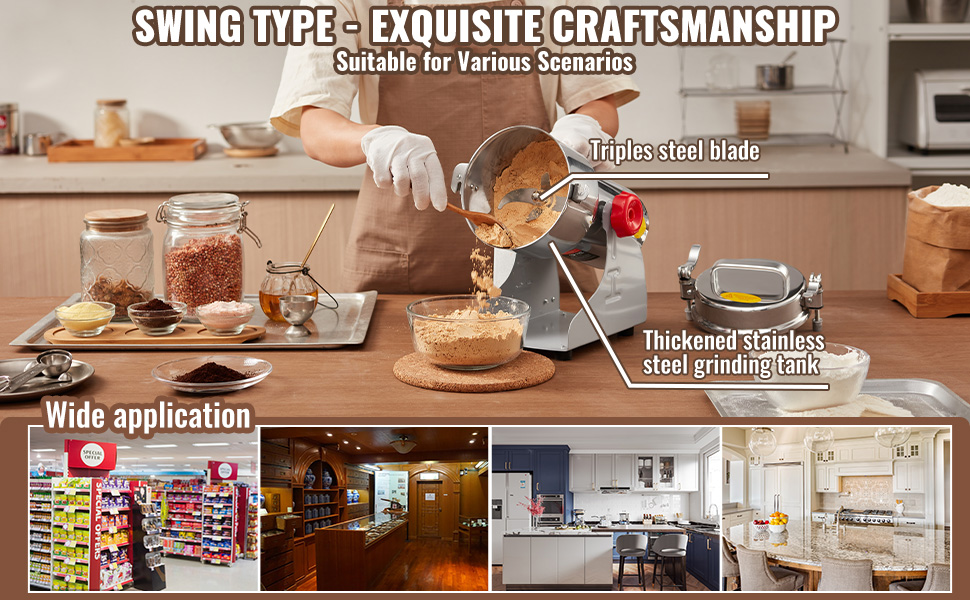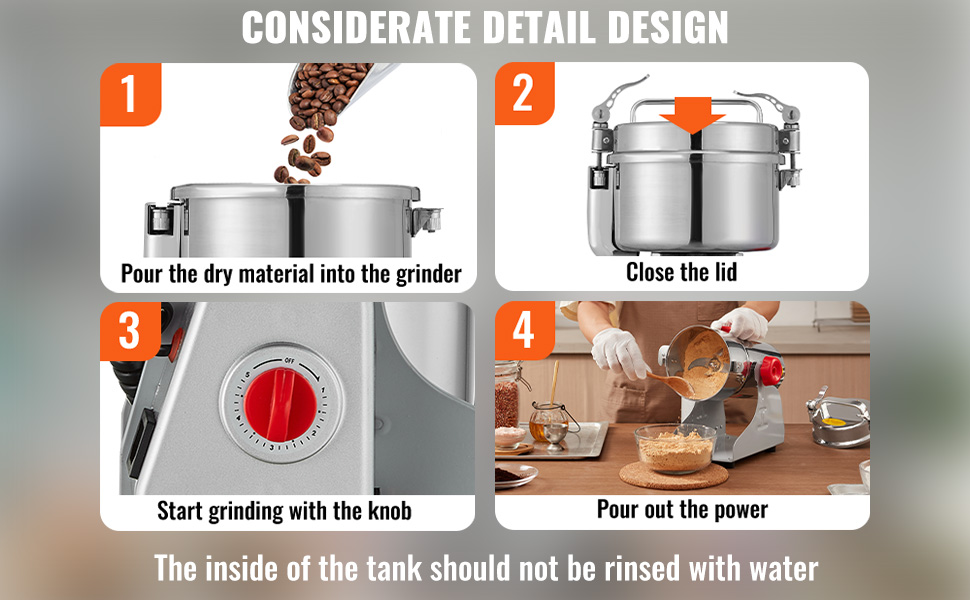



The standout physical feature of this electric steel grinder is its 270-degree swing body, which eliminates the difficult lifting and tilting associated with typical upright designs. The user only swings the entire unit body to dispense the powdered material through the tank opening after grinding – no gripping, tilting, or straining over the machine required. This is a major ergonomic enhancement for users who process numerous batches in a session.
The swing function is also active during operation. The rotating blades gently rock the body, moving settled material from the tank walls back into the central cutting zone. This dynamic redistribution allows each particle to traverse through the blade field many times, resulting in a more homogeneous, consistently fine powder than stationary grinding. If a batch leaves a somewhat coarse residue after the first run, a brief sieve and second grind pass will take care of any lingering unevenness.
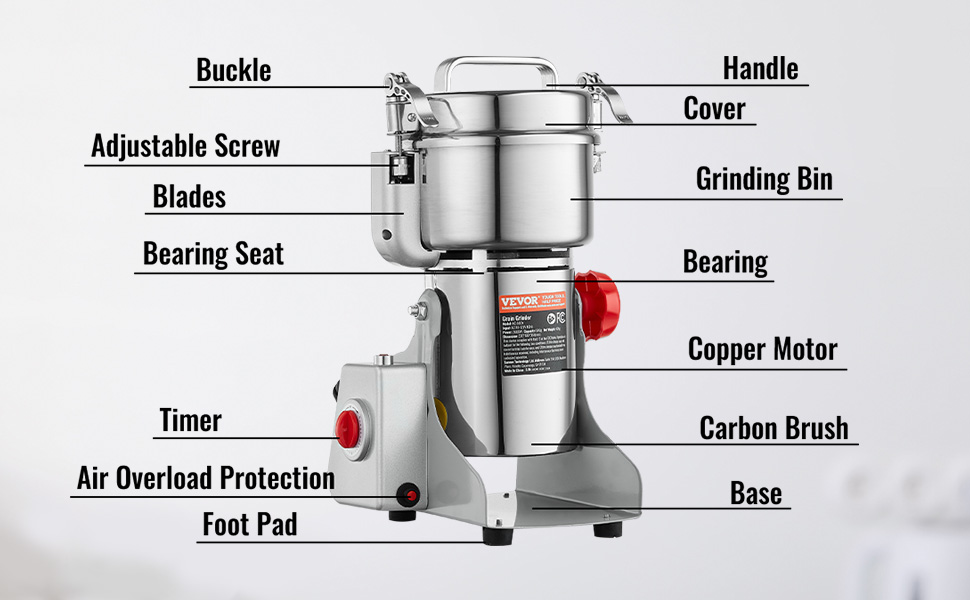
This electric steel grinder has a buckle-lid mechanism to ensure the tank and lid are tightly sealed before you can do anything with it. If the lid is not firmly locked in position, the machine will not start. This eliminates the risk of the lid coming loose during grinding and spreading fine powder across your work surface. This interlock construction is particularly critical for processing lightweight components such as pepper or rosemary that fly around at high speeds.
The sealed design also protects the contents from external contamination during processing and prevents spills. All contact surfaces are made of food-grade stainless steel, so you will never have a metallic taste or a chemical reaction with what you are grinding. The tight closure also helps contain volatile aromatic compounds within spices and herbs, so each batch retains its natural aroma and potency. The device is thus equally useful for pharmaceutical ingredient processing and culinary spice grinding applications.
The digital timer display allows the operator to program and monitor grinding time without an external clock or manual estimation. Exact time management is important, as over-grinding some spices or grains can alter their flavor profile or create undesirable heat in the tank. Being able to specify an accurate countdown also means it’s just as reliably not under-processed as it is not over-processed.
The display also makes it easier to repeat results from batch to batch. Once a user knows the optimal grind time for a particular ingredient, such as 45 seconds for cinnamon or 60 seconds for dried corn kernels, that setting can be used consistently every time. This repeatability is valuable in commercial kitchens, pharmaceutical processing facilities, and food production contexts where output standardization is required. The timer also reinforces the 5-minute operating cycle, reminding workers to pause and let the motor rest for its suggested 10-minute interval.
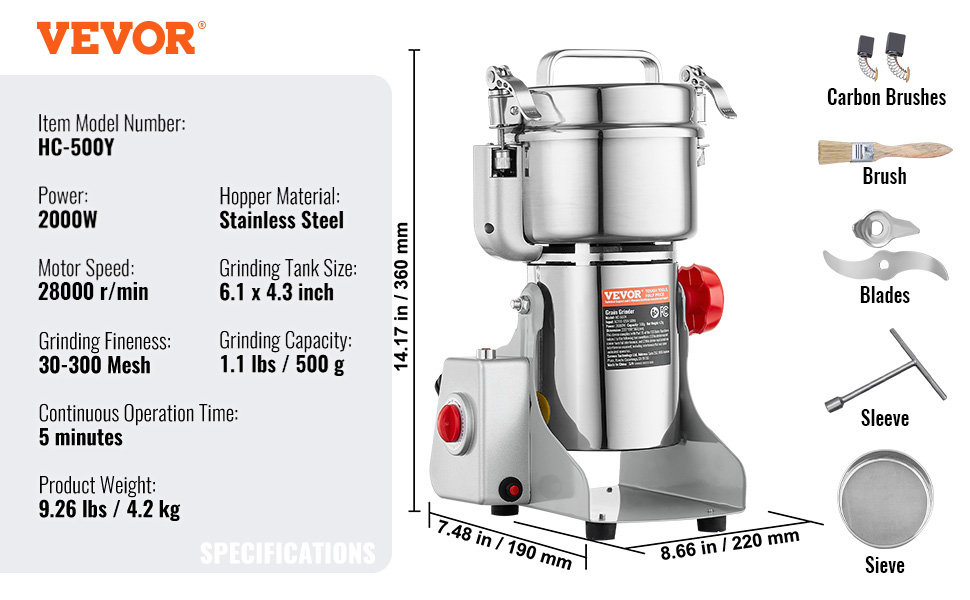
The stainless steel grinding tank, 6.1 × 4.3 in. (15.5 × 11cm), is a reasonable compromise between capacity and grinding efficiency, with a maximum of 500g of dry material per batch. If the tank is more than 2/3 full, the space between the blades and the material is limited, causing the blades to contact the material unevenly. Thus, the recommended fill level of 1/2 capacity ensures that each particle is exposed to the blades for the complete cycle.
With 30-second active grind time and a 500g batch size, operators can grind large volumes in short cycles with minimal downtime. The tank is also sized for the three-layer blade assembly so that the crushing, horn, and powder-removal blades operate within their appropriate material depth ranges. This tank capacity will allow a modest personal batch of coffee beans or a larger industrial batch of dried herbs without needing to reconfigure between uses.
It is lightweight at only 9.26 lbs (4.2 kg) and compact at 8.66 × 7.48 × 14.17 inches (220 × 190 × 360 mm), so it doesn’t take up much counter space while delivering commercial-level performance. It is easy to move between workstations or tuck away in a cabinet when not in active use – a practical plus in kitchens where counter space is at a premium – and with its tiny footprint, it does not take up much room.
The machine is small but structurally built to withstand the mechanical stress of blades turning at 28,000 RPM, with minimal movement or instability when placed on a flat surface. The weight distribution ensures that the base remains firmly rooted during operation, even with the swing body in motion. The device's portability and operational reliability make it ideal for use in many environments, including home kitchens, small food enterprises, hospital nutrition departments, and herbal medicine production facilities.
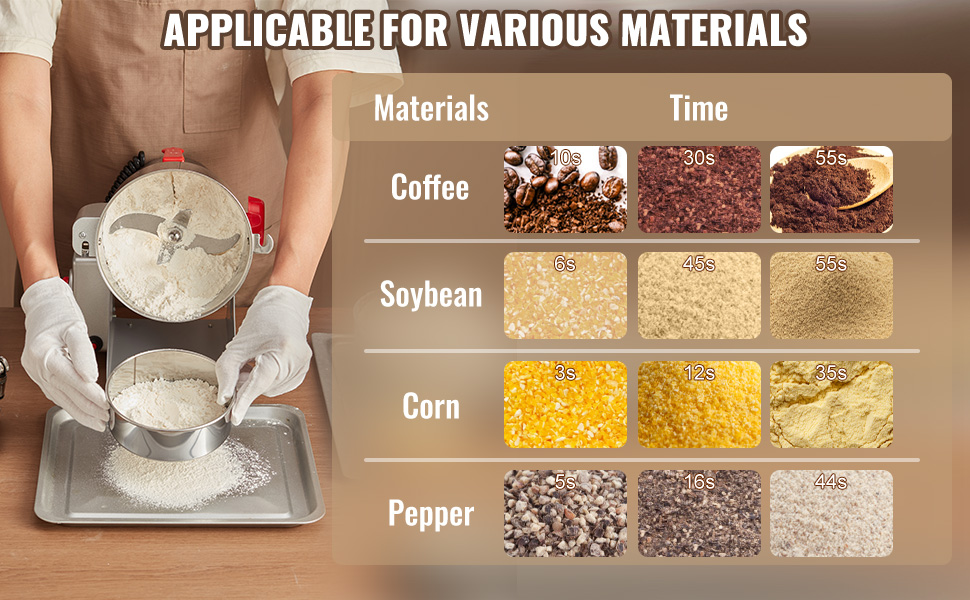
This electric steel grinder was designed specifically for handling dry materials. It may take a wide range of appropriate inputs, including soy, corn, barley, wheat, oats, rye, peas, coffee beans, fennel, pepper, cinnamon, and rosemary. This dry-operation requirement is intentional; the 403 stainless steel tank and high-speed blade assembly are designed for brittle, dehydrated materials that will break up neatly when they hit the blade rather than spreading out or clogging.
This machine is incompatible with wet, fresh, oily, or sticky materials and should not be used to process them. They can cover the blades, hinder motor performance, and compromise hygiene. But this electric steel grinder grinds to a wide range of finenesses, from 30 to 300 mesh, for specified materials, so that it can be adapted to everything from coarse cracked grain to superfine pharmaceutical powder. Its broad applications in the food, gourmet, and pharmaceutical industries make it a reliable single-unit investment for many dry-processing needs.