
Exercise Equipment Mat




Results for Exercise Equipment Mat
A wide range of exercise equipment mats from VEVOR is available to safeguard your flooring and lessen vibration and noise while working out. Our exercise mats for equipment offer outstanding durability and performance, whether you're outfitting a commercial fitness center, setting up a home gym, or designing a peaceful workout area in an apartment. VEVOR exercise equipment mats offer reasonably priced solutions that blend premium materials with useful design, ranging from small mats for single machines to large-format options for full gym coverage. Every mat is designed to look professional while withstanding heavy equipment and rigorous training sessions.
VEVOR High-Performance Exercise Equipment Floor Mats for Complete Gym Protection
Are you sick of your neighbors complaining about noise, damaged equipment, and scraped floors? Selecting the ideal exercise machine mat may safeguard your flooring and equipment investments while completely changing your training area. Home gym owners and fitness experts face unique obstacles, which VEVOR's exercise equipment mats address. Our exercise equipment mats offer a sturdy, protected barrier that reduces vibration transmission, absorbs impact, and designates a specific area for working out.
Understanding Size & Thickness for Optimal Floor Protection
Choosing the appropriate exercise equipment mats, size, and density ensures optimal protection and performance across a variety of training situations.
Matching Mat Size to Your Equipment Footprint
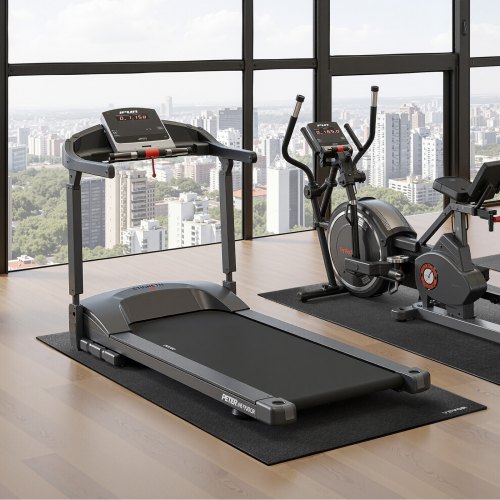
For equipment stability and efficient floor protection, the proper size is essential. Measure your machine's footprint, including any extension points used during exercise (e.g., the length of the treadmill belt or the rowing machine rails), when selecting mats for exercise equipment. To give a safety buffer and allow for mobility, add 6 to 12 inches on all sides.
Think about whether a seamless large-format option or discrete mats would work better for your layout if you have multiple pieces of equipment. For compact machines, 4x6 feet for the majority of cardio equipment, and 6x8 feet or more for complete coverage, VEVOR offers exercise equipment mats in typical sizes. Our modular alternatives are ideal for changing gym settings, as they let you connect multiple mats to create personalized arrangements. Keep in mind that excessive coverage guards against floor damage from lost weights, shifting equipment, and user movement outside the machine.
Thickness Requirements for Different Equipment Types
The weight of the exercise equipment mats and their level of use significantly impact the optimal mat thickness. Stationary bikes and ellipticals are examples of lightweight cardio equipment that work well on 6-7mm exercise machine mats because they offer sufficient cushioning without being overly compressive. A thickness of 8–10 mm is necessary for treadmills and other heavy equipment to absorb vibration and prevent the mat from deteriorating due to frequent impacts.
VEVOR suggests 12–15mm exercise equipment mats that can withstand dropped weights and high-point stresses for Olympic lifting platforms, power racks, and free weights. Additionally, thicker mats provide better noise attenuation, which is crucial for shared areas or apartment dwellers. Match the density to your particular equipment, though, as too much thickness can cause instability for some machines. You can choose the best protection-to-stability ratio for your training style with VEVOR's range, which clearly states thickness specs.
Floor Type Considerations and Compatibility
Certain mat qualities are required for various flooring materials to maintain traction and prevent damage. Smooth-bottomed exercise equipment mats that won't collect trash or leave friction marks are necessary because hardwood floors are especially prone to scratches and dents. The non-abrasive undersides of VEVOR's exercise equipment mats protect fragile surfaces while maintaining their firmness. Prioritize cushioning and moisture resistance over surface protection for concrete basement gyms; our rubber-based solutions perform exceptionally well in these conditions.
Because carpet can cause equipment to shift or sink, it poses special challenges. Firmer, less compressible mats perform best on carpeted surfaces. Mats with textured bottoms that prevent sliding without adhesives are beneficial for tile and laminate flooring. When choosing exercise equipment mat specifications, consider the value and vulnerability of your floor; premium flooring warrants spending more on thicker, more protective mats that maintain your home's value.
Strategic Placement for Maximum Coverage Benefits
Simple equipment placement is only one aspect of thoughtful mat layout. To provide a safe step-off area and capture debris kicked up by shoes, place your exercise mat with extra length at the back of the treadmill when using it. To catch dirt before it reaches the equipment zones, place extra mats at your gym's entrances. Create distinct spaces with mats of the right size for each form of exercise in multi-station gyms. Stretching, strength training, and cardio areas all require various levels of protection.
With VEVOR's exercise equipment mats, you can position them to create visual boundaries that give your area organization and full floor coverage. Select mats with beveled edges to enable seamless transitions without catching for rotating or relocating equipment. When designing the layout, consider traffic patterns and your movement between stations. Strategically placing mats for exercise equipment makes the training area safer and more efficient.
Selecting the Right Material & Noise Reduction Features
Your exercise equipment mats construction and composition directly impact durability, noise reduction, and the overall workout experience in shared living areas.
Comparing Rubber, PVC, and Foam Material Properties
Your choice of material has a major impact on the longevity and performance qualities of your mat. Heavy equipment and high-impact exercises are best suited to high-density rubber exercise equipment mats due to their exceptional durability and vibration-damping capabilities. Rubber products from VEVOR, including exercise equipment mats, offer superior noise reduction through natural shock absorption, resistance to compression, and shape retention under heavy loads. PVC-based mats offer a cost-effective and high-performing combination, with smooth surfaces that make cleaning easier and prevent moisture absorption.
Foam mats work well in places that need the most cushioning for floor exercises or lighter cardio machines, but they are less resilient under large equipment. Recycled-rubber exercise equipment floor mats offer professional-grade performance and environmentally sustainable durability for dedicated home gyms. Each material offers unique benefits: foam for comfort, PVC for ease of maintenance, and rubber for optimal protection. To help you match qualities to your unique needs, VEVOR exercise equipment mats clearly label the materials' composition.
Noise and Vibration Dampening Technologies
When working out early in the morning or late at night, effective noise reduction safeguards relationships with neighbors and household members. Denser materials absorb more vibration before it travels through the flooring, which affects the acoustic effectiveness of exercise mats for equipment. The high-end exercise machine mat options from VEVOR feature multiple layers with varying densities that absorb different vibration frequencies.
The top surface prevents equipment wear, the middle layers absorb shock and vibration, and the bottom layer offers stability and grip. When choosing exercise equipment mats for apartments or condos, pay special attention to those that meet decibel-reduction standards. Because of their molecular makeup, rubber-based materials naturally perform better than PVC in damping applications. The most effective way to reduce noise is to strategically place thicker mats beneath high-impact areas, such as weight-drop zones or treadmill belt strikes. Compared to equipment placed directly on hard ground, appropriate mats for exercise equipment can reduce noise transmission by 40–60%.
Why Choose VEVOR Exercise Equipment Mats for Your Fitness Space?
VEVOR provides complete workout equipment mat solutions that offer outstanding value along with professional-grade protection. With sizes and materials that fit every type of flooring or equipment, our wide selection covers every possible gym layout, from single-machine setups to full workout centers. To ensure it will endure years of rigorous use while retaining its protective and noise-reducing qualities, every exercise machine mat undergoes a thorough quality testing process. VEVOR makes it easy to design the safe, expert training area you deserve, with affordable prices, quick shipping, and helpful customer service. Explore our full range of exercise equipment mats online and confidently revamp your gym.
FAQs
Can I cut exercise equipment mats to fit custom spaces?
Yes, you can trim most rubber and PVC mats with a straight edge and a sharp utility knife, though doing so may void warranties. For the cleanest edges, take precise measurements and cut from the underside.
Do exercise mats work on carpeted floors?
Yes, but to keep equipment from sinking, pick carpets that are harder and less compressible. The mat shields the underlying flooring from equipment weight while providing a sturdy base atop carpet.
How do I clean and maintain my exercise equipment mat?
To eliminate debris, sweep or vacuum often. Then mop with a light soap-and-water solution. Steer clear of strong chemicals that can break down rubber. Before reinstalling equipment, let the mats completely dry.
Will rubber mats leave marks on my floor?
Premium matting, such as VEVOR's, uses rubber compounds that don't stain flooring. To eliminate any short-term odors, let the new mats air out for 24 to 48 hours before installation.
What thickness mat do I need for a treadmill?
Select a mat thickness of 8–10 mm for a treadmill to efficiently absorb impact and vibration. While thicker alternatives provide the best noise attenuation for apartments, thinner mats may wear out or compress over time.
