
Download VEVOR App 

Exclusive 5,00€ off for your first three orders on the App.
Scan the QR code to download
A wide range of arched loading ramps from VEVOR is available for a variety of loading applications in commercial, industrial, and residential environments. For loading motorcycles, ATVs, wheelchairs, lawnmowers, and heavy machinery onto trucks, trailers, and elevated platforms, our aluminum ramps offer outstanding durability and reliability. VEVOR arched loading ramps are available in lengths and weight capacities from 600 to 7,500 pounds, ensuring safe, effective loading solutions for any requirement. For optimal performance and lifespan, each ramp has anti-slip surfaces, a corrosion-resistant aluminum structure, and careful engineering.
Do you find it difficult to securely load wheelchairs, motorcycles, or heavy machinery onto trucks and trailers? Smooth, secure operations and tedious, risky loading experiences can be significantly affected by the loading ramp. VEVOR arched loading ramps offer dependable solutions for contractors, machine operators, and racing enthusiasts, meeting accessibility demands across a variety of loading scenarios by combining a high weight capacity with an easy-to-use design.
You can choose arched loading ramps that safely handle your equipment and meet your specific loading environment by considering weight capacity and dimensional criteria.
The longevity and safe operation of the equipment depend on the choice of arched loading ramps with the appropriate weight capacity. For lightweight applications like lawn mowers and small ATVs, VEVOR aluminum loading ramps have a 600-pound capacity; for heavy-duty commercial equipment and automobiles, the capacity ranges up to 7,500 pounds. Always consider the entire weight of the vehicle or equipment, including any cargo, fuel, or extras, when determining your demands. Selecting ramps rated at least 25–30% above your actual load weight is an essential safety factor that offers a margin of safety under dynamic loading conditions.
Since the majority of street bikes weigh between 400 and 700 pounds, our aluminum motorcycle ramps with a 1,500-pound capacity are well suited for motorcycle enthusiasts who need sufficient clearance. Depending on the size and accessories of their vehicles, ATV and UTV owners usually require ramps with a capacity of 1,500–3,000 pounds. Our heavy-duty arched loading ramps with 5,000–7,500-pound ratings are necessary for commercial applications that use riding mowers, compact tractors, or skid steers. Keep in mind that weight capacity applies only to the two ramps operating together, and that using only one ramp or distributing weight unevenly drastically reduces the safe loading limit.
When using arched loading ramps, ramp length directly affects the loading angle, which in turn affects user safety and ease of use. To accommodate different truck bed heights, trailer combinations, and loading situations, VEVOR offers lengths from 5 to 10 feet. Longer ramps generally produce softer inclines, which lowers the possibility of equipment bottoming out, losing traction, or becoming difficult for operators to operate. 6-7 foot aluminum ramps offer a comfortable 18–20 degree slant that most equipment can manage with ease for typical pickup truck beds that are approximately 20–24 inches high.
Higher deck heights in trailer applications frequently necessitate longer ramps. 8–10-foot folding aluminum ramps help keep a 36-inch-tall trailer at a tolerable incline of less than 25 degrees. For wheeled equipment, steeper slopes over 30 degrees become difficult, and for motorcycles or ATVs, where weight moves significantly during ascent, they can be hazardous. When choosing length, consider your equipment's wheelbase, approach angle, and ground clearance. Arched ramps provide center clearance for exhaust systems and undercarriage parts, but they must be long enough to avoid scratching when going from the ground to the ramp surface.
On aluminum trailer ramps and loading systems, ramp width strongly influences stability and compatibility with different wheel configurations. The standard width of VEVOR arched loading ramps is 11 to 15 inches, with larger options available for certain applications. Motorcycle loading requires a minimum tire profile width of 10 to 11 inches; however, 12 to 13 inches offers greater comfort and facilitates alignment. ATV and UTV tires differ greatly: sport quads have smaller profiles, often 8 to 10 inches, while utility vehicles may have 12-inch or larger tires, requiring a suitable ramp width.
Wider tire spacing and sturdy loading platforms are two advantages of 14–15-inch-wide arched loading ramps for lawn equipment and compact tractors. Single-piece or connected ramp layouts 30 to 36 inches wide ensure safe passage with sufficient edge clearance for wheelchair accessibility applications. For safe operation, always measure the tire or wheel width of your equipment and allow at least two to three inches of clearance on each side. Depending on your main use case, wider ramps provide more stability and forgiveness during alignment, but they also increase overall weight and storage needs.
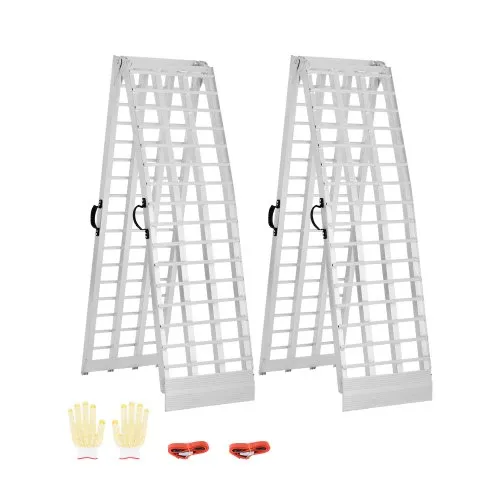
Unlike flat alternatives, these aluminum loading ramps have an arched design that provides critical additional ground clearance for oil pans, exhaust pipes, and undercarriage parts. Depending on the ramp's length and intended use, VEVOR arched loading ramps have center arch heights that range from 3 to 6 inches. During the loading transition, this raised middle part protects lawnmower decks, ATV skid plates, and low-hanging motorbike exhaust systems from damage. In addition, the arch shape reduces the risk of scraping when equipment moves from a horizontal surface onto the inclined ramp, improving approach and departure angles compared to flat ramps.
The 4-6 inch arch clearance that aluminum motorcycle ramps offer is especially useful for motorcycles with low-slung cruiser exhaust systems. Despite arch advantages, racing ATVs with performance modifications and sport bikes with under-tail exhausts may still need to pay close attention to the approach angle. Rather than producing an abrupt angle that could bottom out equipment, the gradual curve of high-quality arched loading ramps distributes the load more evenly. When weighing your options, consider both the transition radius and the arch height. Gentler curves allow for lower equipment while preserving structural integrity along the ramp span.
The long-term durability, practicality, and functionality of aluminum ramps across a variety of settings and applications are determined by the material's construction and mobility.
For arched loading ramps used in a variety of settings, aluminum offers the best combination of strength, weight, and corrosion resistance. To achieve remarkable strength-to-weight ratios, VEVOR aluminum loading ramps use aerospace-grade aluminum alloys. These ramps often weigh 40–60% less than identical steel ramps while maintaining load capacities on par with or better than steel ramps. For people who work alone or set up ramps frequently during the day, its lightweight design greatly lessens user fatigue during setup and storage. Without the need for protective coatings or routine maintenance, the material's inherent resistance to rust and corrosion makes it ideal for equipment exposed to rain, snow, road salt, and humid storage conditions.
Quality aluminum trailer ramps have non-slip patterns stamped or punched into the surface, making them easier to use on muddy, oily, or wet ground. The roughness of aluminum doesn't go away as it does with painted surfaces, which helps keep the ramp's handling traits. Due to their high thermal retention, steel ramps can get too hot in full sunlight. Aluminum, on the other hand, can be used at temperatures below freezing without breaking. Aluminum ramps typically last longer than comparable ramps that require periodic structural repairs or refinishing. This means that professional contractors, landscapers, and equipment-hire businesses spend less on replacements and experience less downtime.
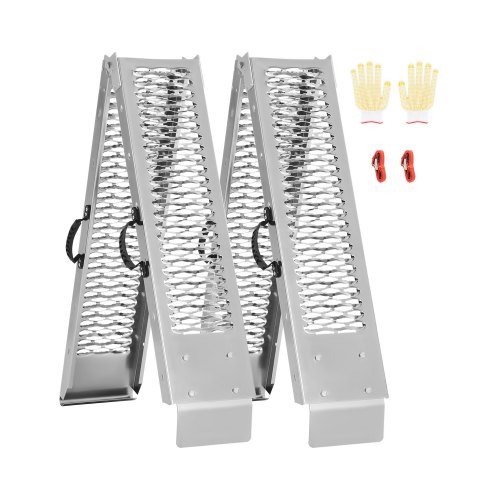
People who don't have much storage space or need to move things around frequently may find that folding aluminum ramps are a beneficial choice. VEVOR offers bi-fold and tri-fold folding configurations. Compared to solid ramps, these layouts cut storage length by 50–66%. One-piece bi-fold arched loading ramps usually have a center hinge with a safe locking mechanism that lets them fold into 4-foot sections for storage in the truck bed or hanging in the garage. The 9-foot ramps on tri-fold models fold down to just 3 feet, making them even more compact. This makes them ideal for small storage closets or car trunks.
Heavy duty hinges and strengthened mounting points are features of high quality folding aluminum ramps that preserve structural integrity under maximum load capacity and frequent use. When storing the ramp vertically, safety pins or locking straps keep it folded and prevent it from opening unintentionally during transportation. Certain aluminum motorcycle ramps made by VEVOR feature carrying handles at appropriate points to provide comfortable one-person transport from storage to a vehicle. When choosing between solid and folding ramps, consider the dimensions of the storage area. Solid ramps are easier for users with designated storage areas, while folding designs are ideal for users parking in regular garages, apartments, or service trucks with limited equipment space.
For both residential and commercial applications, VEVOR offers complete arched loading ramp solutions that combine expert grade craftsmanship, adjustable weight capacities, and affordable prices. The corrosion-resistant materials, non-slip surfaces, and well-considered design features of our aluminum loading ramps guarantee years of dependable use with a variety of bikes, ATVs, equipment, and accessibility requirements. VEVOR offers the ideal solution for every loading challenge, with options ranging from lightweight folding aluminum ramps to robust commercial models. Browse our whole inventory now to discover the VEVOR difference—backed warranties and prompt customer service for secure, reliable loading operations.
Most ATVs weigh 400-800 pounds, so aluminum ramps rated for 1,500-2,000 pounds provide an adequate safety margin. Always check your specific ATV weight, including fuel, accessories, and cargo, then select ramps rated at least 25% higher than your total load.
Yes, quality folding aluminum ramps from VEVOR maintain the same weight capacity as solid designs when properly deployed and locked. Reinforced hinges and engineering ensure the folding mechanism doesn't compromise structural strength under rated loads.
For pickup beds 20-24 inches high, 6-7-foot arched loading ramps create comfortable 18-20-degree angles suitable for most equipment. Tall lifted trucks or heavier equipment benefit from 8-9-foot aluminum loading ramps for gentler inclines.
Use ramps with rubber-coated top edges that grip tailgate or trailer edges securely. Additionally, attach safety straps to anchor points, ensure level ground positioning, and have an assistant stabilize ramps during initial equipment contact for maximum safety.
Yes, the arched design specifically accommodates low-hanging exhaust systems with 4-6 inches of center clearance. Choose an appropriate ramp length to maintain gentle approach angles, and verify your specific motorcycle's exhaust routing and ground clearance specifications.