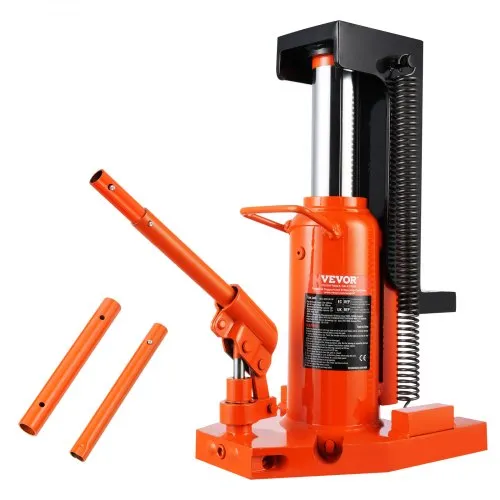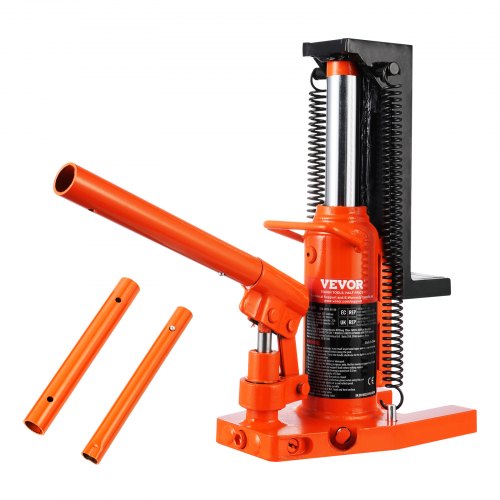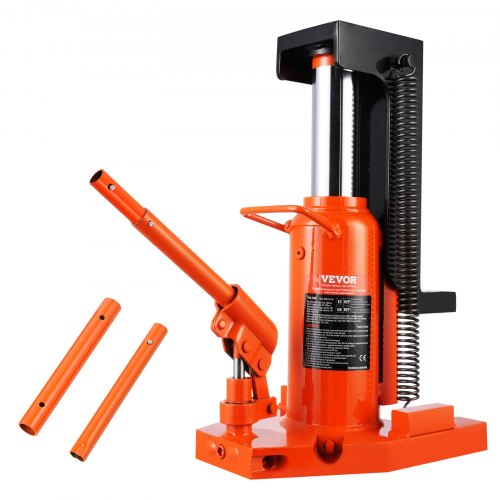

VEVOR offers a range of hydraulic toe jacks for professionals and industrial users who need to lift loads precisely in tight spaces. Our range includes 5-ton, 10-ton, and 20-ton capacities, allowing you to lift light machinery and assist with repairs on heavy equipment. In all kinds of workplaces, from factories and auto shops to building sites, VEVOR hydraulic toe jacks deliver the power and dependability you need for safe, effective lifting.
Are you looking for reliable lifting gear that can get into tight areas under heavy machinery and tools? Hydraulic lift toe jacks are very useful for repair workers, riggers, and factory workers who need to lift heavy items in tight spaces where standard jacks cannot reach. With a low-profile toe that slides under equipment, these special lifting tools are essential for moving machinery, leveling equipment, and performing repairs in factories, warehouses, and other industrial facilities.
Before you can choose the right hydraulic toe jack, you need to know how much weight you need to lift and how much clearance you have.
The maximum weight a hydraulic toe jack can safely support is determined by its rated lifting capacity. A 5 ton hydraulic toe jack is great for workbenches, lighter machinery, and small pieces of equipment weighing up to 10,000 pounds. These units work great for small repair shops and places that need to lift things occasionally. The 10 ton hydraulic toe jack is the best choice for most industrial applications because it can lift to 20,000 pounds, enough for most CNC machines, industrial presses, and medium-sized manufacturing equipment.
The 20 ton hydraulic toe jack is very powerful, capable of lifting up to 40,000 pounds, including large presses, heavy milling machines, and other large industrial equipment. To be safe, always choose a capacity number that is at least 20% higher than the heaviest load you expect to put on it. Think about how much your equipment, along with any attachments, tools, or other items on it, weighs.
The maximum lift height determines how far you can raise the load above the ground. Most standard hydraulic toe jacks can lift 8 inches, which is high enough for most maintenance and positioning jobs.
For shimming, making small changes, and just making room to put blocking or dollies in place, lower lift heights of about 4 to 5 inches work well. Medium lift heights of 5 to 6 inches are good for general machinery maintenance because they allow workers to get under equipment to check, fix, or clean it. Higher lift heights of 6 to 8 inches allow for more significant repositioning work, leveling equipment on uneven floors, and situations needing a lot of ground space.
Carefully think about the requirements for your unique application. Choose a hydraulic toe jack with a higher lift height if you need to stack blocking materials or make more room for working under equipment.
The toe profile is very important for getting into tight areas under heavy machinery. Most heavy duty hydraulic toe jacks have toe heights of about 1 to 2 inches when fully lowered. This makes it easy for them to fit under machines with little space between the machines and the floor. The toe length is usually between 4 and 6 inches, providing enough surface area to distribute lifting forces while maintaining a compact footprint.
The width is usually between 2.5 and 4 inches, which is the right size for support and for fitting into small spaces. Before you buy, make sure the jack's toe will fit by measuring the space under your equipment. Check for any mounting nuts, oil pans, or other structural parts that could get in the way of placing the jack. For safe, balanced lifting, the toe should be positioned so that its contact area is centered under the load’s center of gravity.
How quickly you can reach the lift height you want depends on the length of your stroke. Longer-stroke hydraulic toe jacks require fewer pumping cycles to reach their full height, making them more efficient when time is of the essence. A typical stroke might lift the load about 0.25 to 0.5 inches per pump, meaning it would take roughly 12 to 24 pump strokes to raise the load 6 inches.
Premium models feature better-tuned hydraulic systems, enabling them to move things faster with less physical effort. When evaluating stroke efficiency, consider how often you move things. If you have to lift and lower tools all day, you should buy hydraulic toe jacks with better pumping performance to keep your workers from getting tired and boost productivity.
Besides basic lifting capacity, features such as portability and safety ensure activities are safe and effective across a variety of work settings.
The versatility of your hydraulic toe jack setup depends largely on portability. Built-in carrying handles make it easy for one person to move from one work area to another, which is important for repair teams that need to cover a lot of ground inside a building. Because they are small and evenly distributed in weight, these jacks are easier to move around in tight production spaces or workshops. Some heavy duty hydraulic toe jack models come with wheel kits or transport carts, making them easy to move around large facilities.
Depending on the size, they usually weigh between 30 and 150 pounds. Lighter 5-ton models are easier to move around, while heavier 20-ton models offer better stability and power. Storage footprint is also important. To make the best use of shop floor space, look for designs that can stand straight or stack well when not in use.
Safety features keep loads from falling by mistake and protect the operator while they lift. Positive locking mechanisms hold the load firmly even if hydraulic pressure fails. They engage automatically at set lift intervals. These locks typically engage every half-inch of lift travel, giving you a number of safe places all along the lifting range. Release valves must allow controlled, slow lowering to prevent sudden drops that could injure workers or damage equipment.
Check out models with release buttons that are easy to reach while still being safe and out of the way of the load. Overload protection systems stop operation when the load exceeds the stated capacity. This helps prevent structural damage and serious accidents. Good hydraulic toe jacks have pressure-release valves that open automatically when the safety limit is exceeded. This keeps the tool and the people using it safe.
Professional-grade construction and low prices make VEVOR hydraulic toe jacks a great deal for industrial lifting tasks. With capacities ranging from 5 tons to 20 tons, we're sure you'll be able to find the right lifting option for any job. Strong hydraulic systems, reliable safety features, and long-lasting steel construction make each unit ready for tough work conditions. When you choose VEVOR, you benefit from reliable lifting performance and our commitment to quality and customer support.
The main difference is the weight they can lift: 10-ton models can handle up to 20,000 pounds, while 20-ton models can handle up to 40,000 pounds. Also, the 20-ton units are bigger, heavier, and built to last longer in commercial settings.
If the surface isn't perfectly flat, don't worry, hydraulic toe jacks can still work on it. Make sure the base stays in place, and the load stays balanced at all times. If the ground is soft or uneven, put steel plates under the jack to keep it stable.
Before each use, check your jack for damage or leaks. Lubricate moving parts once a month and change the hydraulic fluid once a year. Heavy-use areas may need repairs more frequently to ensure they function well and remain safe.
Do not go over the maximum capacity. Always use on stable surfaces, engage the safety locks before working under loads, lower loads slowly using the release valve, and never put body parts under loads that are not secured. Always wear the right safety gear.
No, hydraulic toe jacks are meant only for moving and lifting. When you lift something, you need to put blocks, stands, or other fixed supports under it right away, before you do any work or leave the area.