Boat Trailer Guide






Results for Boat Trailer Guide
VEVOR guides help you load your boat trailer without guessing, whether you are using a quiet ramp in the morning or a crosswind at night. Galvanized and powder-coated steel post-style guide-ons, height-adjustable poles that fit both deep-V hulls and shallow jon boats, and LED-lit types that double as running lights for wide loads are all available. Universal mounting pieces work with most standard trailer frames, and PVC sleeves protect your hull. VEVOR has trailers for all kinds of boats, from bass boats and pontoons to yachts and personal watercraft. The prices are low enough that you can launch your boat by yourself.
VEVOR Boat Trailer Guides for Straight Loading in Wind, Current, and Low Light
Ever spent twenty minutes at the ramp facing a crosswind while a line formed behind you? You can load your boat trailer by yourself without a spotter because the VEVOR boat trailer guides give you both a visual and a physical reference that centers your hull every time. Pick the height, mounting style, and lighting setup that works best for your boat and the ramp conditions where you live.
Choosing Boat Trailer Guides by Post Style and Adjustability
How much help you get at the ramp depends on the guide design and how well it fits your boat. Choose based on your boat's width, your trailer frame, and the water where you launch.
Why Post Style Guides Dominate the Ramp
Vertical posts remain the most popular for a reason. Post style boat trailer guides are tall enough to be seen above the water even when the trailer is underwater. This makes it easy to see where you are aiming as you back down the ramp. For small metal fishing boats, the standard post height is about 40 inches. For deep-V hulls and cuddy cabins, it is at least 60 inches. To make things easier, the post should sit above the waterline at your boat's widest point. This way, it will touch the side of the boat instead of sliding under it.
Compare this to bunk-style guides, which are flat and support the hull more than steer it. Although bunk-shaped boat load guides work well on calm inland lakes, they disappear underwater at a steep ramp and become invisible. Most fishermen and weekend boaters find that vertical posts are more useful. Boat trailer posts help with wind push, current drift, and the small alignment issues that happen every time you load without someone else on the dock.
Height Adjustment and Getting the Fit Right
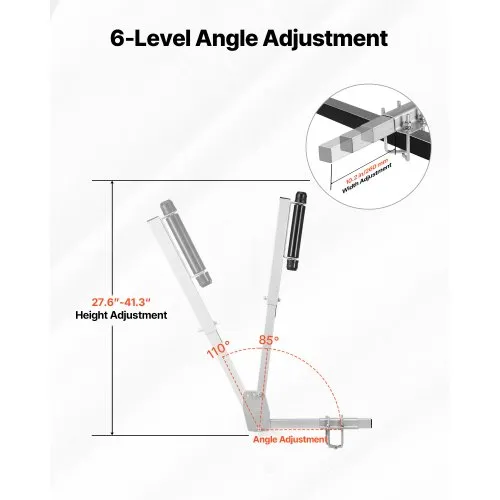
It is either a fixed-height post that fits your ship, or it doesn't. If you own more than one boat or plan to improve in a few seasons, height adjustable steel boat trailer guide poles are well worth the small extra cost. Most of the time, you adjust them by telescoping an inner tube held in place by a bolt or pin through pre-drilled holes. This tube usually has four to eight inches of vertical flight. If you set the post too low, the PVC sleeve will touch your hull between the chine and the rub rail. If you set it too high, it will catch the gunwale.
Width is just as important. You can set the distance between the adjustable trailer guide poles and crossbar brackets to fit your beam. Usually, you should leave two to four inches of space on each side. Most people get that clearance number wrong. If it's too tight, every load scrapes the gelcoat; if too wide, the guides won't touch when you need them to. Set the bolts before you go to the ramp, not in the parking lot. Measure your beam at its widest point and add the clearance.
Mounting, Fit, and Trailer Compatibility
The main factor determining compatibility is frame size. Most boat guides for trailer use have U-bolt mounting clamps that fit frames that are two to three inches wide. This size fits most single- and tandem-axle trailers on the road. Before you order, check your frame's cross-section. Different frame types, like square tube, C-channel, and I-beam, need slightly different bracket shapes. Also, a clamp that does not sit flat will come loose after a season of vibration.
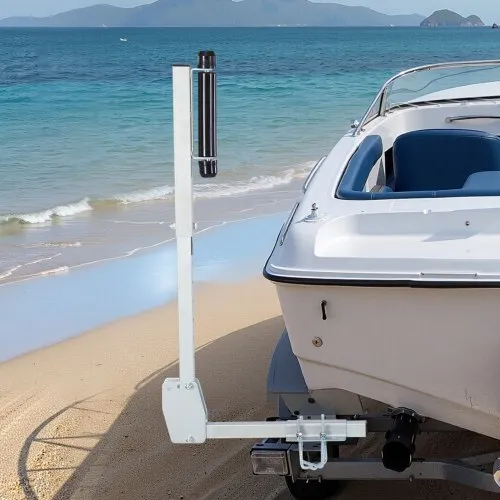
Position matters as much as the mounting location. Connect the boat guide to the back of the trailer so that it is about level with the transom when the boat is fully seated. This gives the boat the longest row of guides it can get as it comes on board. Make sure all the bolts are tight, and check again after the first few trips. Galvanized hardware takes time to settle, and a loose U-bolt is the most common reason boat trailer guides break. Vibration over hundreds of highway miles slowly loosens threads. A steel lock washer or thread-locking compound prevents this.
Real Ramp Scenarios Where Guides Earn Their Keep
Usually, wind is to blame. Most people can not turn a pontoon or high-freeboard hull around quickly enough with a fifteen-knot crosswind. Posts give the boat something to slide against, so it doesn't move past the bunks. Flow works the same way on rivers and tidal ramps. During the last few feet of approach, when accuracy matters most, the stern moves downstream with the moving water.
When loading at night or in low light, boat trailer guide poles really make a difference. When it is dark out, the posts are often the only thing you can use to find your way when you are at the helm. Launching by yourself is the biggest advantage. With properly set guides, you can drive on, walk forward, hook the winch strap, and pull out. You do not need a spotter, make multiple tries, or hold up the line on a busy Saturday morning.
Materials and LED Features in VEVOR Boat Trailer Guides
How many seasons you get depends on the materials used to build them. Guides spend half their lives underwater, often in salty water. Lighting determines whether you can see them when it counts.
Steel Construction and Corrosion Protection
There is a reason why galvanized steel is still the standard. Hot-dip galvanizing attaches a zinc layer to the base metal. This protection keeps steel trailer guide-ons from rusting for much longer than painting. Powder-coated steel looks better and works well in fresh water, but any cracks in the coating turn into rust spots. In coastal areas, galvanizing is the better option.
Look for tube ends that are sealed and have drain holes. As water builds up inside a hollow post, it rusts from the inside out. That is why truly rustproof boat trailer guides cover both the inside and the outside. The PVC cover does two things: it protects your hull from metal, and it protects the post from wear. If the sleeves crack, replace them, because a split sleeve can expose bare steel and scratch the gelcoat. The cheapest maintenance you will ever do is to rinse your gear with fresh water after a saltwater trip.
LED Lighting for Night and Low-Visibility Loading
Guide posts with built-in lights become visible markers. Connecting guide poles with LED lights to your trailer's existing wiring harness uses very little power while showing you where the edges of your load are. The legal benefit comes with the practical one. Many places require extra side markers for loads that are wider than the trailer's lights. Lit posts meet that need and also help with loading.
Before you buy, make sure it is waterproof. For parts that go fully underwater every time they are launched, aim for at least an IP67 rating. Sealed wiring connections are just as important as the light housing itself. The standard setup has amber facing forward and red facing backward. When you load your boat, well-designed boat guide posts for trailers keep the wires inside the post, out of the water, and out of harm's way.
Why Choose VEVOR Boat Trailer Guides?
You can find all of VEVOR's post heights and finishes, from 40 to 60 inches, galvanized and powder-coated, height- and width-adjustable, and with LED lights, so you can find the right one for your hull and ramp without spending too much. Low prices, marine-grade corrosion protection, and easy mounting with U-bolts mean most trailers don't need any changes. Every purchase includes clear warranty terms and quick after-sale customer support. Check out the full collection of boat trailer guides right now to make your next launch a one-time job.
FAQs
Do these fit my trailer frame?
They work with frames that are two to three inches wide, which means most single-axle and tandem-axle trucks can use them. Before you buy, measure your frame width and cross-section to make sure the bracket will fit.
How high should my posts be?
At their largest point, the posts should stick out above the waterline of your hull. For solid contact, small aluminum boats need about 40 inches, while deep-V hulls and cabin boats need about 50 to 60 inches.
Can I put them in myself?
Yes. It takes about 30 minutes per side and requires only simple hand tools. After your first few trips, check the torque on all of the U-bolts again because galvanized hardware settles after installation.
Are they safe to use in salt water?
For frequent saltwater immersion, hot-dip galvanized models work well. Rinse with clean water after every trip, and check the PVC sleeves every so often and replace any that crack and let the metal below show.
Do the LED ones need different wiring?
No, LED models use standard connectors to connect to your trailer's light harness. Pick units with an IP rating of 67 or higher, since these parts are fully submerged every time they are launched or retrieved.