Deals
Deals by Categories




More Ways to Save

Best Sellers
Best Sellers by Categories
New
New by Categories
Download VEVOR App 

Get 5,00€ Off 99,00€+ Orders on Your First 3 App Orders
Scan the QR code to download
SKU: SCJGSZKJ180M5QBRCV2
Copy


+12
More


VEVOR Core Drill Machine 2.03-18 cm Dia 2600W Handheld Core Drill Rig for Mixing
4.6 792 Reviews
108 90 €
Earn at least 2% points on purchases or save up to 15%.
Each when you buy 0+.
Shop
Get -% off for new user
Get 5,00€ Off 99,00€+ Orders on Your First 3 App Orders.
Download Now


Features & Details
- Versatile Multi-Function Use: Whether you need precise drilling or mixing cement, paint, or glue, this core drill machine handles it all with ease. The symmetrical auxiliary handle ensures comfort and stability, even during extended use. Quickly switch between different modes to meet a variety of construction needs.
- Powerful Core Drilling Efficiency: Equipped with a 2600W motor and adjustable speed, this core drill rig can handle hole sizes ranging from Φ0.8-7.1 in / Φ20-180 mm effortlessly. Whether drilling large or small holes, this tool ensures every task is efficient and precise.
- Handheld Design for Maximum Control: The core drilling machine features optimized weight distribution and structural design, allowing easy handling in various construction environments. Whether working in tight spaces or at elevated heights, you can easily adjust the drilling angle and depth for perfect results every time.
- Wet & Dry Cutting Capabilities: Our concrete core drill supports both dry and wet cutting modes. Dry cutting is ideal for fast drilling in dry environments or high-efficiency scenarios, while wet cutting reduces dust and heat, providing enhanced safety and comfort during operation.
- Engineered for Precision Drilling: The coring drill is designed for easy operation when drilling through reinforced concrete, red brick, marble, and more. It meets professional standards and is versatile enough for various tasks like installing air conditioners, kitchen pipes, stair railings, and even highway maintenance.
Product specification
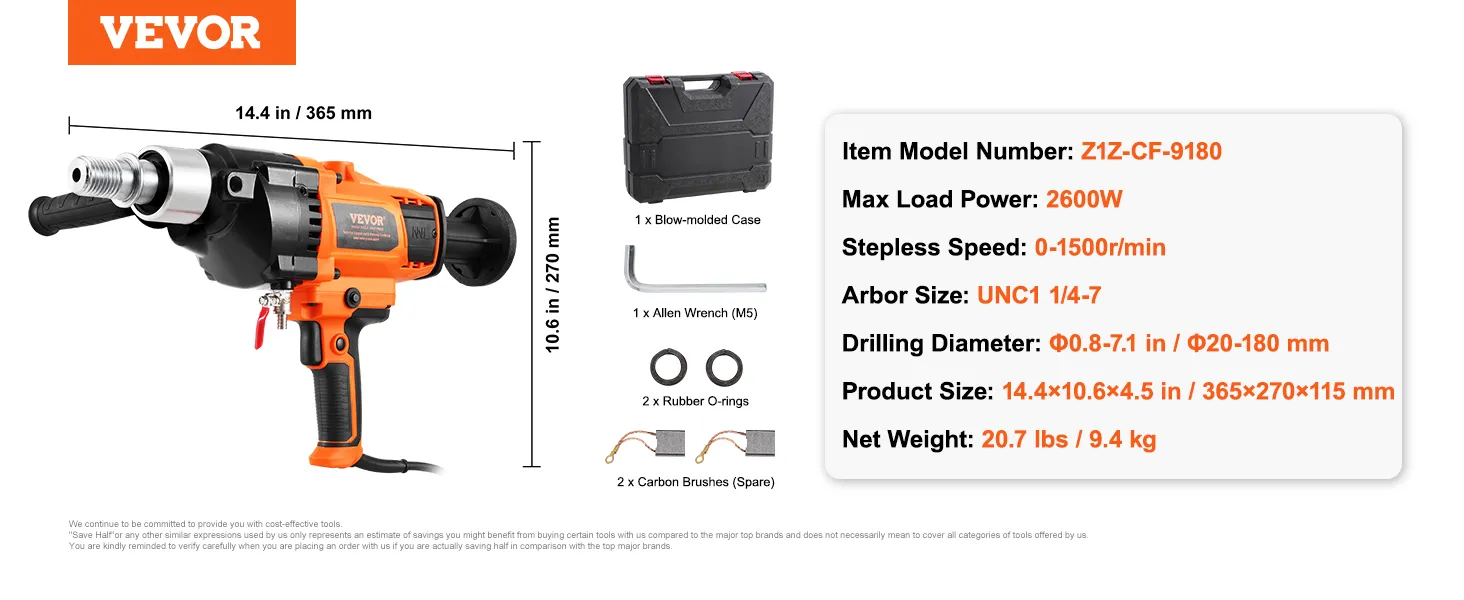
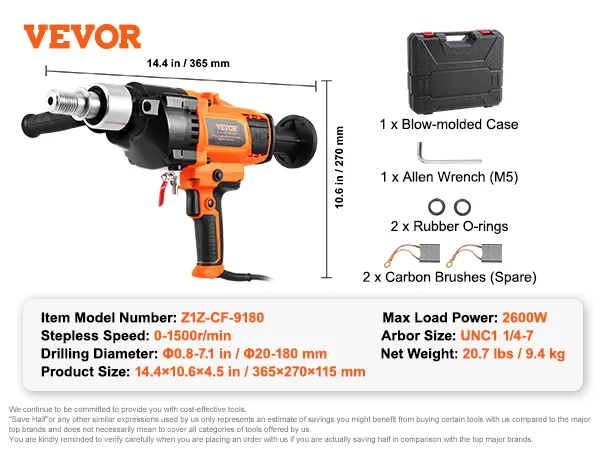
- Item Model Number Z1Z-CF-9180/CF-DCD07
- Max Load Power 2600W
- Drilling Diameter Φ0.8-7.1 in / Φ20-180 mm
- Arbor Size UNC1 1/4-7
- Net Weight 20.7 lbs / 9.4 kg
Frequently Bought Together
Reviews
About this item
Questions and Answers
Explore
Reviews 4.6
All reviews are from verified purchases
Average rating based on 792 reviews
Reviews 4.6
All reviews are from verified purchases
See all 792 reviews
About this item
Product specification
- Item Model Number
- Z1Z-CF-9180/CF-DCD07
- Max Load Power
- 2600W
- Drilling Diameter
- Φ0.8-7.1 in / Φ20-180 mm
- Arbor Size
- UNC1 1/4-7
- Net Weight
- 20.7 lbs / 9.4 kg
Description


Effortless Drilling Every Time!
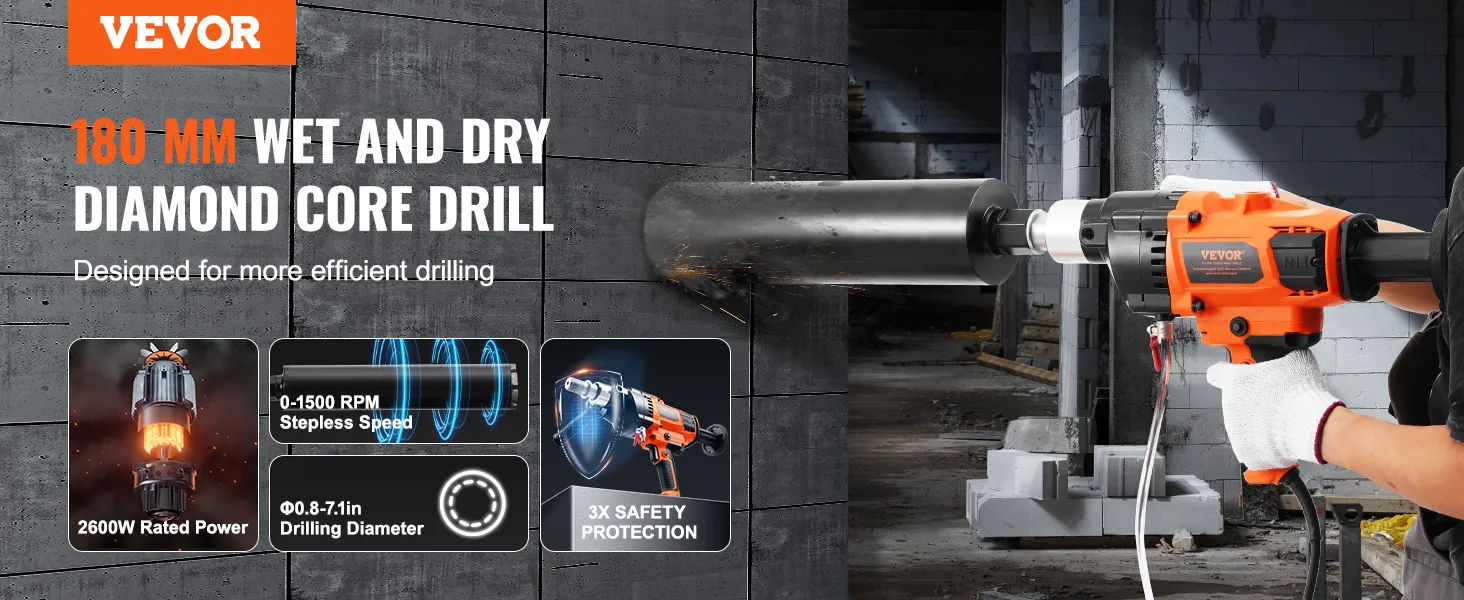
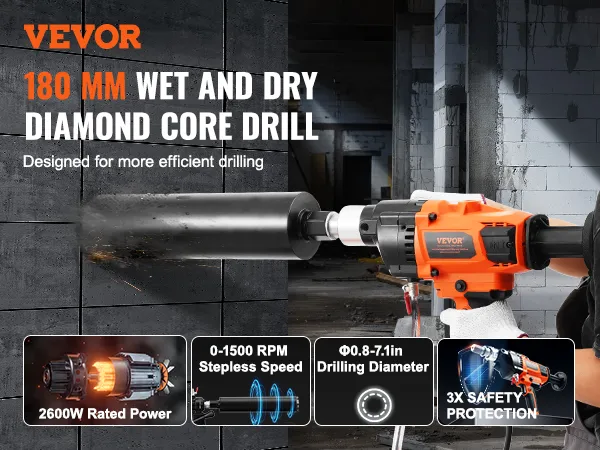
The core drill machine's 2600W motor provides ample power for tackling tough materials, making the drilling process faster and more stable. The adjustable speed allows you to fine-tune the speed based on different materials and project requirements, ensuring precise control.
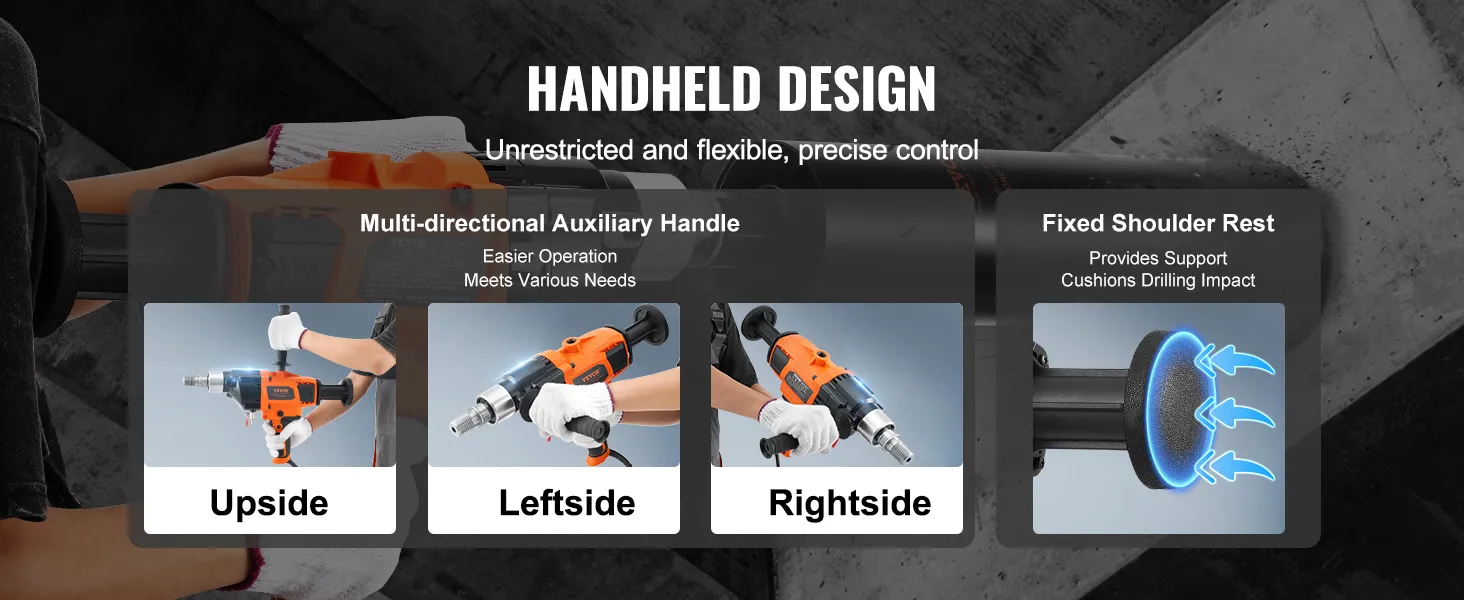
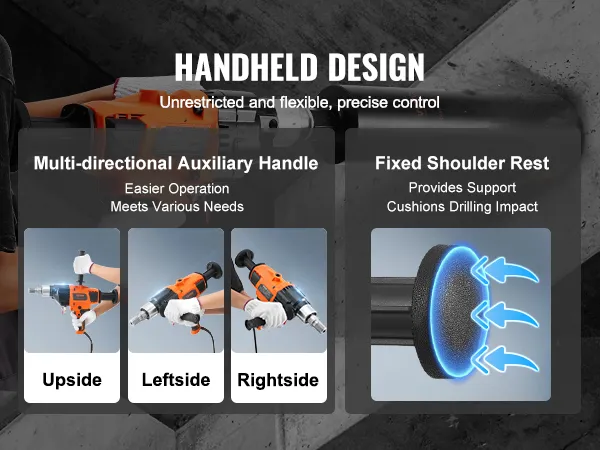
The lightweight handheld design makes the core drill rig easy and comfortable to use, perfect for precision drilling tasks. It allows you to operate in tight or irregular areas. Whether adjusting the drilling angle or working in confined positions, it meets your needs, increasing efficiency.
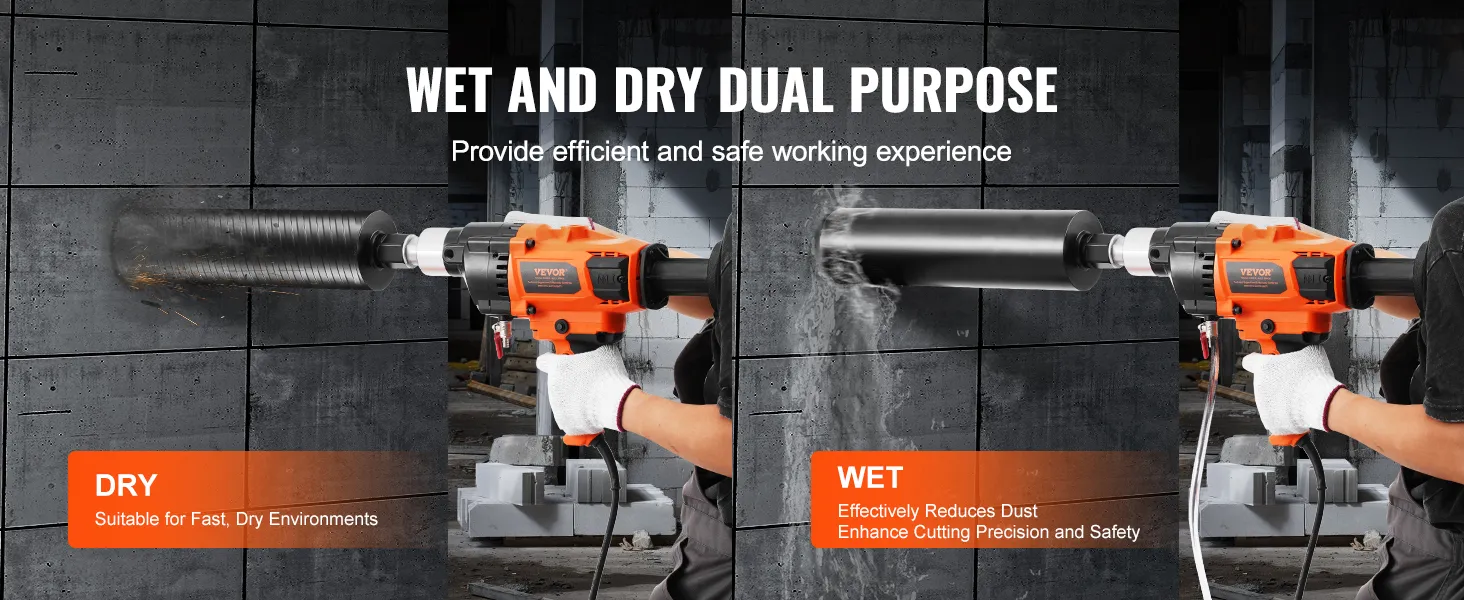
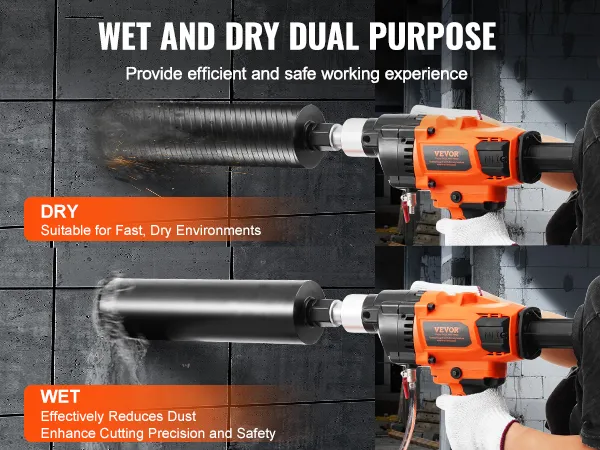
Experience superior cutting and debris removal speed with the dry cutting mode. The wet cutting mode reduces dust and overheating during operation, improving safety and comfort in the work environment. It also helps reduce tool wear, extending the core drilling machine's lifespan.
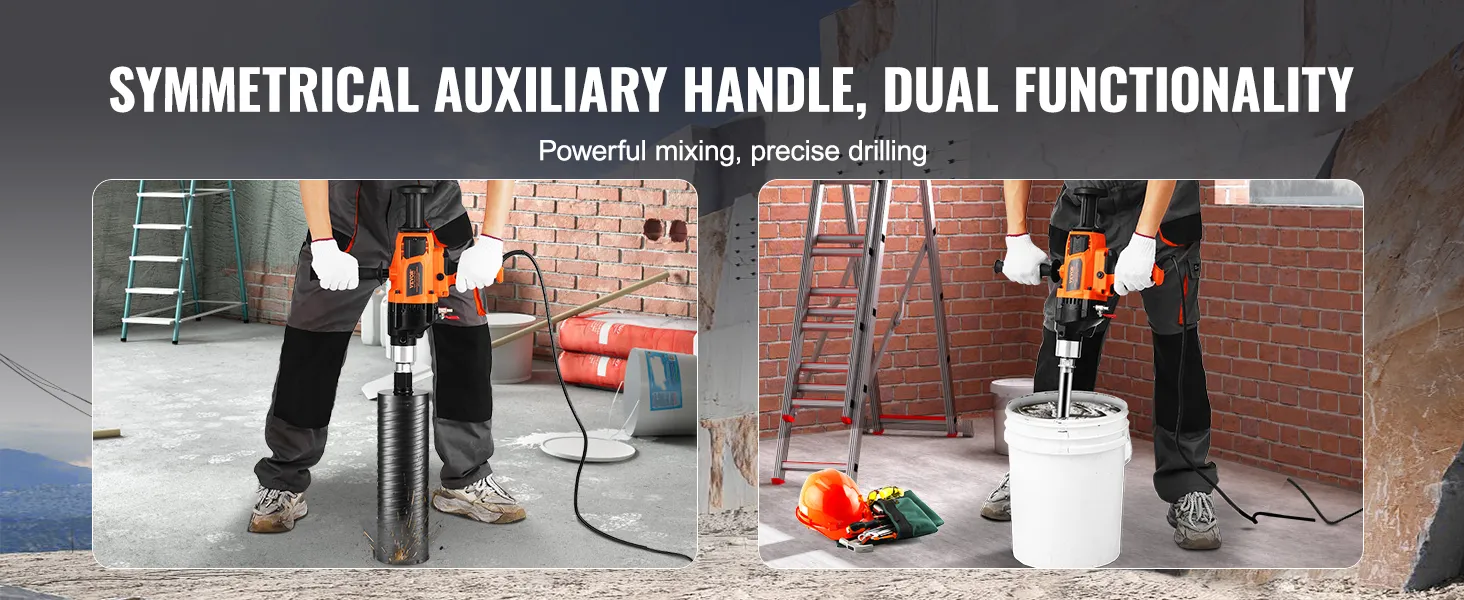
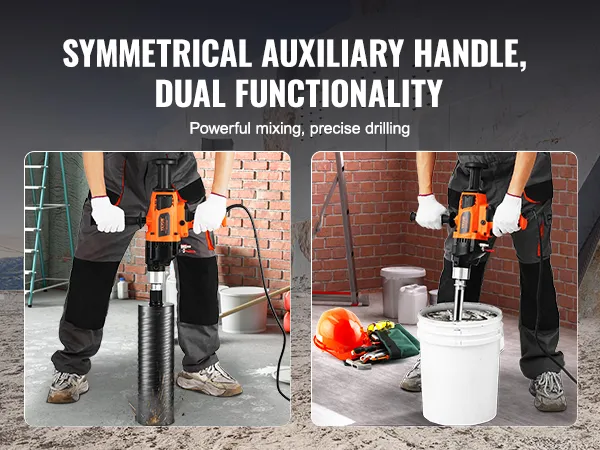
This handheld concrete core drill not only excels at efficient drilling but also features a powerful mixing function. It’s ideal for mixing various construction materials like cement, paint, and glue, providing you with a convenient and efficient solution for your project needs.
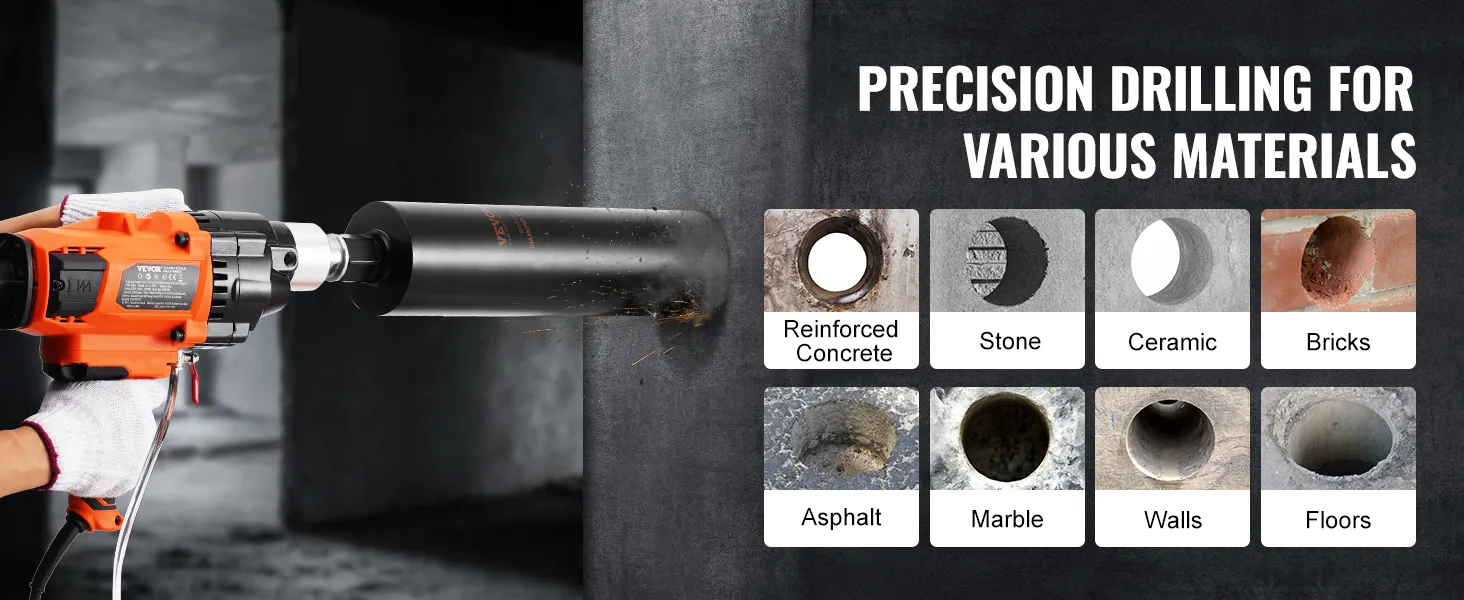
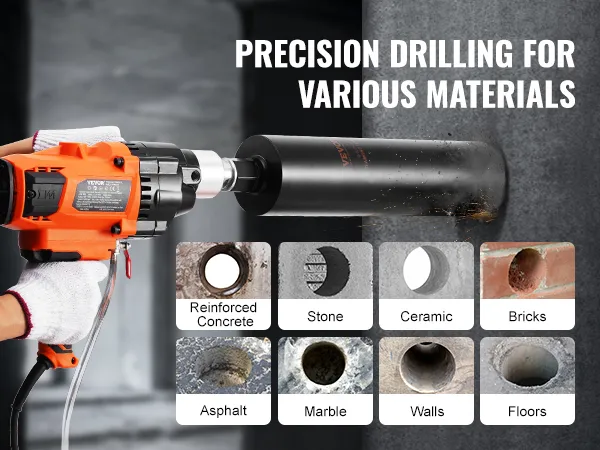
Our coring drill can efficiently cut through a variety of materials such as reinforced concrete, stone, asphalt, marble, ceramic, walls, floors, and bricks, meeting the needs of various construction projects.
Handheld Core Drill Machine with 2600W Motor and Adjustable Speed for Drilling and Mixing
The handheld core drill machine features a 2600W max-load motor and adjustable speed, with hole sizes ranging from 0.8 to 7.1 inches (Φ20–180 mm) to suit different materials and project sizes. When the bit strikes dense reinforced concrete or tough aggregate in the middle of a hole, the motor maintains constant torque, with no loss of output. The machine doesn’t just do core drilling; it also handles mixing cement, paint, and glue, so it’s a true dual-function tool for construction and renovation work where both functions are on the same job.
You can switch between drilling and mixing modes quickly, so you don’t have to lug a separate mixing tool to sites where you also need to drill. 2600W motor, so it can do both jobs at the professional work level required, without the performance gap that lower-wattage multi-function alternatives have, where one task is compromised to accommodate the other.
Optimized Weight Distribution for Control in Tight Spaces and Elevated Positions
The machine is structurally engineered to balance the 20.7 lb frame and distribute weight during use so that the operator, not the tool's center of gravity, controls the angle and pressure of the drill. Unbalanced machines at height or in tight wall cavities can accelerate arm fatigue and reduce bore accuracy over a long session. The hand held format allows direct positional control for angled penetrations, limited access spaces, and elevated bores where stand mounted setups are not practical.
Only handheld operation is practical for site conditions such as air-conditioning sleeve penetrations through exterior walls, kitchen piping routing in finished interiors, and stair-railing anchor bores. Optimized weight distribution means the operator can position the drill at various points and accurately adjust the drilling angle and depth without fatigue building to the point of affecting hole quality or requiring a mid-stroke stop to recover grip strength.
Wet and Dry Cutting Modes for Dust-Reduced, Precise Operation on Any Surface
Water is supplied to the bore during operation on wet-cutting operations, continuously washing out debris and cooling the bit's face during the stroke. Heat buildup at the bit erodes the bonding between the diamond segment and the bit, reducing cutting efficiency and narrowing the effective bore diameter over repeated use. Wet mode is intended for indoor renovation applications, such as pipe penetrations through finished walls and conduit runs in occupied spaces, and it keeps airborne dust levels low to protect operator health and the cleanliness of finished surfaces.
Dry cutting includes outdoor work and site conditions where access to a water supply is limited or where runoff of water near adjacent finished surfaces presents a management problem. Switching between modes does not require internal reconfiguration, but only a connection/disconnection of the water line. Both modes are at the full 2600W motor output, so the speed and torque of the drilling are the same between the settings - the choice is purely a function of site conditions and material requirements, not a performance trade-off between wet and dry operation.
Handheld Core Drill Machine with Φ20–180 mm Range and UNC1 1/4-7 Arbor
The drilling diameter range of Φ20–180 mm covers small conduit penetrations at the low end and large pipe sleeves or ventilation duct openings at the high end, all with this single handheld core drill machine, without switching tools or reconfiguring the machine. That range encompasses the entire spectrum of penetration diameters encountered in residential and light commercial construction without the need for a second machine for bigger bores.
The UNC1 1/4-7 arbor is a standard professional thread spec that accepts a wide range of third-party core bits beyond those that come in the factory box. Where the job requires a diameter outside the normal range, compatible bits are readily available, and no thread adapters or reducers are necessary. The machine weighs 20.7 lbs. and is light enough to carry and operate alone for a full day of varied drilling and mixing tasks at multiple locations, without a second operator for repositioning/support.
Symmetrical Auxiliary Handle for Stability and Comfort During Extended Use
The symmetrical auxiliary handle provides you with a balanced two-handed grip that equally distributes the reaction torque of the motor across both arms as you drill. This 2600W machine includes a secondary handle, resulting in an uneven distribution of rotational resistance when used without it. It leads to quicker fatigue in the primary grip hand and reduces precise control during prolonged use or when drilling multiple holes.
The symmetrical design is suitable for both right- and left-handed operators, with no changes to the device needed between operators. If you’re mixing continuously, say, moving the attachment through cement, paint, or glue, the auxiliary handle gives you the staying power to maintain consistent mixing depth and coverage throughout the entire batch. The handle design directly correlates with the time the operator can maintain accurate control before fatigue necessitates a stop, extending that window on both drilling and mixing tasks through extended-use comfort.
Precision Performance on Reinforced Concrete, Red Brick, and Marble
The handheld core drill machine is designed for the material resistance levels that most quickly expose the weaknesses of underpowered drill rigs. Reinforced concrete is dense aggregate with embedded steel rebar to catch bit segments when torque is insufficient. A 2600W motor can handle both materials effectively, without the stalling that indicates a motor is being pushed beyond its practical capacity at these diameters. Adjustable speed accounts for the different resistance characteristics of red brick and marble.
Brick is uniformly abrasive across the bore face. Marble is dense and brittle at the edge of the hole, where excessive speed can cause chipping and uneven walls. Marble may be drilled slowly to achieve a cleaner bore edge. Brick may be drilled at higher speeds without overloading the bit. Professional applications include air conditioner installations, kitchen plumbing penetrations, stair railing anchor bores, highway maintenance work, and the full range of trade and contractor work requiring sustained motor output and diameter flexibility over a full working day.
Product guides and documents
User manual-en (PDF) Review
Questions and Answers (4)
Com qual tensao esta máquina trabalha?
Pode ser utilizado com tensões que variam de 220 a 230 V.
By vevor
Helpful
(
0
)
Bună ziua, la aparatul asta mi ați trimis un filmulețu în care trebuie sa stâng roata dintata de la ambreiaj, piesa aia am tot strâns, aparatul acuma ii foarte sensibil și întra foarte repede ambreiajul, pot primi sau sa cumpăr roata aia dintata?
Ne cerem scuze că accesoriile nu se vând separat. Dacă aveți nevoie să înlocuiți accesoriile după achiziționarea produsului nostru, vă rugăm să contactați echipa de servicii post-vânzare pentru a vedea dacă vă pot trimite accesoriile.
By vevor
Helpful
(
0
)
Is there safty if drill get stock in wall, so the wont throw you down the ladder?
This product has a clutch, and the clutch can only work when the load power reaches about 4000W. Using this product requires high professionalism. If you are not a professional user, it is recommended to use it with a bracket.
By vevor
Helpful
(
0
)
Hi!! I suppose this machine is for 230V ?
Yes, it will work on 230v.
By vevor
Helpful
(
0
)
In Stock
Security & Privacy
FREE Returns
Professional Service
Compare with similar items
Similar Items You Might Like
People Who Bought This Item Also Bought
Best sellers in this category
People Who Viewed This Item Also Viewed
Your Browsing History