Jag använder den till att öppna/stänga porten till båthuset. Fungerar jättebra med fjärrkontrollen när jag ska köra in båten och parkera.
Bra pris och snabb leverans.
Helt nöjd.
SKU: DDGSSHLYXWXS5L5MUV2


Top highlights
- 1320 lbs load capacity with single or double cable options for versatile lifting needs.
- Powerful motor with large cooling fan ensures efficient operation and prevents overheating.
- Dual control options with wired and wireless remotes for flexible and safe operation.
AI Summarized from product information
Specifications
- Item Model Number PA600
- Single Cable Lifting Height 40 ft/12 m
- Double Cable Lifting Height 20 ft/6 m
- Single Cable Lifting Load Capacity 660 lbs/300 kg
- Double Cable Lifting Load Capacity 1320 lbs/600 kg
- Single Cable Lifting Speed 27.6 ft/min (8.4 m/min)
Reviews · 4.6
Reviews · 4.6
 stefan
in
 on Oct 14,2026
on Oct 14,2026
598.8 kg Wired/Wireless 1.60 m
buchauer.woit
in
 on Oct 13,2026
on Oct 13,2026
598.8 kg Wired/Wireless 1.60 m
Unschlagbares Preis-Leistungsverhältnis!!
Funktioniert wie versprochen inkl. Fernbedienung.
About this item
Description


VEVOR Electric Hoist – Lift Your Cargo with No Effort
Equipped with a reliable air-cooled motor, this electric hoist makes lifting easy and consistent. Its cooling system and fan help prevent overheating, so you can keep working longer without a hitch.
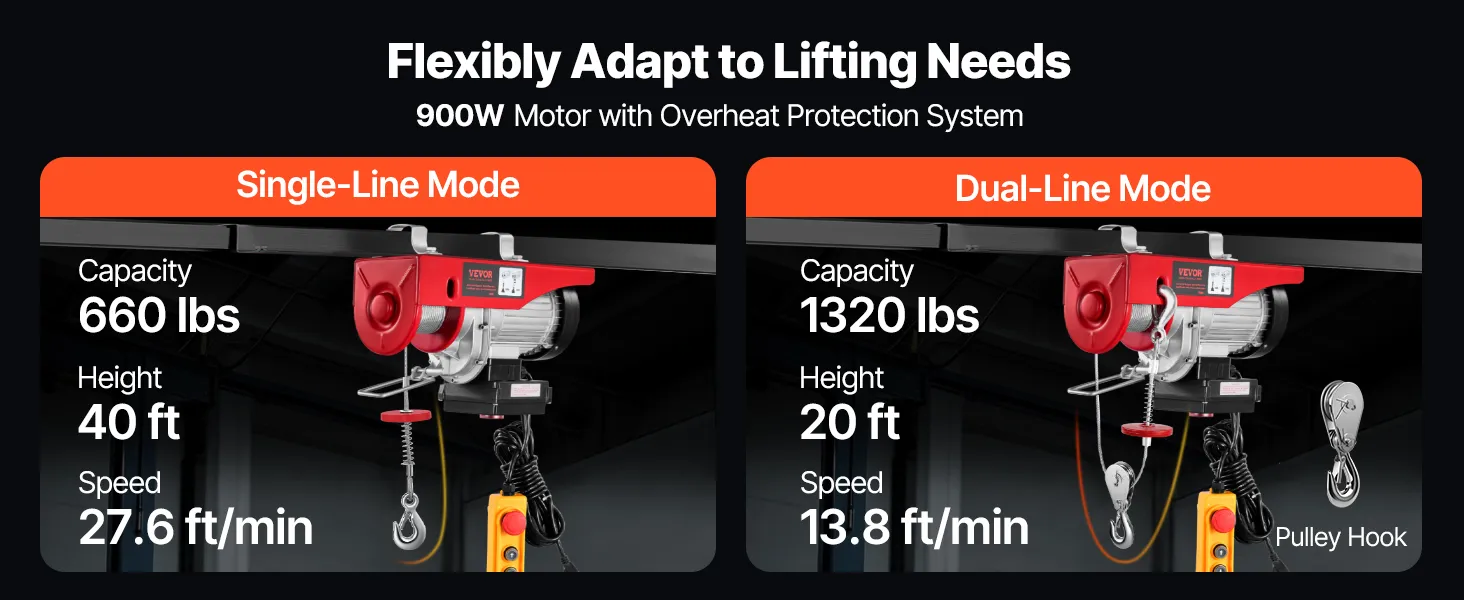
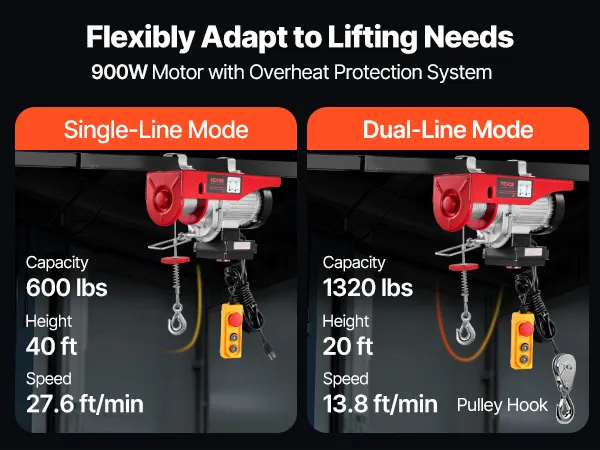
Need speed or strength? Switch between single-cable mode for faster lifts with lighter loads or double-cable mode for heavier jobs. Our electric winch is built to handle whatever you throw at it.
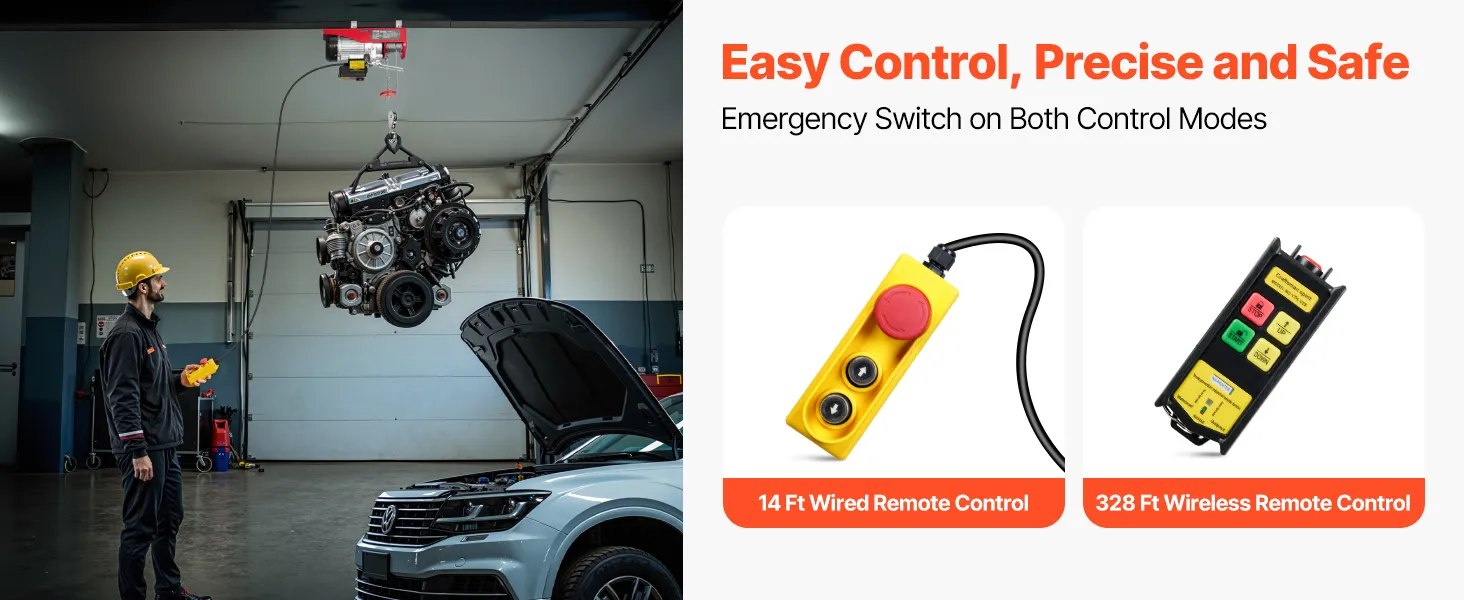
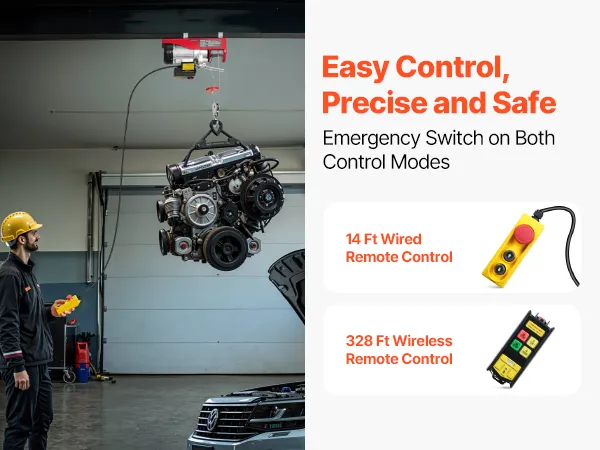
Whether you're up close or far away, this ceiling lift has you covered with both wired and wireless controls. With a wireless range of up to 328 ft (100 m) and an emergency stop switch, you've got peace of mind and flexibility to get the job done right.
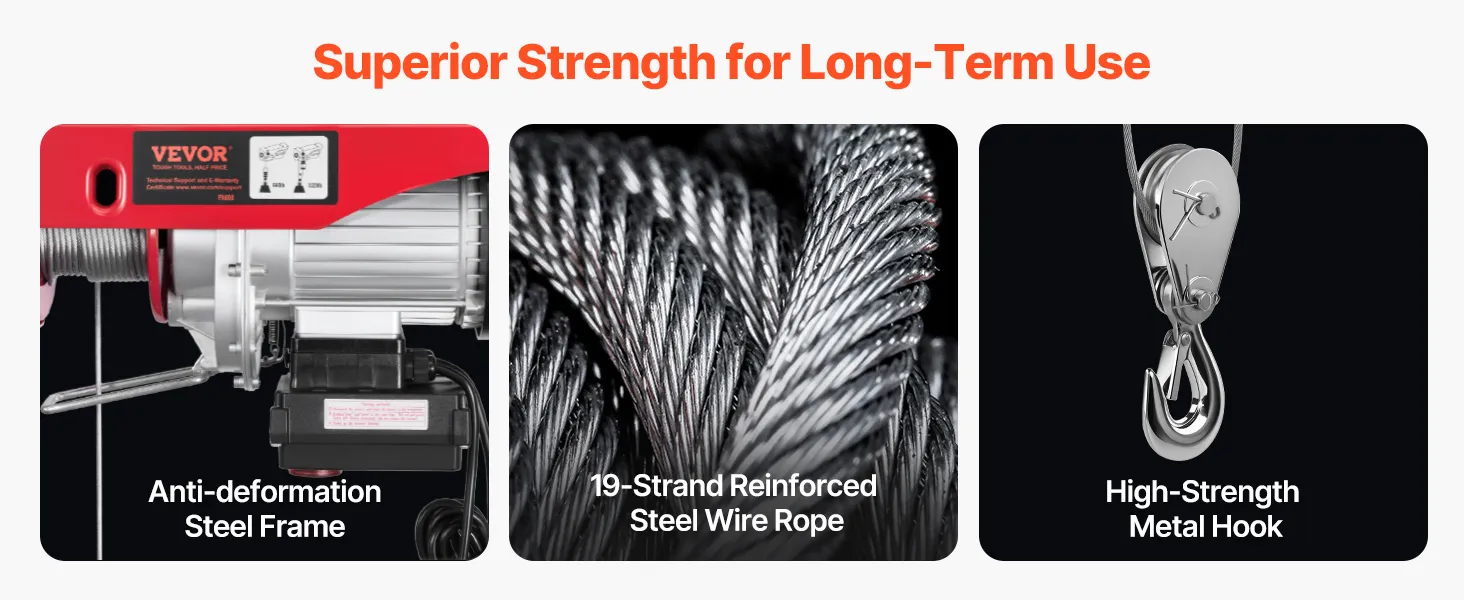
Crafted from durable alloy steel and a coated steel cable, our garage hoist is all about stability. The thick cable and anti-tipping design mean it can handle heavy loads safely while overheating protection keeps everything running smoothly.
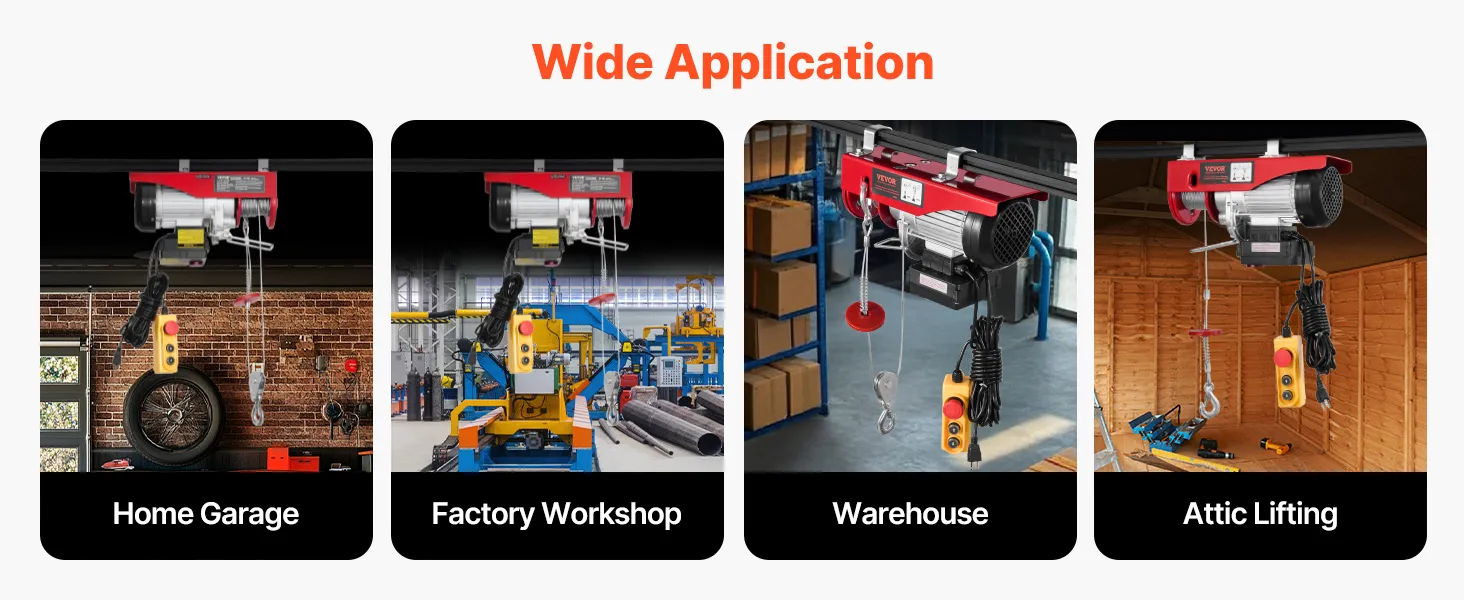
Whether you're working in your garage, warehouse, or workshop, this electric cable hoist adapts to a variety of tasks, making it an ideal tool for any project.
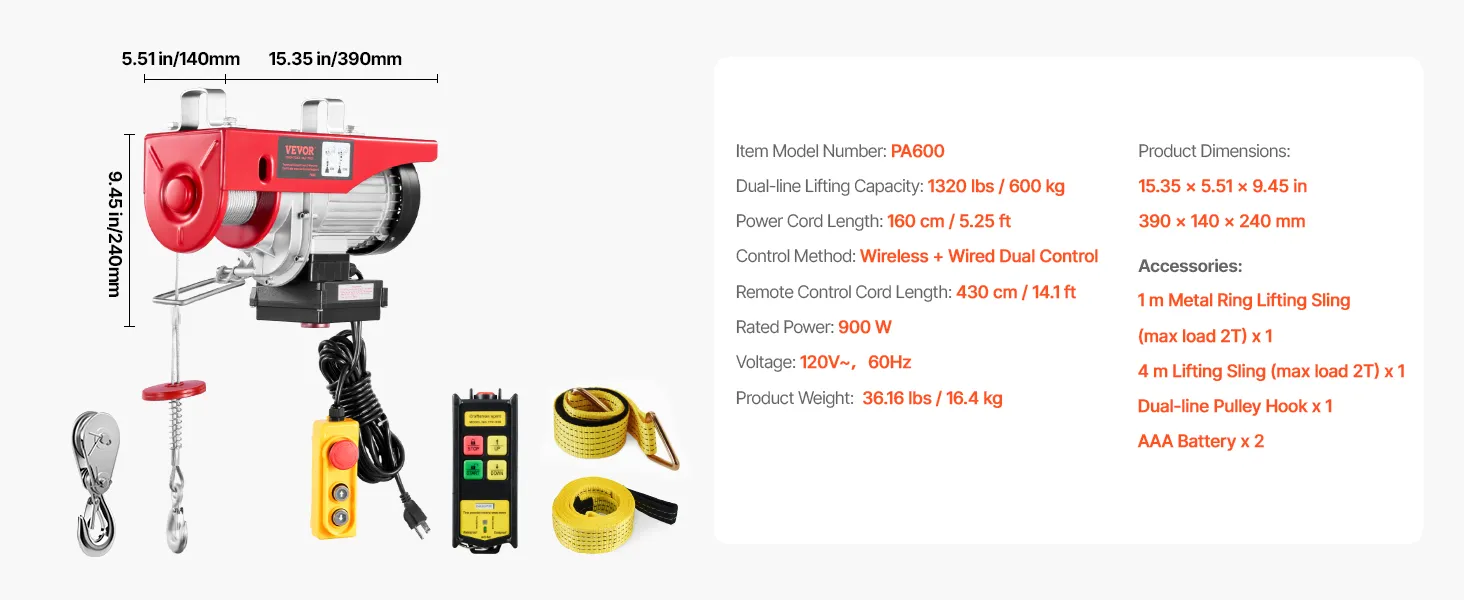
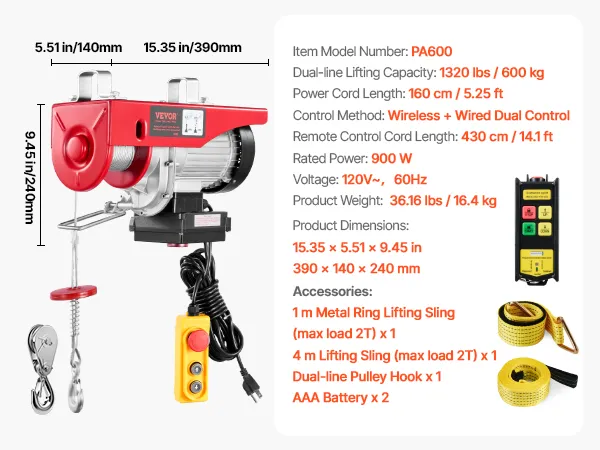
Engine Hoist Crane with 1320 lbs Dual-Cable Capacity for Heavy Workshop Loads
When set to single-cable mode, this VEVOR engine hoist crane can lift up to 660 pounds (300 kg), and in double-cable mode, up to 1320 pounds (600 kg). It can lift heavy loads in professional garages, workshops, and warehouses. The 40 ft (12 m) single-line lifting height provides sufficient reach for most garages, workshops, and warehouse spaces.
You can use this range of capacities to lift a small engine, change a transmission, move big workshop equipment, or move construction supplies without pushing the machine too far. Operating below the maximum rated capacity can support smoother lifting performance during routine tasks. This directly affects the machine’s reliability and longevity.
Dual Wireless and Wired Remote Control for Maximum Operational Flexibility
Most hoists only have one way to control them. You get two from this one. You can use the wireless remote from up to 328 feet (100 m) away, keeping you out of the way of the loads during lifts and letting you move around the work area as needed. The 14-foot (4.2-meter) wired remote gives you close-range precision for work that needs physical control but does not require a radio signal.
It is easy to switch between the two. Use wireless for large moves and long-distance control, and wired for positioning down to the millimeter. Both control options provide convenient operation during lifting tasks. This dual-control setup eliminates the problems associated with single-mode systems in business settings where conditions change throughout the workday.
Air-Cooled Motor with Overheating Protection for Consistent Long-Run Performance
During operation, the built-in cooling fan actively pulls heat away from the motor case. This keeps the motor from overheating, which would otherwise cause it to shut down early or damage parts after extended use. Active cooling keeps the machine running at all times, so users who run multiple lift cycles in a row—common in busy garages and production settings—do not have to take breaks to cool down between cycles.
The motor is designed to maintain the same torque from the first shift lift to the last. The motor is built to handle repeated lifting cycles under rated operating conditions. Overheating protection adds an extra layer of safety by cutting power before thermal damage can occur if temperatures rise unexpectedly.
One Cable for Speed, Two Cables for the Heavy Stuff
In single-cable mode, the lift moves at 27.6 ft/min (8.4 m/min), which is fast enough to keep a busy process running without long waits between cycles. When the load is too much for a single cable to handle safely, switching to a double cable halves the speed to 13.8 ft/min (4.2 m/min) while doubling the load capacity to 1320 lbs. The only thing that changes is how the rigging is set up around the hook block. Both modes use the same wire-and-drum system.
Because it has two modes, this design gives you more options for pulling jobs. With a single cable speed, lighter pulls can go faster. The double-cable mode can hold heavier loads, making it easier to lift and more stable. This versatility is very useful for workshops that handle a variety of load weights throughout the day and saves them a lot of money.
Electromagnetic Brake and Emergency Stop for Reliable Load Security
When the motor stops, the electromagnetic brake immediately brings the load to a stop in the air. It keeps the load in place without letting it drift or fall over time, and it does not require steady power to hold it. When you use accurate placement or short suspension, loads stay where you leave them between moves. When the motor starts up again, the brake releases smoothly. There is no jerk or lag at the beginning of each movement.
The emergency stop button instantly stops the load without a remote. If an unexpected load change occurs, an obstacle appears, or someone walks into the danger zone under a suspended load, it all stops with one press. The electromagnetic brake and the emergency stop operate independently.
Alloy Steel Construction and Anti-Tip Hook Design for Structural Safety
We chose alloy steel for the hoist body because it has high tensile strength and does not deform under long-term load. Lower-grade steel structures can bend or wear out over time at their working capacity, but alloy steel stays the same size through many heavy-duty rounds over the product's service life.
The hook assembly has an anti-tipping stop that keeps the load from riding off the hook while it moves. This is a way that normal open hooks can fail when the load is moving. The 2-channel mounting bracket system uses metal or solid wooden strips to connect directly to ceiling crossbeams. The included mounting brackets support installation on suitable overhead structures, in accordance with the product instructions.
Engine Hoist Crane Built for Garages, Warehouses, and Factory Environments
When used in a garage for engine pulls and transmission swaps, in stores for moving stock, and in factories for handling parts, this engine hoist crane can handle all kinds of professional lifting tasks without any changes. The 1320 lb lifting capacity is suitable for engines, transmissions, compressors, machinery components, workshop equipment, and construction materials.
This unit is as safe as it is powerful, thanks to its dual-remote system, electromagnetic brakes, and alloy-steel build. Ceiling-mounted placement keeps the floor clear, maximizing limited floor space where people need to work. This engine hoist crane combines dual remote-control options, multiple safety features, and high lifting capacity for a wide range of material-handling tasks. This VEVOR unit has the power, control, and dependability that heavy lifting work really needs, whether you are running a busy business workshop or working on difficult home projects.
Product guides and documents
Frequently Bought Together
VEVOR Electric Hoist Crane Winch 598.7 kg 9997.4 cm Wireless & 426.7 cm Wired Remote
4.6 222
113 90 €
Get -% off for new user
Each when you buy 0+.
Shop
5,00€ off 1st App Order 99,00€+


In Stock
Compare with similar items
Explore your interests
Recommended Searches
engine crane 2 ton used engines near me small engine turbo engine hoist crane engine hoists four cylinder engine engine driven welders 2.7 liter turbo engine xr6 turbo engine engine machine s and j engines engine cherry picker cherry picker engine hoist 6 cylinder engine 3 ton engine crane engine lift crane engine lifting crane scissor lift parts crane arcade game 2jz engine twin turbo