
Corner Braces




Results for Corner Braces
A corner brace is a metal reinforcing bracket that joins two pieces of material meeting at an angle and holds that joint rigid. Fixed with screws or bolts through pre-drilled holes, it spreads the stress of a connection across a wider area than the fasteners could alone, so the joint resists loosening, twisting, and pulling apart under load. By tying two adjacent members tightly together, it keeps a structure square, stops a frame from racking out of shape over time, and reinforces a weak or repaired joint so it can safely carry more weight than the bare connection would.
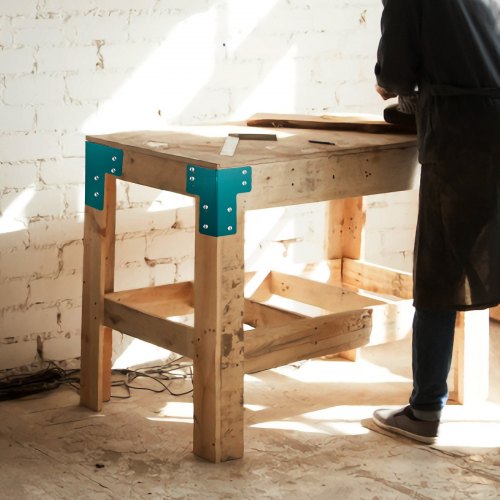
VEVOR corner braces come in several forms. Flat braces sit flush across a joint face to reinforce butt joints, while L-shaped braces wrap a 90-degree corner to lock right-angle frames. Heavy-duty gusseted angle brackets step up to structural loads, and stainless steel or aluminum versions trade some strength for rust resistance and light weight. Sizes run from roughly 1-inch arms for craft work to 5 inches and beyond for framing, and specialized structural pieces such as compound-angle platform brackets, hurricane ties, and face-mount joist hangers extend the range into decks, raised stands, and roof construction. Typical uses are reinforcing furniture and cabinet corners, squaring shelves and workbench frames, and tying structural timber joints together.
Five things decide what you need:
- Joint type: flat braces reinforce surfaces that meet in one plane, while L-shaped braces hold two pieces at a true 90 degrees.
- Load: light repairs need only a small brace, but shelving, workbenches, and structural joints call for thick, gusseted, heavy-duty stock.
- Size: match the arm length to the thickness of the thinnest piece you are joining, and go longer as the load climbs.
- Material: stainless steel and aluminum resist rust for outdoor, marine, or damp settings, while coated carbon steel suits dry indoor work.
- Fasteners: confirm the brace holes fit your screws, bolts, or lag screws, and use rated anchors when mounting into concrete or masonry.
Browse the full corner brace collection to match a brace to every joint, from light furniture repairs to heavy structural framing, and pair them with the right deck and post-base hardware for bigger builds.
Corner Brace Types at a Glance
The table below sums up the main corner brace sub-types and where each one earns its place.
| Type | Form / Profile | Typical Material | Load Suitability | Selection Note |
|---|---|---|---|---|
| Flat corner brace | Single flat plate across one joint face | Aluminum or stainless steel | Light to medium | Stays almost hidden, so good where a clean furniture surface matters |
| L-shaped corner brace | Two perpendicular arms at 90 degrees | Heavy-gauge or stainless steel | Medium to heavy | Default pick for squaring frames, shelves, and cabinet corners |
| Heavy-duty corner brace | Thick, gusseted angle bracket | Thick-gauge steel, powder-coated or galvanized | Heavy and structural | Choose when one joint must carry hundreds of pounds without flexing |
| Stainless steel corner brace | Flat or L profile | Stainless steel | Light to heavy by size | Worth it outdoors, near water, or in food preparation areas |
| Aluminum corner brace | Flat or L profile | Anodized aluminum | Light | Best where low weight matters more than maximum strength |
VEVOR Corner Braces for Secure Joints, Furniture Repairs, and Structural Reinforcement
Are you looking for the ideal brace to stabilize a structural corner, secure an unstable shelf, or reinforce a workbench frame? VEVOR corner braces are designed for heavy-load applications, outdoor structures, and indoor furnishings, as they are long-lasting and easy to install. With our extensive selection of brace types, sizes, and materials, you can find a suitable option for your project.
Corner Brace Types and Materials: Choosing What Works Best for Your Project
There are several types of corner braces. Whether you are creating furniture, fortifying a workbench, or installing outdoor brackets, the kind and material you select will have a direct impact on how well your structure holds up over time.
Flat Corner Braces for Surface-Level Reinforcement
Among the most useful fasteners for light structural repairs, furniture assembly, and woodworking are flat corner braces. These braces, which are designed to rest flush against two joined surfaces, distribute load over a large area, reducing joint tension and preventing warping or splitting over time. VEVOR flat corner braces are perfect for picture frames, table aprons, and cabinet backs, thanks to pre-drilled screw holes that make installation easy with regular wood screws or bolts.
VEVOR flat corner braces, which come in aluminum and stainless steel finishes, are resistant to rust and corrosion, prolonging their useful life in humid workshop settings. Because of their low profile, they are almost undetectable when installed, maintaining a tidy, polished appearance. Flat corner braces from VEVOR are a practical first option for DIY woodworkers and furniture makers looking for a dependable, reasonably priced strengthening solution. You have complete control over how much support you provide at any connection, thanks to their variety of sizes, which range from tiny 2-inch brackets for craft projects to larger 6-inch plates for heavier furniture applications.
L-Shaped Corner Braces for Right-Angle Joints
The traditional L-shaped corner brace design is designed to form and strengthen 90-degree joints in partition walls, workstation frames, shelf units, and door frames. The two-arm perpendicular arrangement can handle both compressive and tensile loads along the joint and keeps adjacent pieces securely aligned. Heavy-gauge steel and stainless steel are used to make VEVOR L-shaped corner braces, which provide a rigid connection that resists bending under normal loads.
When erecting workshop shelves, constructing storage racks, or attaching wall-mounted brackets, these braces excel at exact right-angle alignment. The L-shaped corner braces from VEVOR have countersunk holes for flush screw heads, smooth stamped edges, and a brushed or zinc-coated finish for corrosion resistance. The sizes range from huge 4-inch x 4-inch braces that can support structural joints in furniture frames and framing projects to small 1-inch x 1-inch pieces ideal for light-duty cabinet work. L-shaped corner braces consistently provide solid 90-degree stability, whether you are a professional carpenter installing custom cabinetry or a homeowner taking on weekend repairs.
Heavy Duty Corner Braces for Structural and Industrial Applications
Heavy-duty corner braces take over to meet the most demanding load-bearing requirements when conventional brackets are just insufficiently robust. These braces, which are larger and wider than typical hardware-store brackets, are used in industrial shelving, garage storage systems, workbench legs, and structural timber construction. They are designed to support much greater loads. The thick-gauge steel VEVOR heavy-duty corner braces feature strengthened gussets and large mounting holes to accommodate larger bolts and lag screws.
Contractors, woodworkers, and fabricators who need brackets to secure large shelving systems containing tools, equipment, or materials weighing hundreds of pounds or more are particularly fond of these braces. In wet basements, garages, and outdoor sheds, VEVOR's heavy-duty corner braces offer exceptional rust protection with either a black powder coat or a galvanized zinc finish. Because of their sturdy design, these corner braces won't twist, bend, or pull away from the wall under strain. Purchasing heavy-duty corner braces from VEVOR ensures your construction remains sturdy and secure for years of typical use when designing a workbench corner bracket system that must support heavy vises, grinders, and power tools without flexing.
Stainless Steel and Aluminum Corner Braces for Corrosion Resistance
One of the most crucial choices when choosing corner braces is the material, especially for outdoor, maritime, or high-humidity settings, where regular carbon steel can rust and deteriorate more quickly. When exposed to moisture, sea air, and cleaning agents, stainless steel corner braces exhibit remarkable corrosion resistance, retaining their strength and gloss. VEVOR stainless steel corner braces are perfect for outdoor pergolas, food preparation areas, and maritime woodworking projects, thanks to their smooth, stain-resistant finish.
Without significantly increasing the structure's weight, aluminum corner braces provide a lightweight substitute that yet offers remarkable resistance to oxidation and corrosion. They are especially helpful in applications like portable workbenches, lightweight furniture, and exhibition fixtures where weight is an issue. Anodizing VEVOR aluminum corner braces increases their longevity and surface hardness, reducing visible wear and scratches during installation and regular use. Both hobbyist builders and seasoned contractors can use VEVOR's stainless steel and aluminum corner braces, as they are fully compatible with standard bolts and don't require any special tools for installation.
Matching Corner Braces to Common Projects
Use this guide to line up a typical project with a brace form, an arm size, and the fastener that suits it.
| Project | Suggested Brace Form | Suggested Arm Size | Recommended Fastener | What to Watch For |
|---|---|---|---|---|
| Picture frames and craft joints | Flat brace | 1 to 2 in | Short wood screws | Keep screws clear of the edge so thin stock does not split |
| Cabinet and shelf corners | L-shaped brace | 2 to 3 in | Wood screws | Set braces where they stay hidden from normal sightlines |
| Workbench and table frames | Heavy-duty L brace | 3 to 4 in | Bolts or lag screws | Match arm length to the thinnest member being joined |
| Garage and storage racking | Gusseted heavy-duty brace | 5 in or more | Lag screws into studs | Split shelf load across every brace so none is overloaded |
| Masonry or concrete mounts | Heavy-duty brace | 4 in or more | Rated wall anchors | Use anchors sized to the pull-out load, not just screws |
Selecting the Right Corner Brace Size and Load Capacity for Your Application
Just as crucial as choosing the appropriate material is choosing the right size and load rating for your corner braces. A structural failure and safety hazard could result from an undersized brace on a heavy shelf or structural frame.
Understanding Corner Brace Sizes and When to Use Each
Corner braces are available in many different sizes, usually determined by the length of each arm. Lightweight applications such as picture frames, craft projects, small cabinet doors, and thin shelves for ornamental objects are best suited to small braces measuring 1 to 2 inches per arm. The mainstay of furniture construction, medium-sized corner braces with arm lengths of 3 to 4 inches are perfect for strengthening workbench corners, mid-weight shelving units, and table legs. Larger braces with arms of at least five inches are usually reserved for structural joints in industrial applications, large shelves, garage storage systems, and timber framing.
When choosing the size, you should consider both the thickness of the material being joined and the anticipated load the joint will support. You can tailor the brace size to your project requirements, as VEVOR corner braces include visible labels with arm dimensions and hole patterns. By ensuring that screws or bolts land in solid material, away from edges, the proper size maximizes holding strength and reduces the risk of wood splitting. Generally speaking, the brace arm length should be greater for heavier applications and at least as long as the thickness of the thinnest piece of material being linked.
Load Capacity Guidelines for Workbench and Structural Corner Brackets
For corner braces used in heavy-duty or structural applications, load capacity is the defining criterion. For instance, workbench corner brackets must withstand the dynamic forces generated by hammering, cutting, drilling, and pressing, as well as the static weight of tools and materials resting on the bench surface. When correctly fitted with the necessary fasteners into solid wood or steel, some VEVOR heavy-duty corner braces may support well over 200 pounds per brace.
Plan to install corner braces at each connection point for shelving systems in garages and workshops. Then, divide the total load per shelf by the number of braces. By doing this, weight is distributed uniformly, and no brace is overloaded. Use the proper anchors rated for the anticipated load when installing bracing into concrete or masonry. Because VEVOR corner braces work with various anchor hardware, you can install them on a variety of surfaces. To ensure your installation operates safely and reliably over time, always adhere to the manufacturer's load specifications and use the recommended fastener size.
Best-Seller Comparison
The comparison below lines up the structural brackets on this page by the specs that actually separate them.
| Product | Bracket Type | Fits / Inner Size | Wall Thickness | Load Rating | Finish | Pack Qty | Best For |
|---|---|---|---|---|---|---|---|
| Compound Angle Platform Bracket, 4 Pcs | Compound-angle platform bracket | Fits 3.5 x 3.5 in posts | 0.12 in | 2204 lbs | Black rust-resistant | 4 pcs | Smallest pack here; one deer stand or a single raised platform |
| Compound Angle Platform Bracket, 8 Pcs | Compound-angle platform bracket | Fits 3.5 x 3.5 in posts | 0.12 in | 2204 lbs | Black rust-resistant | 8 pcs | Same bracket in bulk; multiple stands or a larger elevated build |
| Hurricane Ties for Rafters, 25 Pcs | Hurricane rafter tie | Inner 5.31 x 1.57 x 2.48 in | 0.04 in | / | Rustproof coating | 25 pcs | Only rafter-to-wall tie here; roof and truss uplift resistance |
| Face-Mount Joist Hanger, 50 Pcs | Face-mount joist hanger | Inner 1.57 x 1.50 x 7.83 in | 0.04 in | / | Rustproof coating | 50 pcs | Largest count and only joist hanger; floor and ceiling joist runs |
Why Choose VEVOR Corner Braces?
Every builder, woodworker, and contractor needs VEVOR corner braces because they offer value, durability, and variety. Our extensive selection covers a wide range of joint and load needs, from heavy-duty stainless steel and aluminum alternatives to flat and L-shaped corner braces. Take advantage of affordable prices, quick shipping, and trustworthy post-purchase assistance with each order. Purchase VEVOR corner braces now to construct with confidence.
FAQs
What is the difference between flat corner braces and L-shaped corner braces?
While L-shaped corner braces form or reinforce 90-degree right-angle joints, flat corner braces rest flush on the surface to strengthen butt joints. For surface repairs, use flat bracing; for frame and shelf construction, use L-shaped braces.
Are VEVOR stainless steel corner braces suitable for outdoor use?
Yes, stainless steel corner braces are ideal for outdoor pergolas, garden structures, and marine applications because they are resistant to rust, moisture, and corrosion. Even when exposed to weather and humidity for extended periods, they retain their strength and attractiveness.
How do I determine the right size corner brace for my project?
The length of the brace arm should match the thickness of the material being connected. Select a thicker gauge and a longer arm for heavy loads. For sufficient support in workbench and structural applications, braces with arms at least 3 inches in length are typically required.
Can VEVOR heavy duty corner braces support workbench loads?
Yes, when fitted properly, VEVOR heavy-duty corner braces made of thick-gauge steel are rated to withstand the static and dynamic forces typical of workshop settings, such as heavy tools, vises, and vigorous work processes.
What fasteners should I use with aluminum corner braces?
To prevent galvanic corrosion between dissimilar metals, use nuts or screws coated with zinc or stainless steel, and use aluminum corner braces. Machine bolts are advised for metal-to-metal connections, although standard wood screws are suitable for wood applications.
Can you recommend the best corner braces for heavy-duty use?
For the heaviest loads, choose thick-gauge, gusseted heavy-duty corner braces rather than thin flat plates. VEVOR compound-angle platform brackets, for example, are rated to 2204 lbs in 0.12-inch steel. Match the brace to your fasteners and mount it into solid wood or steel.
What are the different sizes of corner braces available?
Corner braces generally range from about 1-inch arms for craft and cabinet work up to 5 inches and beyond for structural framing. Larger structural pieces, such as VEVOR deer blind platform brackets, fit standard 3.5 x 3.5-inch posts. Pick an arm length at least as long as the thinnest piece you are joining.
Can drawer corner braces improve cabinet stability?
Yes. Small flat or L-shaped corner braces fitted inside drawer and cabinet corners hold the joints square and stop them loosening or racking with repeated use. Position each brace where it stays out of sight, and drive screws into solid material away from the panel edge to avoid splitting.
How much weight can corner braces hold?
Capacity depends on the brace size, thickness, fasteners, and the material it mounts into, so VEVOR lists ratings per product rather than one universal figure. Heavy-duty compound-angle platform brackets, for instance, are rated to 2204 lbs, while structural hurricane ties reinforce roof joints against uplift. Always spread the load across several braces.