Deer Hoist














Results for Deer Hoist
From a deer hoist for truck beds at the hunting lodge to a tripod deer hoist in a distant field location without vehicle access, VEVOR's deer hoist lineup covers every mounting type and field scenario a hunter sees. VEVOR provides specially designed options with the lifting capacity and portability to handle every harvest scenario cleanly and effectively, whether you need a trailer hitch deer hoist for speedy tailgate processing, a UTV deer hoist for backcountry retrieval, or a deer skinning hoist for the processing shed.
VEVOR Deer Hoist for Truck, Hitch, Tripod, and UTV Applications
A good deer hoist deserves a spot in every hunter's arsenal since it can swiftly and safely lift a deer off the ground after harvest. Whether you are processing at the truck, at camp, or deep in the bush where only a UTV can reach, VEVOR deer hoist models offer the lifting capacity, mounting versatility, and field-ready durability to efficiently handle whitetail, mule deer, and larger animals.
Deer Hoist by Mounting Type and Field Application
Where and how a deer hoist fits into your hunting and processing workflow depends on the mounting style. From truck bed cranes to freestanding tripod systems for remote field use, VEVOR's array includes every common mounting configuration with models designed to meet the unique requirements of each application.
Deer Hoist for Truck: Powerful Lifting at the Hunting Camp
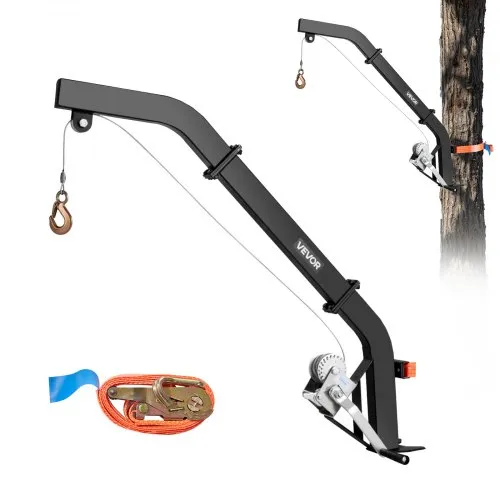
The most popular setup among committed hunters who handle wildlife from their vehicle or in a permanent hunting camp is a deer hoist for a truck. To raise the deer off the ground for field dressing, skinning, and quartering without the need for a separate support structure or tree access, truck-mounted hoists usually use a crane arm or boom system that fastens to the truck bed.
The heavy-duty steel deer hoist for VEVOR truck models is rated for lifting larger game animals, including mature bucks. The mounting methods allow the hoist to be placed before the hunt and withdrawn for regular truck use at the conclusion of the season, as they securely fasten to standard truck bed stake pockets or rail systems without requiring permanent alterations to the vehicle. For hunters who use their trucks for both seasonal hunting and daily travel, this temporary addition is a major practical benefit.
To provide the deer with appropriate working-height access during field dressing and skinning, the crane arm on VEVOR's truck hoist models swings outward from the truck bed. When processing several animals in a single day or when hunting alone without a partner to help with heavy lifting at the tailgate, electric winch options on some models replace manual cranking with powered lifting that raises a fully loaded deer carcass to working height without physical strain.
Trailer Hitch Deer Hoist: Versatile Mounting for Any Tow-Equipped Vehicle
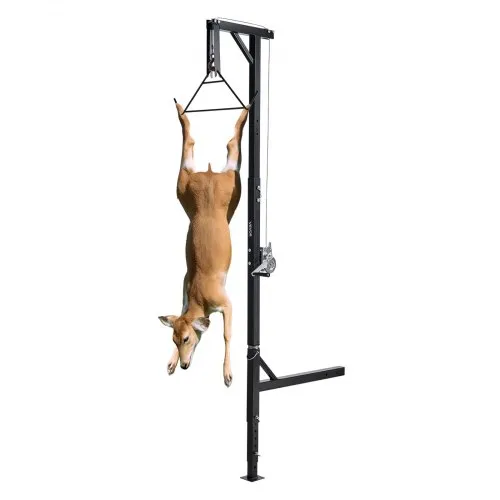
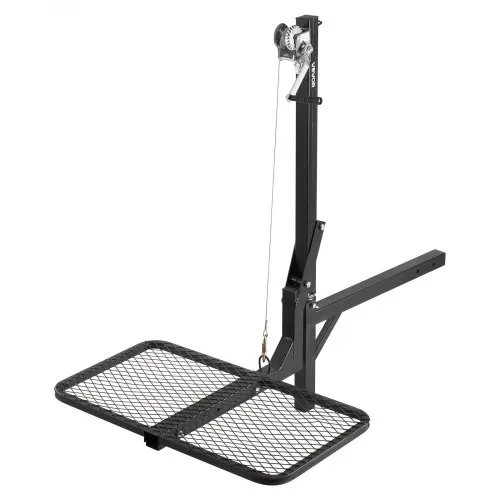
Any tow-equipped vehicle, including trucks, SUVs, and ATV trailers, may become an instant game hoist platform by simply inserting a trailer hitch deer hoist into a standard 2-inch receiver hitch. This feature eliminates the need for permanent mounting hardware or truck bed access. The hoist is compatible with almost all hunting vehicles on the road thanks to its receiver-based mounting system, and its quick-insert installation allows it to be deployed and ready within minutes of reaching the processing area.
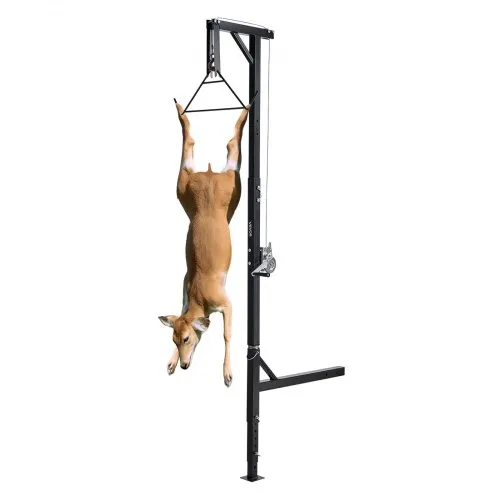
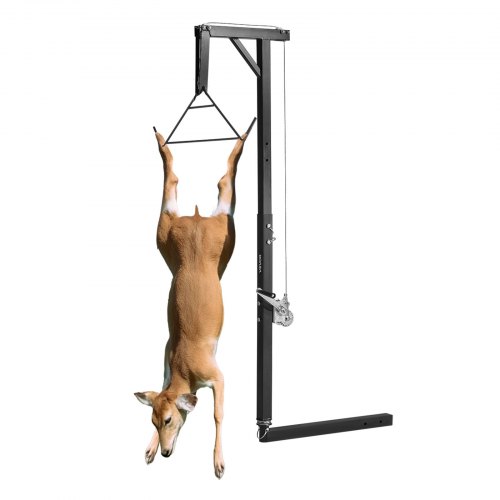
The trailer hitch deer hoist models from VEVOR raise the deer to a comfortable working height next to the car's rear bumper using a receiver-insert shank, a vertical lifting arm, and a winch or pulley system. Throughout the entire processing procedure, the hitch-mounted posture keeps the deer away from the vehicle body. It provides steady support without flex or movement that would needlessly complicate the skinning and quartering process.
Because hitch mounting is so versatile, VEVOR's trailer hitch deer hoist models are useful for hunters who own multiple vehicles or share hunting camp equipment with a group that brings different trucks and SUVs every season. Every vehicle in the camp can use a single hoist as long as a standard 2-inch receiver is available. This feature eliminates the need for each vehicle to have its own specialized hoist equipment during the hunting season.
Tripod Deer Hoist: Standalone Lifting for Any Location
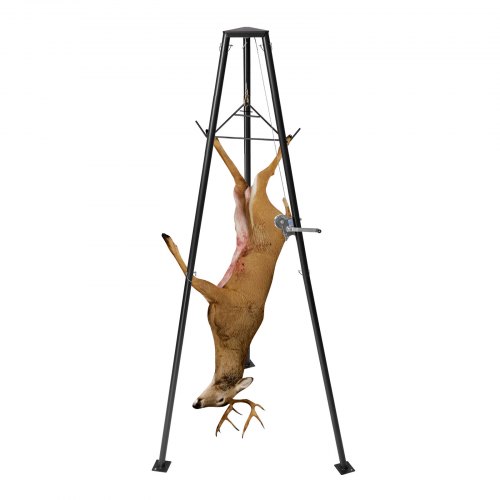
The most location-flexible option in the deer hoist category is a tripod deer hoist, which stands independently on three legs and requires no vehicle access, tree support, or fixed overhead structure. In a field, meadow clearing, hunting camp without trees, or any other place the deer falls, set up a tripod deer hoist and process the animal there without hauling it to a car or looking for an overhead branch sturdy enough to sustain the weight.
Under the dynamic pressures of a swinging deer carcass during processing, VEVOR's tripod deer hoist models offer solid, tip-resistant support thanks to their wide-stance leg arrangement and heavy-duty steel tubing construction. The overhead apex fitting accepts a pulley-and-hook system that smoothly raises the deer to working height, and the tripod's load rating supports mature whitetail, mule deer, and similarly sized game without structural concerns during processing.
Leg length adjustability on VEVOR's tripod models allows the working height to be tuned for the operator's comfort and the terrain's surface conditions, keeping the deer at an ideal processing height, whether the ground is level or slightly uneven. For hunters who cover varied terrain and don't always have vehicle access to the harvest location, a VEVOR tripod deer hoist provides complete processing capability wherever the animal is recovered.
UTV Deer Hoist: Backcountry Retrieval and Processing Capability
A UTV deer hoist mounts to the roll cage, bed, or hitch receiver of a side-by-side utility vehicle, bringing powered lifting capability to the backcountry locations where UTVs are the primary means of accessing remote hunting ground. Loading a mature deer onto a UTV bed manually is physically demanding and awkward; a purpose-built UTV deer hoist eliminates that struggle by mechanically lifting the animal to bed height for clean loading, without requiring multiple people or risky manual lifting techniques.
VEVOR's UTV deer hoist models are designed to be compatible with standard UTV roll cage tubing and bed rail configurations, using clamp-on or bolt-on mounting systems that attach securely without permanent vehicle modifications. The compact crane arm and winch system fold down for transport through dense terrain and deploy quickly when a harvest is reached, keeping the hoist out of the way during the drive-in and functional within minutes of arriving at the animal.
Electric winch options on VEVOR's UTV models integrate with the vehicle's 12-volt electrical system, providing effortless powered lifting that handles a fully loaded deer without manual effort from the operator. For solo hunters who pursue game in remote backcountry without a hunting partner, a UTV deer hoist transforms a previously two-person recovery operation into a single-person operation that can be managed safely and efficiently without physical risk.
Capacity, Portability, and Key Features in Deer Hoists
Beyond mounting style, a deer hoist's lifting capacity and portability determine whether it can handle the size of your average game and transport it easily to all your hunting locations during the season.
Lifting Capacity: Matching the Hoist to Your Game Size
The criteria that establishes whether a deer hoist can handle the amount of animal you usually harvest without operating at or above its rated limit is known as lifting capacity. The weight range covered by VEVOR's deer hoist models, which are rated in pounds of lifting capacity, extends from average doe-sized deer to enormous mature bucks and game animals of comparable size that push toward the upper end of typical whitetail weights in high-nutrition areas.
Choosing a hoist with a capacity that easily exceeds your heaviest anticipated harvest provides a useful safety margin that safeguards the operator and the machinery during processing. Compared with devices operating well within their design limits, hoists operating continuously close to their rated capacity wear out more quickly and are more likely to fail. Choosing a model rated over your average game weight is always the right course of action for safe, dependable, long-term performance in the field. VEVOR clearly specifies capacity ratings across its entire deer hoist portfolio.
A single person can raise a large animal to working height without the raw strength required for direct lifting, thanks to a deer hanger pulley system built into the hoist mechanism, which increases the operator's pulling force. One of the biggest logistical obstacles to successful solo hunting in remote areas is eliminated by VEVOR's pulley-equipped models, which make solo field processing feasible for hunters of varying physical strength.
Portable Deer Hoist: Compact and Field-Ready for Mobile Hunters
For hunters who cover ground on foot, visit several properties during a season, or just need a lightweight processing tool that fits in a pack or truck bed without taking up much room, a portable deer hoist is the ideal option because it prioritizes packability and ease of transportation in addition to functional lifting performance. Compact folding designs, lightweight aluminum or thin-walled steel construction, and low component counts that reduce packed size and weight are ways to achieve portability in this category.
The portable deer hoist versions from VEVOR are small enough to fit in a truck toolbox, ATV storage rack, or hunting pack without interfering with other equipment. The folded form factor ensures that the hoist can be carried to the harvest location rather than requiring a vehicle to transport it within range of the animal, and the setup from packed configuration to operational takes minutes without tools.
VEVOR's portable models retain the lifting capacity and structural stability required for efficient field processing of typical deer-sized game, despite their compact size. VEVOR builds its portable hoists to deliver the same fundamental performance as larger stationary models, within the weight and size envelope that true field portability demands for hunting equipment used throughout a whole season, proving that lightweight construction does not equate to reduced usefulness.
Why Choose VEVOR Deer Hoist?
With capacity ratings and portability options appropriate for every hunting style and game size, VEVOR deer hoist models cover every mounting configuration, from a deer hoist for a truck at hunting camp to a tripod deer hoist in the remote field, a trailer hitch deer hoist for any tow-equipped vehicle, and a UTV deer hoist for backcountry recovery. Every hunter can afford high-quality field-processing equipment thanks to competitive pricing, and every purchase is confidently backed by dependable after-sales care. Browse VEVOR's whole selection of deer hoists to process each harvest with the appropriate equipment.
FAQs
What receiver hitch size does a trailer hitch deer hoist require?
The majority of trucks, SUVs, and tow-equipped vehicles have a standard 2-inch receiver hitch, which is compatible with most VEVOR trailer hitch deer hoists. Before making a purchase, always check the receiver size on your particular vehicle versus the hoist's shank measurements specified in the product specifications.
Can a tripod deer hoist be used on uneven ground?
Yes, the leg lengths of VEVOR's tripod deer hoist models can be adjusted to maintain the hoist's stability and levelness on uneven or sloping terrain. Before lifting any cargo during field processing, make sure the hoist is stable and that all three legs are firmly in place.
How does a deer hanger pulley system make lifting easier?
A single person can elevate a large deer carcass to working height with far less physical effort than direct lifting, thanks to a deer-hanger pulley system that multiplies the operator's input force through mechanical advantage. For hunters of all physical strength levels, solo field processing is feasible using VEVOR's pulley-equipped hoists.
Is a UTV deer hoist compatible with all side-by-side brands?
The clamp-on or receiver-based mounting solutions used by VEVOR's UTV deer hoist models are compatible with most common UTV roll cage tube diameters and bed rail configurations. Before making a purchase, compare the compatibility specifications of the particular model to the receiver specification or roll cage tube size of your UTV to ensure a safe fit.