Inside Diameter Measuring Tool











Results for Inside Diameter Measuring Tool
Discover all of VEVOR's dial test indicators, designed for engineers, toolmakers, machinists, and workshop enthusiasts who want precise, repeatable measurements. With dependable precision instruments designed for both professional and hobbyist use, VEVOR covers every application, whether you require a monolithic dial test indicator for surface inspection or a dial test indicator set with a magnetic stand for complete workholding settings.
VEVOR Dial Test Indicators with Magnetic Stand for Accurate Workshop and Machine Shop Measurement
Are you looking for dial test indicators for the surface plate, lathe, or milling machine that provide accurate readings? Accurate measurement instruments are necessary for high-quality outcomes, whether you are centering a workpiece, checking runout, or confirming flatness. For quick, reliable, and repeatable measurements in any workshop setting, machinists and engineers can rely on VEVOR's selection of dial test indicators, dial test indicator sets, and magnetic stand dial indicator configurations.
Measurement Range & Accuracy in VEVOR Dial Test Indicators
The two characteristics that determine whether a dial test indicator is actually helpful for your application are measurement range and accuracy. The purpose of VEVOR dial test indicators is to provide reliable, consistent readings for a variety of measuring applications, such as confirming bore alignment on precision machine sets or monitoring surface runout on a lathe.
Understanding Measurement Range for Different Applications
The measurement range is the maximum distance that the indicator's contact point can move while maintaining calibration accuracy. Short-, mid-, and extended-range dial test indicators make up the majority of indicators used for machining and inspection. For high-sensitivity activities like centering work in a four-jaw chuck, monitoring spindle runout, or examining ground surfaces where variations are measured in ten thousandths of an inch, short-range indicators with travel of 0.008 to 0.016 inches are perfect.
For common workshop applications, such as confirming part alignment, checking parallelism, and making quick surface comparisons, mid-range dial test indicators with a travel of up to 0.060 inches are more adaptable. Users can choose the appropriate instrument with the sensitivity required for their task thanks to VEVOR's dial test indicator range, which covers both short- and mid-range travel requirements. For inspection activities that require less precision and where greater travel is more crucial than ultra-fine resolution, extended-range variants are also available. You can avoid the irritation of an indicator bottoming out in the middle of a measurement or failing to register slight but significant variances by matching the range to your application.
Graduation Increments and Reading Resolution
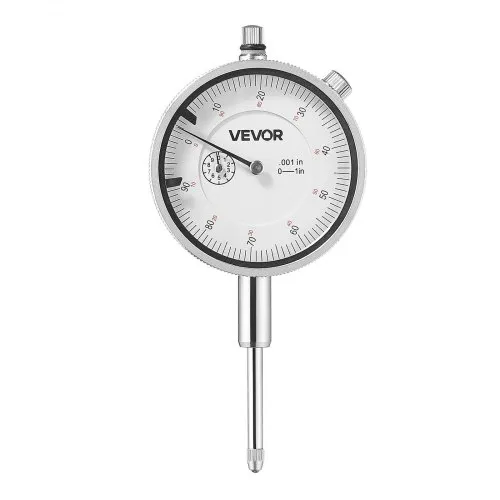
How finely you can resolve a measurement depends on the graduation increment, which is the smallest division that is visible on the indicator dial face. Depending on the model, VEVOR dial test indicators are available in metric graduations of 0.01mm and 0.001mm, as well as common graduation increments of 0.0005 inches and 0.001 inches. A 0.001-inch graduation offers enough precision for the majority of basic machining and inspection tasks to identify surface variation, runout, or misalignment that could compromise part quality.
Finer graduations of 0.0005 inches enable the user to identify and fix significantly smaller variations before they build up into out-of-tolerance conditions for higher-precision tasks such as grinding, lapping, or precision boring. Choosing the appropriate resolution for your measurement assignment is simple with VEVOR's clear specification of graduation increments throughout all dial test indicator listings. VEVOR's designs also prioritize dial face readability; under workplace lighting, readings are easy to quickly comprehend without misreading neighboring graduations thanks to high-contrast numbers, clear graduation lines, and balanced pointer weight.
Accuracy Tolerances and Calibration Standards
The maximum allowable error over a dial test indicator's whole measurement range is known as accuracy tolerance. A well-made indicator maintains its accuracy tolerance not only at a single calibrated location but throughout its entire travel. To ensure dial test indicators are suitable for their intended use, VEVOR manufactures them in accordance with established accuracy standards and provides comprehensive documentation of tolerance specifications.
An accuracy tolerance of ±0.001 inches or greater across the whole range is more than sufficient for the majority of workshop machining activities. VEVOR's dial test indicator set options provide higher-grade instruments to meet the tight tolerance requirements of precision grinding, tool and die work, and quality control inspection. Indicators used in challenging environments with vibration, temperature fluctuations, or heavy daily use benefit greatly from periodic recalibration against a reference standard to preserve accuracy over time. For certain models, VEVOR provides calibration documentation, giving expert users the traceability records needed for production-quality control.
Contact Point Styles and Their Impact on Measurement Accuracy
The contact point directly affects the repeatability and dependability of dial test indicator readings, as well as the tip that makes physical contact with the workpiece surface. The most prevalent contact points in hardened carbide or ruby are standard ball-type ones, which offer uniform contact geometry on curved, flat, and cylindrical surfaces. While ruby tips reduce friction on delicate surface finishes, carbide tips provide superior wear resistance for high-frequency usage on hard workpiece materials.
In addition to being compatible with a variety of alternative tip designs, such as flat discs, pointed tips, and extended-length contacts for reaching into nooks and crannies, VEVOR dial test indicators come with standard contact points. By choosing the appropriate contact point for your workpiece geometry, you can avoid measurement mistakes brought on by interference from tip geometry. For instance, a flat disc on a curved surface may give false readings if the contact area is excessively large relative to the surface curvature. For users who want specific tip configurations, VEVOR's compatibility with conventional M2.5 and 4-48 UNF threaded contact point systems guarantees a wide range of aftermarket accessory availability.
Mounting Options & Features in VEVOR Dial Test Indicators
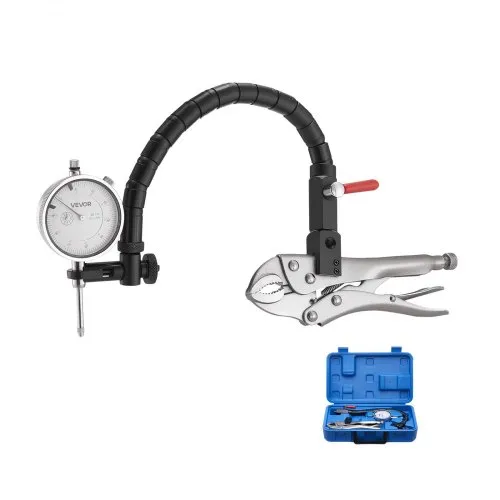
The usefulness of a dial test indicator depends on how well it mounts. VEVOR offers magnetic stand dial indicator configurations and flexible mounting attachments that let you precisely place and secure your indicator while measuring at a lathe, milling machine, surface plates, or inspection bench.
Magnetic Stand Configurations and Holding Strength
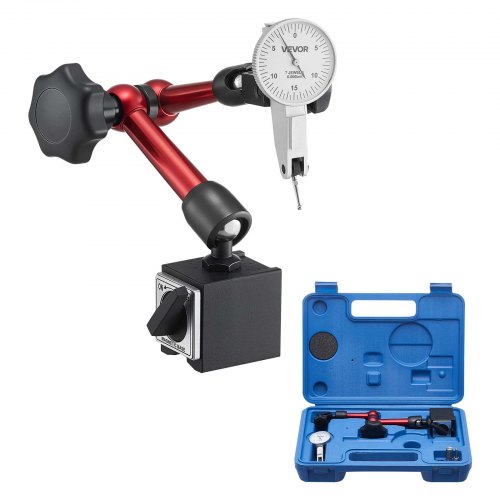
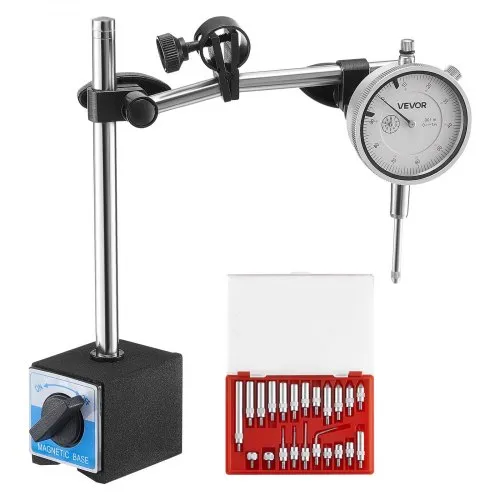
The most popular mounting option for dial test indicators in workshop settings is the magnetic stand. On any ferrous surface, including machine tables, lathe beds, surface plates, and vise bodies, a high-quality magnetic stand dial test indicator arrangement offers firm, vibration-resistant gripping. A simple twist of a lever or knob is all it takes to activate and disengage the switchable permanent-magnet bases used by VEVOR magnetic supports, enabling quick repositioning without tools.
Even when the articulating arm is extended to reach awkward measuring locations, stability is maintained by the magnetic base's holding force, which typically ranges from about 60 lbs to 176 lbs or more on heavy-duty models across VEVOR's range. It is possible to position the indicator at almost any angle and height in relation to the magnetic base thanks to the articulating arm system, which consists of one or more jointed sections with independent locking controls. After the main arm is locked, the indicator head can be micro-positioned using the fine adjustment capabilities of some VEVOR dial test indicators with magnetic stands, allowing precise placement of the contact point without interfering with the overall setup.
Dovetail Mounting, Stem Mounting, and Compatibility Features
Dovetail clamp systems and stem holders that fasten straight to machine tool spindles, boring heads, toolposts, and bespoke fixtures are further mounting options for dial test indicators, in addition to magnetic stands. For most lever-type dial indicators, dovetail mounting is the typical interface. It offers a reliable, safe connection that resists rotation and vertical movement when measurement weights are present. The standard dovetail dimensions used by VEVOR dial test indicators are compatible with the most widely used third-party holders and accessories on the market.
Common on plunger-style dial indicators and some test indicator models, stem installation via a 3/8-inch or 8mm cylindrical shank provides simple clamping in collet holders, drill chucks, and universal indicator holders. The dial test indicator set packages from VEVOR often include a magnetic stand and several mounting adapters, allowing customers to quickly access the most popular installation configurations without purchasing extra parts. The VEVOR dial test indicator with magnetic stand can be positioned in a variety of ways, including dovetail extension bars, swivel adapters, and back-lug mounting options. This feature allows them to be used in unusual measurement configurations that fixed-position mounting solutions cannot support.
Why Choose VEVOR Dial Test Indicators?
VEVOR dial test indicators are precision tools that benefit machinists, engineers, and workshop users at all levels by combining measurement accuracy, wide range coverage, and versatile mounting options. VEVOR offers professional-grade tools at affordable costs, ranging from high-resolution dial test indicator sets for quality inspection work to complete dial test indicators with magnetic stand configurations ready for immediate use. Every purchase comes with reliable after-sales support. Get VEVOR dial test indicators now to increase the accuracy of all your measuring tasks.
FAQs
What is the difference between a dial test indicator and a dial indicator?
A dial test indicator is ideal for measuring at angles and in confined spaces because it uses a lever-actuated contact point that moves in an arc. The plunger of a conventional dial indicator is linear. Dial test indicators provide easier access in constrained measuring setups, though both types measure deviation.
What magnetic base holding force do I need for stable dial indicator readings?
A magnetic stand with a holding force of 60 to 130 pounds is sufficient for the majority of lathe and milling machine operations. To help avoid undesired movement during measurement, select a magnetic stand dial test indicator with a holding strength of 150 lbs or more for longer arm extensions or high vibration conditions.
Can I use VEVOR dial test indicators for checking lathe runout?
Yes, VEVOR dial test indicators are ideal for examining workpiece concentricity, chuck runout, and spindle runout on lathes. Place the contact point against the rotating surface, mount the indicator using a toolpost holder or a magnetic stand, and read the deviation straight from the dial face.
What graduation increment should I choose for general machining work?
The most sensible option for general machining, alignment, and inspection activities is a 0.001-inch graduation. For the majority of workshop applications, it offers enough resolution. Choose a 0.0005-inch graduation indicator instead if you need finer resolution for precision grinding or precise surface inspection.