
Lawn Care








Results for Lawn Care
Discover VEVOR's full line of lawn spreaders, including walk-behind, tow-behind, and compost spreaders, designed for property managers, professional landscapers, and homeowners managing lawns of all sizes. VEVOR offers dependable, well-made spreading equipment that provides consistent, even coverage with each pass, whether you are overseeding a residential yard, distributing compost over garden beds, or applying fertilizer across a sizable pasture. For practical lawn care, each spreader combines durable construction, practical capacity, and competitive pricing.
VEVOR Lawn Spreaders for Seed, Fertilizer, and Compost Applications
Are you looking for lawn spreaders that can efficiently fertilize a large property or overseed a small garden in a single pass? For both homeowners and professional landscapers, VEVOR offers tow-behind spreaders, walk-behind spreaders, and compost spreaders in a range of capacities. Choose the ideal spreader for your lawn's size, material type, and equipment configuration right now.
Lawn Spreader Types and the Capacities That Match Every Property Size
The area you need to cover, the equipment you currently own, and the materials you intend to spread will all influence the type of lawn spreader you choose. With a variety of hopper capacities and tow-behind and walk-behind configurations available in VEVOR's lineup, you can perfectly adapt the spreader to your property and operation.
Tow Behind Lawn Spreaders for Large Properties and Riding Mowers
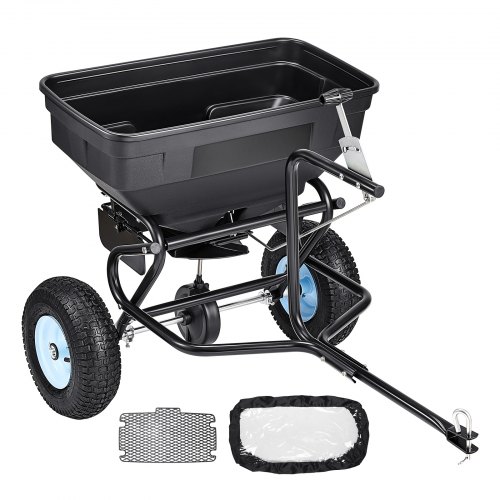
Large amounts of seed, fertilizer, ice melt, or granular material can be spread across expansive lawns, pastures, sports fields, and large rural properties in a fraction of the time a walk behind spreader would take, thanks to a tow behind lawn spreader that attaches to the hitch receiver of a riding lawnmower, garden tractor, ATV, or utility vehicle. The heavy-duty poly hoppers used in VEVOR tow-behind lawn spreaders are resistant to corrosion from fertilizer salts, UV degradation, and cracking. This feature extends the hopper's lifespan through multiple seasons of outdoor storage and frequent use in both wet and dry conditions. The VEVOR tow behind line's hopper capacities range from 65 pounds for residential models to 130 pounds or more for professional-grade spreaders intended for large-acreage property management and commercial landscaping.
With an adjustable gate at the hopper outlet that regulates the flow rate of material from the hopper to the spinning disc, the spreading mechanism in VEVOR tow-behind lawn spreaders uses a ground-driven or electrically actuated spinning disc that distributes material in a wide arc behind the tow vehicle. The main method for calibrating the spread rate to match application guidelines for the particular seed variety, fertilizer formulation, or other granular material being applied is this flow rate adjustment. Instead of patchy growth and nutrient hotspots arising from uneven application, a consistent spread rate across the entire area ensures even nutrient distribution, uniform germination, and predictable results. With VEVOR tow-behind lawn spreaders, the hopper gate can be closed during turns, overlapping passes, and transitions between spreading regions without stopping or dismounting the tow vehicle, thanks to a shut-off cable routed to the tow vehicle operator position.
Walk Behind Spreaders for Residential Lawns and Precise Application
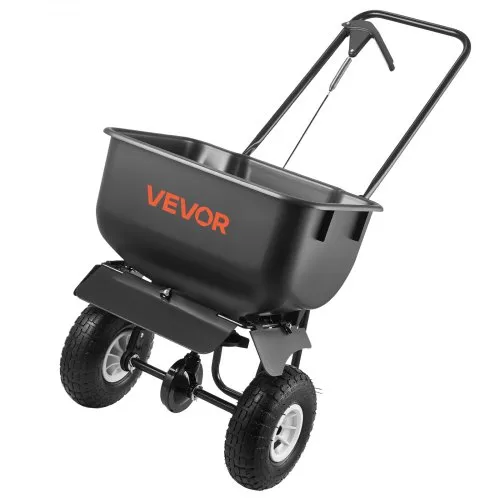
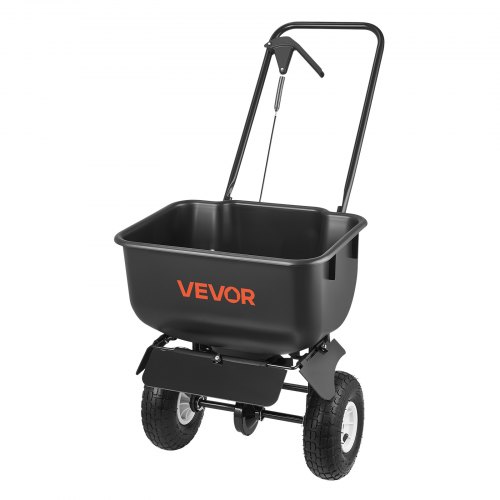
For residential properties without a riding mower or tractor, for areas too small or irregularly shaped for a tow-behind unit to navigate effectively, and for applications requiring precise edge control near garden beds, driveways, and sidewalks where over-application would damage plantings or cause runoff issues, a walk behind spreader is the practical option because the operator pushes the spreader across the lawn. VEVOR walk behind spreaders use either a drop spreader design that deposits material directly below the hopper in a controlled strip precisely as wide as the spreader body for maximum placement accuracy or a spinning broadcast disc mechanism that disperses material in a wide pattern in front of and to the operator's sides.
Compared to drop spreaders, broadcast walk-behind spreaders from VEVOR cover a broader swath on every pass, requiring fewer passes to finish a given area and increasing production on larger residential lawns, where efficiency is crucial. Drop spreaders are the best option for edging, striping, and any application where material must be kept precisely within set boundaries since they sacrifice swath width in exchange for exact placement control. With pneumatic or solid rubber tires sized to move easily over lawn surfaces without scalping turf or sinking into soft soil after rain, VEVOR walk-behind spreader frames feature powder-coated steel construction that resists rust even when frequently exposed to moist fertilizer granules and wet grass.
Compost Spreaders for Soil Amendment and Garden Health
The heavier, denser, and more irregular particle sizes found in compost, aged manure, peat, and other organic soil amendments would clog or jam a typical granular fertilizer spreader not made for coarser materials. A compost spreader is a specialized variation within the lawn spreaders category. Compared to standard fertilizer spreaders, VEVOR compost spreaders feature wider hopper openings, larger-diameter agitator systems, and stronger drive mechanisms to prevent bridging and blockages that result in uneven application when spreading organic materials through machinery designed exclusively for uniform granular products.
In a thorough lawn care program, spreading compost over lawn areas improves soil structure, boosts microbial activity, improves moisture retention, and provides a slow-release nutrient profile that balances the quick-acting effects of synthetic fertilizers. Instead of relying on hand spreading with a shovel and rake, which is both physically taxing and inherently inconsistent in depth of application, VEVOR compost spreaders enable homeowners and landscapers to deliver these benefits across large areas effectively. The operator can calibrate the application thickness to the recommended depth for topdressing established lawns, which usually ranges from one-quarter to one-half inch of compost per application, using the VEVOR compost spreader's adjustable spread width and rate controls.
Hopper Capacity and Refill Frequency Across the Spreader Range
One of the most practically important features for any property owner or landscaping expert managing more than a modest residential lawn is hopper capacity, which directly impacts how many times you need to stop, replenish, and resume during a spreading session. For a small residential lot, where a single load of fertilizer or seed covers the entire area in a single pass, a small hopper with a capacity of 20 to 40 pounds is sufficient. However, on a half-acre or larger property, where multiple refills disrupt workflow and make it challenging to maintain consistent spread rate continuity across refill boundaries, this hopper becomes a major productivity bottleneck.
VEVOR lawn spreaders support professional landscaping crews that must maintain productivity across properties of various sizes throughout a working day. They range in capacity from small residential hoppers to large-volume tow behind models that hold enough material to cover multiple acres between refills. Smooth interior hopper surfaces stop material from sticking to the walls and causing erroneous metering as the load decreases. VEVOR spreaders' hopper openings are sized to accept material directly from conventional fertilizer bags and compost containers, eliminating the need for a separate transfer funnel. The ability to swiftly refill and resume spreading without requiring extensive cleanup or adjustment between loads is a true productivity advantage that VEVOR incorporates into the spreader design from the very beginning for workers handling many properties in a single day.
Coverage Width and Material Compatibility in Lawn Spreaders
How well a lawn spreader covers a specific area and whether it can handle the full range of products your lawn care program demands across various seasons and applications depend on its coverage width and material compatibility.
Coverage Width and Its Effect on Application Efficiency
The horizontal distance over which a spreader distributes material in a single pass is known as the coverage width, also called the spread width or swath width. It has a direct mathematical relationship with the number of passes needed to cover a specific area. A spreader with a 10-foot spread width requires half as many passes to cover the same area as one with a 5-foot spread width, reducing the time and effort required to finish the application by half. Depending on the model and spinner speed setting, VEVOR tow-behind lawn spreaders can achieve broadcast widths of 8 to 12 feet or more, making them truly effective for large-area coverage where productivity depends on reducing pass counts.
Under typical working conditions, walk-behind broadcast spreaders in the VEVOR range may reach spread widths of 6 to 10 feet. The spread width can vary depending on the type of material being spread, the flow rate setting, and walking speed. Because heavier granules travel farther from the spinner than lighter ones at the same flow rate, operators must calibrate their spreader settings independently for each product type rather than assuming a single setting is effective for all.
Material Compatibility Across Fertilizers, Seeds, and Organic Amendments
From fine-grass seed and coarse granular fertilizer in the spring and summer to ice-melt pellets in the winter and organic compost or topdressing material in the fall, lawn spreaders are often used with a wide range of materials throughout the year. Not all spreaders are equally adept at handling all material types. To prevent bridging and uneven flow that degrade application quality when a spreader's mechanisms are not well matched to the material being spread, VEVOR lawn spreaders are designed with adjustable gate openings and agitator systems that accommodate particle size variation across these materials.
For any lawn spreader used with fertilizers, corrosion resistance is a crucial material compatibility factor. Fertilizers include salts that, when left in contact after a spreading session or left uncleaned, aggressively erode unprotected steel components. Poly hoppers, stainless-steel hardware at key contact points, and powder-coated or galvanized steel frames, which are far more resistant to fertilizer-salt corrosion than bare-steel construction, are all features of VEVOR lawn spreaders. After every use, the hopper, gate, and spreading mechanism should be thoroughly cleaned with clean water to remove any remaining fertilizer. VEVOR spreader designs make this process easier with smooth internal surfaces and easily accessible parts that rinse clean fast without needing to be disassembled.
Why Choose VEVOR Lawn Spreaders?
For private residents, professional landscapers, and large-property managers alike, VEVOR offers a full line of lawn spreaders, including walk-behind, tow-behind, and compost spreaders. Reliable lawn care equipment is affordable for all budgets because of the spreaders' sturdy, corrosion-resistant construction, useful hopper capacities, flexible spread rates, and affordable prices. Your spreader is designed to provide season after season with VEVOR's trustworthy after-sales support. Choose the ideal spreader for your lawn now by browsing the entire lineup.
FAQs
What is the main difference between a tow behind spreader and a walk behind spreader?
With a large hopper capacity, a tow-behind spreader quickly covers wide areas when attached to an ATV or riding mower. Smaller residential lawns or areas requiring fine edge control close to beds and hard surfaces are best suited for a walk behind spreader, which is manually pushed.
Can I use a lawn spreader for ice melt in winter?
Yes, most VEVOR broadcast lawn spreaders can handle granular ice melt. After each use, thoroughly rinse the hopper, disc, and frame with clean water to remove any corrosive salt residue that could otherwise accelerate rust and component degradation.
How do I calibrate a lawn spreader for accurate application rates?
To confirm the true application rate, start with the gate-opening setting recommended by the manufacturer for your product, then run a test over a defined area and weigh the material spread. Set the gate up or down until the measured rate corresponds to the suggested rate on the product label.
