Measuring Rods


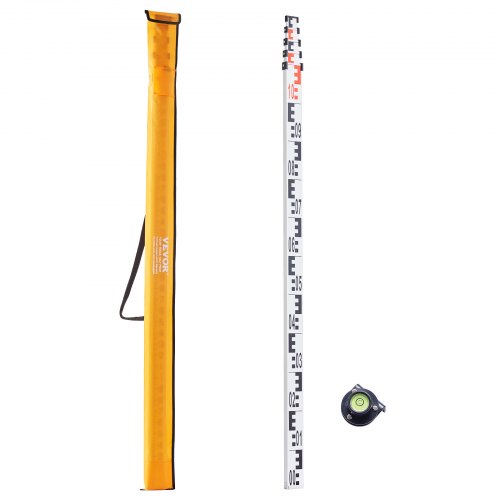




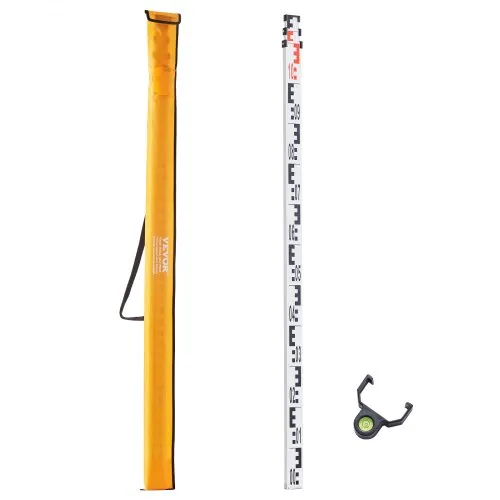


Results for Measuring Rods
A measuring rod is a long, rigid graduated staff used to determine height, elevation, and linear distance in the field. Held upright at a target point, it presents a marked scale that an operator reads directly or sights through a leveling instrument to establish how far one point sits above, below, or away from another. The face carries printed graduations at fixed intervals, giving a repeatable reference against which readings are taken. Because the rod itself defines the scale, its straightness, graduation accuracy, and stability under handling determine whether every measurement taken against it holds true.
On this page the rods are telescopic aluminum grade rods, built from three to six nesting sections that extend from roughly 9 to 25 feet and lock at each joint for a firm sighting face. Every rod carries a double-sided scale, with feet and tenths or feet and eighths on the front and feet and inches on the back, plus a bubble level and a carry bag. Telescopic measuring rods collapse short for transport, while rigid aluminum grade rods hold a flat face for elevation work. Typical uses are differential leveling, benchmark and grade checks, elevation surveys, and interior height and clearance readings.
Four things decide what you need:
- Reach: match the extended length to the tallest elevation or height you must read without repositioning.
- Sections: more sections fold to a shorter carry length but add joints to extend and lock at each setup.
- Graduation scale: choose feet and tenths for engineer's leveling or feet and eighths for inch-based layout.
- Weight: a lighter rod is easier to hold plumb at arm's length through a long reading session.
Browse the full range of measuring rods to match reach, graduation, and packed length to the work ahead, and compare the telescopic grade rod lengths to find the right fit for your site.
Measuring Rod Types at a Glance
The four rod styles used in field measurement differ in how they are built and read, which decides the work each one suits.
| Rod Type | Form / Design | How a Reading Is Taken | Graduation Face | Key Advantage |
|---|---|---|---|---|
| Telescopic measuring rod | Collapsible, 3 to 6 nesting sections | Sighted through a leveling instrument at distance | High-contrast face read through the eyepiece | Packs short to carry across sites on foot |
| Push rod measuring tool | Flexible or semi-rigid shaft | Pushed into the void and read along the shaft | Scale printed along the shaft, no line of sight | Reaches dimensions inside ducts, pipes and voids |
| End measuring rod | Fixed body with reinforced contact tips | Physical contact at one or both ends | Zero begins at the physical end, no sighting | No foot offset to add on interior dimensions |
| Aluminum grade rod | Rigid extruded single-face profile | Sighted through a level or total station | E-pattern or direct-reading graduations | Flat stable face gives bounce-free elevation reads |
VEVOR Measuring Rods Built for the Accuracy That Field Conditions Actually Require
An imprecise measuring rod does not give simply one inaccurate reading. Small mistakes in rod graduation, dimensional instability, or section-locking failures are magnified throughout an entire survey, leading to larger project issues. VEVOR makes measuring rods with the knowledge that precision in the field starts with the rod itself, before the instrument, operator, or conditions even enter the picture.
Rod Type and Configuration: Choosing the Right VEVOR Measuring Rod for Every Task
Measuring rods are specialized tools, and the design that works well for a grade survey on an open site is not the same as the one that works effectively in a restricted interior space or for a push-style clearance measurement. Understanding each rod type and its strengths leads to greater outcomes and fewer compromises in the field.
Telescopic Measuring Rods: Packable Length for Field Mobility
For transfer from one measuring location to the next, a telescoping measuring rod is collapsed to a small carry length. Sections are then extended to reach the complete graduation range needed for the reading. Its collapsible design makes the telescopic measuring rod an advantage for surveyors and field personnel who traverse extensive regions on foot and cannot realistically transport full-length rigid rods over uneven terrain.
The VEVOR telescopic measuring rods have precision locking collars at each section joint to keep the extended length firm, with no flex or compression during field handling. The locking mechanism is a critical part of any telescopic measuring rod. A joint that can move under pressure will result in cumulative length inaccuracies at each reading. VEVOR collar designs clamp securely in a single action and release cleanly when adjustment is required.
Graduation marks on VEVOR telescopic measuring rods are printed in high contrast. They are clearly visible when viewed through an instrument eyepiece at common surveying distances. The markings are well-spaced and precisely aligned throughout every segment of the rod, even at the transitions between collapsed sections, when it is most difficult to maintain continuity of graduation.
Aluminum Grade Rods for Elevation Accuracy on Construction and Survey Sites
Aluminum grade rods are the pole of choice for differential leveling, benchmark work, and elevation surveys, where measurements are taken at varying distances across a site with a level or total station. The flat, hard structure of a grade rod gives a definite graduation face to the instrument without the flexibility or bounce that influences readings recorded with inferior rod material.
VEVOR aluminum grade rod designs are made from extruded aluminum profiles with tight dimensional tolerances that maintain straightness along the whole rod length without sagging or bowing under their own weight. This structural rigidity is important for grade rod use, as the rod, curving at mid-length can introduce elevation reading errors. The aluminum structure also makes the rod light enough for one operator to hold stable at arm's length throughout the reading.
The graduation face on a VEVOR aluminum grading rod features E-pattern or direct reading graduation styles that conform to normal leveling instrument standards, making the transfer to VEVOR measuring rods easy for experienced surveyors already familiar with common rod formats. VEVOR aluminum grade rod alternatives are available in several lengths to meet the vertical range requirements of different site types and survey procedures.
End Measuring Rods for Precise Interior and Confined-Space Measurements
An end measuring rod is a rod designed for the measurement of distances and clearances, the point of measurement being at one or both physical ends of the rod, rather than on the graduated face. This design is perfect for measuring interior spaces between walls, checking ceiling height, checking clearance in a structure, or any time you need to measure from a hard surface that the rod must physically touch.
VEVOR end measuring rod designs start the zero graduation point at the physical end of the rod. This means you can start measuring at a contact surface and do not need to compensate for a foot offset or start mark above the base. This zero-at-the-end design is why end-measuring rods are the proper tool for interior-dimension work, where adding a constant offset to every reading is unacceptable. The contact-point accuracy is built into the rod design.
The physical architecture of VEVOR end measuring rods is designed to provide durable contact ends that are subjected to the highest wear during normal use. End caps or reinforced tips prevent the graduation zero point from being distorted by repeated contact with concrete floors, masonry walls, and structural steel. For contractors and inspectors who need accurate interior clearance and dimension readings regularly, VEVOR end measuring rods are made expressly for that work, rather than general-purpose rods used for a role they were not designed to fulfill.
Push Rod Measuring Tools for Accessing Dimensions in Confined Locations
A push-rod measuring instrument extends the operator's reach to areas that cannot be reached with a regular rigid or telescopic measuring rod. A push rod design helps address measurement challenges in crawl spaces, inside pipes, within duct systems, and in tight structural voids.
VEVOR push rod measuring tools are made with flexible or semi-rigid shaft materials that convey push force into tight areas while providing enough column strength to reach the intended measurement point without collapsing. The scale is arranged along the shaft in a readable format for the operator, providing dimensional measurements without line-of-sight access to the location being measured. This indirect measurement capability distinguishes push rod measuring tools.
VEVOR push rod measuring tools are designed to address real-world daily workflow challenges that traditional measuring rods can't handle, including facilities maintenance, HVAC installation, plumbing, and structural inspection tasks. VEVOR designs these instruments with the operator's usability in mind. The measurement scale is clear, unambiguous, and easy to read even when viewed from an inconvenient position outside the limited space being measured.
Matching a Measuring Rod to the Job
Once the rod styles are clear, the next decision is which one fits the specific setting you are measuring in.
| Job / Setting | Suited Rod Style | Key Consideration | What to Watch For |
|---|---|---|---|
| Differential leveling and benchmark elevation on open sites | Rigid aluminum grade rod | Unobstructed sightline to the instrument | Keep the face plumb; a lean adds elevation error at distance |
| Surveying on foot across large or rough terrain | Telescopic rod with more sections | Packed carry length | More sections fold shorter but add joints to check each setup |
| Interior wall-to-wall and floor-to-ceiling clearances | End measuring rod | Zero at the contact end | Confirm zero sits at the tip or every reading carries an offset |
| Crawl spaces, ducts and pipe voids | Push rod measuring tool | Reach without line of sight | Shaft must hold column strength or it bows and misreads |
| Work near live electrical infrastructure | Non-conductive fiberglass rod | Electrical safety | Pick fiberglass over aluminum wherever contact with live lines is possible |
Material and Measurement Range: The Specifications Behind Field Performance
The length of a measuring rod and the range of graduations it covers are factors that affect whether a rod will last through a full working lifespan and whether a single rod will cover the measurement range required for a certain type of work. VEVOR addresses both factors across its measuring rod lineup.
Why Material Choice Defines Long-Term Rod Performance
Selecting material for measuring rods is a compromise between weight, stiffness, dimensional stability, and resistance to the environment in which the rod will be used. Aluminum, fiberglass, and composites each have distinct strengths in this balance, and the optimal choice depends on where and how the rod is used.
Aluminum measuring rods have the best mix of stiffness and light weight for general survey and construction use. Aluminum machines and extrudes well with tight tolerances, too, which helps achieve the dimensional accuracy surveyors require. The aluminum measuring rods by VEVOR are coated with corrosion-resistant treatments that protect the material from repeated exposure to outdoor environments, preventing the surface degradation that untreated aluminum suffers over time.
Fiberglass measuring rods offer distinct benefits for electrical safety and in locations where contact with active infrastructure is a risk. Fiberglass is non-conductive, an important feature in utility operations and any place where the rod could accidentally touch electrical infrastructure during use. VEVOR fiberglass measuring rods retain the graduation accuracy and structural integrity of aluminum equivalents, while also providing the non-conductive safety margin demanded by electrically sensitive settings.
Graduation Range and Interval for Covering the Measurements Your Work Requires
The graduation range is the maximum height/length that the measuring rod can measure in a single measurement without repositioning. The graduation interval (usually expressed in millimeters, centimeters, or feet and inches, depending on the measurement system) determines the smallest increment the rod can resolve, and the instrument can read at the working distance.
VEVOR measuring rods come in a range of total graduation lengths to accommodate the vertical scope of various survey and construction applications. A 3- to 5-meter graduation range is common for construction leveling. VEVOR offers alternatives across this spectrum, so selection is based on site-specific requirements rather than on what is available.
The graduation interval on VEVOR measuring rods follows standard metric and imperial rules, aligning with the equipment and workflows most professionals already use. For precision measurement applications, VEVOR maintains strict manufacturing tolerances on graduation spacing so that each interval on the rod is true to its nominal dimension, not only at the calibration check points, but all the way along the graduated length.
Best-Seller Measuring Rod Comparison
These five telescopic grade rods, listed in the catalog, differ mainly in reach, packed length, weight, and scale.
| Product | Extended Height | Sections | Folded Length | Weight | Front Scale | Best For |
|---|---|---|---|---|---|---|
| 9 ft, 8ths, 3-Section Rod | 9 ft | 3 | 41.8 in | 1.5 lb | 1/8 in (eighths) | Only eighths scale here; inch-based interior and flooring layout |
| 9 ft, 10ths, 3-Section Rod | 9 ft | 3 | 41.8 in | 1.5 lb | 1/10 ft (tenths) | Shortest tenths rod; quick close-range grade checks |
| 20 ft, 10ths, 6-Section Rod | 20 ft | 6 | 51.4 in | 4.19 lb | 1/10 ft (tenths) | Packs shortest of the tall rods; easiest big rod to carry |
| 16 ft, 10ths, 4-Section Rod | 16 ft | 4 | 55.5 in | 3.42 lb | 1/10 ft (tenths) | Only four-section build here; fewest joints to extend and lock |
| 25 ft, 10ths, 6-Section Rod | 25 ft | 6 | 61.8 in | 5.29 lb | 1/10 ft (tenths) | Greatest vertical range on the page; storey-height elevation work |
Why VEVOR Measuring Rods Belong on Your Job Site
VEVOR measuring rods provide accurate, lasting performance in telescopic, grade, end, and push rod styles for professional surveying, construction, and inspection work. VEVOR is the go-to for field measurement instruments, offering clear graduation markings, premium materials, and accurate dimensional control to support accurate field measurements. Every purchase is backed by competitive pricing and reliable after-sales assistance. Check out the entire line of VEVOR measuring rods today, and add rods to your field equipment that function as precisely as the task requires.
FAQs
What is the difference between a telescopic measuring rod and a fixed-length grade rod?
Telescopic measuring rod, collapsible for simple carrying to full measure length in the field. Ideal for mobile survey operations. This permanent aluminum grade rod is straight and stiff end to end, with no joints. It is perfect for stationary leveling and elevation operations where total rigidity is more important than portability.
Can VEVOR aluminum grade rods be used with any leveling instrument?
Yes. VEVOR aluminum grade rod graduation formats are the conventional E-pattern and direct-reading formats, which are suitable for most optical and digital leveling devices. If you are using a particular instrument configuration, make sure that the graduation style is in line with the way your instrument is read before purchase.
What applications specifically require an end measuring rod?
End measuring rods are the correct tool for measuring internal wall-to-wall distances, verifying floor-to-ceiling height, and checking structural clearances when the measurement must start at a firm contact surface. End measuring rods are designed to eliminate the systematic mistakes introduced by standard measuring rods with foot offsets in these applications.
Are VEVOR measuring rods suitable for use in wet or outdoor conditions?
Yes. VEVOR measuring rods are made of materials and finishes that are chosen for outside field use. Aluminum versions have corrosion-resistant coatings, and fiberglass choices are naturally weather-resistant. Graduation markings are applied to resist fading and damage from normal outdoor exposure and handling.
How accurate are telescopic measuring rods in the field?
Field accuracy depends on holding a firm, plumb face at every setup. These telescopic measuring rods lock at each section and include a bubble level, with graduations printed to a stated range tolerance of ±1/1000 mm. Loose joints or lean, not the scale, cause most field error.
What are the different types of grade rods used in surveying?
Grade rods are grouped by how they fold and read. Telescopic rods collapse into nesting sections for transport, while fixed rods stay rigid end to end. Faces are marked in feet and tenths for engineer's leveling or feet and eighths for inch work, with feet and inches on the back. See the full grade rod range for the available lengths.
What is the difference between a direct elevation rod and a standard grade rod?
A standard grade rod reads from the base upward, so the figure at the instrument's line of sight is a height above the rod foot. A direct elevation, or direct-reading, rod is numbered so the sighted value is read straight off as the point's elevation. Both share the same graduated face.
What are measuring rods used for in construction and surveying?
In construction and surveying, measuring rods establish elevation and height references. Crews use them for differential leveling, setting and checking benchmarks, reading grade across a site with a level or total station, and confirming floor-to-ceiling and clearance dimensions indoors.