Nail Guns






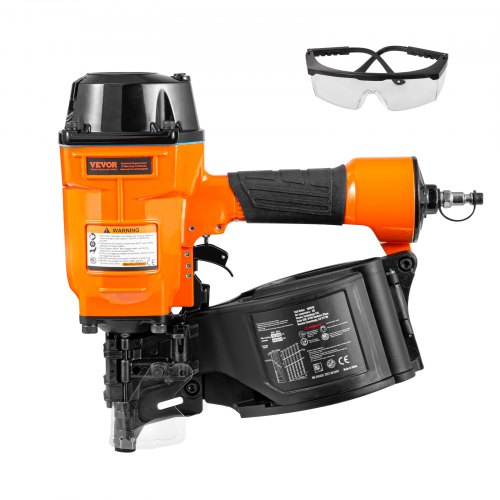


Results for Nail Guns
A nail gun is a power-driven fastening tool that drives a nail into wood or other building material in a single trigger action, doing in one stroke what once took several hammer blows. It converts stored energy into a fast, forceful push on the fastener, seating it cleanly and to a consistent depth below the surface. The tool feeds nails automatically from a loaded magazine, advancing the next fastener after every shot so the operator can work without pausing to reload by hand. The result is quick, accurate, repeatable fastening with reliable holding strength across long stretches of repetitive work.
Nail guns divide into a handful of families, each matched to a fastener size and a job. Brad nailers drive slim 18-gauge brads for trim and cabinet work, while finishing nailers set slightly heavier 16-gauge nails where a joint needs more hold but still has to stay nearly invisible. Framing nailers drive long 21-degree to 30-degree collated nails from 2 inches to 3-1/2 inches for structural lumber, and roofing nailers and coil siding nailers run 15-degree coils for high-volume shingle and panel installation. Pin nailers place headless 23-gauge pins for the most delicate holding. Power comes from compressed air on pneumatic nail guns, or from a cordless battery. Typical uses are finish carpentry, cabinet and furniture assembly, wall framing, decking, sheathing, roofing, and siding installation.
Five things decide which nail gun you need:
- Nailer type: match the tool to the task, from fine brad and pin work up to heavy framing and coil-fed roofing and siding.
- Power source: pneumatic tools stay light and never run flat but need a compressor and hose, while cordless models trade some weight for go-anywhere freedom.
- Nail gauge and length: thinner gauges leave smaller holes for finish work, while longer, thicker nails give the hold that structural joints demand.
- Magazine capacity: stick magazines keep the tool compact, while high-capacity coils cut how often you stop to reload on large runs.
- Application material: softwood, hardwood, OSB, sheathing, and siding panels each resist the driver differently, so depth and drive force have to suit the surface.
Ready to match a tool to the next job? Weigh the cordless brad nailers built for mobile finish work against the pneumatic coil nailers made for all-day roofing and siding runs, and pick the drive, gauge, and magazine that keep your fastening fast and clean.
Nail Gun Types at a Glance
The six nailer families below separate by the fastener they drive, how they are fed, and how they are powered.
| Type / Sub-type | Fastener Size | Magazine and Collation | Power Source | Key Advantage |
|---|---|---|---|---|
| Brad nailer | 18-gauge brads, 5/8 in to 2 in | Straight stick magazine | Pneumatic or cordless | Tiny entry holes need the least filler on finish surfaces |
| Finishing nailer | 16-gauge nails, 1 in to 2-1/2 in | Straight or 20° angled stick | Pneumatic or cordless | More holding power than brads while staying low-visibility |
| Framing nailer | 2 in to 3-1/2 in, 21° to 30° collated | Angled stick magazine | Pneumatic or cordless | Highest drive energy for structural lumber and sheathing |
| Roofing nailer | 3/4 in to 1-3/4 in nails | 15° wire or plastic coil | Pneumatic | Coil feed means the fewest reloads over wide roof areas |
| Coil siding nailer | 1 in to 3-1/4 in nails | 15° coil | Pneumatic | Rapid-cycle coverage across large siding elevations |
| Pin nailer | 23-gauge headless pins, 5/8 in to 1-3/8 in | Straight stick magazine | Pneumatic | Headless pins hold light stock with almost no visible mark |
VEVOR Nail Guns – Roofing Nailers and Siding Coil Nail Guns for Builders, and DIY Applications
Do you need professional nail gun tools for a construction crew, roofing operation, finish carpentry business, or do-it-yourself workshop? Consider features such as nailer type, power source, nail gauge, magazine capacity, and application material when searching for the right nail gun. These features determine whether your fastening workflow maintains the speed, accuracy, and surface quality your project needs on every shift. For every fastening job, from do-it-yourself trim work, framing, and siding installation, VEVOR nail guns have the driving power and long-lasting construction you need.
Choosing Nail Guns by Nailer Type and Power Source
Nailer type and power source are the two most important factors to consider when choosing a nail gun. They will tell you about the nail gauge, drive mechanism, magazine format, and the level of operator mobility you need to achieve consistent fastening results.
Roofing Nailers and Coil Siding Nail Guns with High-Capacity Pneumatic Fastening for Roofing and Siding Installation
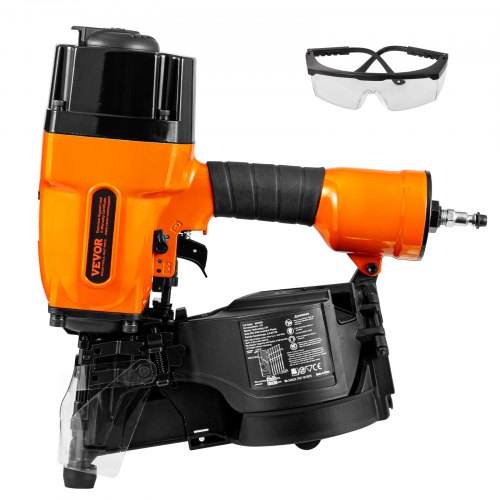
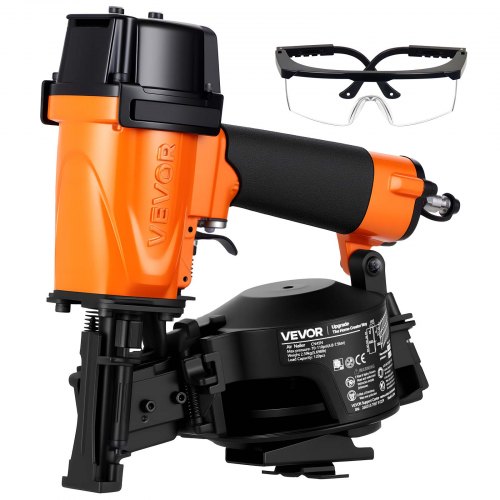
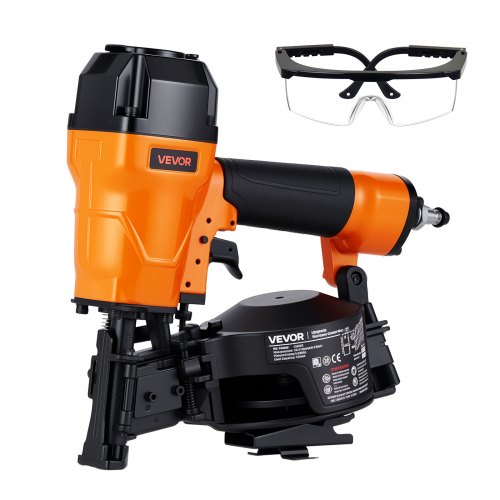
For installing shingles, felt, and siding panels, the roofing nailers and coil siding nail guns provide the high-capacity, rapid-cycle pneumatic fastening performance needed. They use coil magazines, which hold many more nails per load than stick magazines. Hence, there are fewer reloads during continuous, large-area fastening runs on roofing decks and siding elevations. Reloading slows down production and increases labor time per square foot installed. Roofing nailers and siding coil nail guns feature a pneumatic drive mechanism that delivers consistent drive energy per fastener.
It ensures that every roofing or siding nail is driven flush with, or to the exact set depth below, the shingle or panel surface, without overdriving. It can split shingles or underdrive, leaving nail heads protruding and breaking weathertight seals in roofing and siding envelope applications. For roofing, nail guns accept 15-degree to 16-degree wire-weld and plastic-strip coil nails in lengths from 1 inch to 1-3/4 inches. They also feature adjustable depth drives, 360-degree adjustable exhausts, and tool-free jam-clearing mechanisms that keep the jobsite productive when nail feed issues occur.
Brad Nailers and Cordless Brad Nailers with Precision Finish Fastening for Trim, Molding, and Cabinet Work
When it comes to trim, molding, and cabinet work, brad nailers and cordless brad nail guns drive 18-gauge brad nails for precise finish-fastening applications. The narrow-gauge fastener diameter means that there are fewer surface entry points in trim boards, door casings, window moldings, cabinet face frames, and decorative paneling. That means less filler and sanding are needed to hide nail heads in finish carpentry work. It is essential when surface appearance is the primary quality standard and fastener visibility directly affects the professional finish of the installation.
The cordless brad nailer does not require a compressor, hose, or power outlet, unlike pneumatic nail guns. Instead, it has a battery-powered drive system that lets the operator move around the work area freely and work in areas without a compressed air supply. A variety of cordless and pneumatic nail guns feature sequential and contact firing modes, along with tool-free depth adjustment dials for precise nail countersink control. You can use them across different types of wood and panel thicknesses, with dry-fire lockout mechanisms that stop blank firing when the magazine is empty. It also protects the work surface from driver face-contact marks and magazines that hold 100 to 130 brad nails per load, enabling longer fastening runs.
Framing Nailers and Cordless Framing Nailers with Structural Wood Fastening for Wall Framing, Decking, and Sheathing
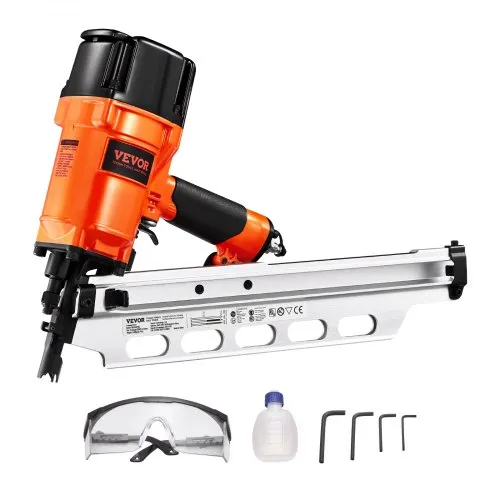
In framing nailers and cordless framing nailers, 21-degree to 30-degree plastic-collated or paper-tape-collated framing nails come in lengths ranging from 2 inches to 3 1/2 inches. They deliver the high-energy drive force needed to fully seat large-diameter framing nails into dimensional lumber, engineered wood products, LVL beams, and OSB sheathing. You can use them for structural wall framing, floor decking, roof sheathing, stair construction, and timber-joining applications where fastener hold strength and consistent drive depth are critical.
Cordless framing nailers feature brushless motor drive systems powered by high-capacity lithium-ion batteries. These nail guns deliver pneumatic-equivalent drive energy without the compressor and hose setup time required by pneumatic nailers at the start of each work session. That means framing crews can start structural fastening as soon as they arrive at the jobsite and work continuously across large framing areas. They are not limited by hose lengths that make it hard to move around during wall panel assembly, joist installation, and sheathing application on multi-story construction projects.
Framing nailers feature adjustable magazine angles and selectable trigger modes for both sequential precision nailing and bump-fire rapid fastening. They also feature tool-free depth adjustment for consistent nail set depth, even when lumber moisture content and grain density change, which can affect drive resistance.
Choosing a Nail Gun by Project
This table pairs common jobs with the right tool and flags the one factor that most often decides the outcome on each.
| Project or Task | Suited Nailer | Key Consideration | What to Watch For |
|---|---|---|---|
| Trim, molding, cabinets | Brad or finishing nailer | Surface visibility | Keep brad depth shallow so fasteners do not pierce veneer |
| Wall framing, decking, sheathing | Framing nailer | Drive energy | Match nail length to lumber thickness for full seating |
| Shingles, felt, roof decks | Roofing nailer | Reload frequency | Set depth carefully; overdriving splits shingles and breaks seals |
| Siding panels, wide walls | Coil siding nailer | Cycle speed | Keep the compressor sized for sustained rapid-fire siding runs |
| Delicate beads, small moldings | Pin nailer | Fastener visibility | Pins hold trim only until glue sets, not structural |
| Mobile or off-grid work | Cordless brad or finishing nailer | Power access | Battery drive works where no compressed air reaches |
Evaluating Nail Guns by Capacity and Features
The magazine capacity and feature specifications of a nail gun are the two most important factors that determine its productivity. These features also determine how easy it is to use in your particular construction or woodworking environment.
Capacity: From 100-Brad Stick Magazines to High-Volume Coil Configurations for Continuous Fastening
There are different types of nail gun magazines. They range from compact brad nailers with 100 to 130 brad stick magazines to roofing nailers and siding coil nail guns with large coil magazines. The range covers high-precision finish carpentry jobs that require placing a single nail precisely. They also cover high-volume roofing and siding jobs that require fastening large areas quickly and continuously without reloading magazines frequently.
Brad nailer stick magazines that hold 100 to 130 nails per load are suitable for installing trim, putting together cabinets, or installing molding. They are essential where moderate nail consumption per work session is important, and compact nailer size and weight are more important than nail-per-load capacity. Roofing nailers and coil siding nail guns have magazines that hold a lot more nails per load. That means that you do not have to reload as often during continuous shingle courses and siding panel runs.
You can put 20 to 64 nails in a framing nailer stick magazine with collation angles ranging from 21 degrees to 30 degrees. The magazine capacity and nailer head geometry are balanced so that the nailer can reach wall plate corners, joist hangers, and blocking positions. The magazine does not interfere with structural fastening in tight framing configurations.
Key Features: Depth Adjustment, Firing Modes, Jam Clearing, and Anti-Dry-Fire Mechanisms
In addition to the basic drive power output, nail guns include several features that make them more useful and accurate when nailing. These include depth control, firing mode selection, jam management, and protective mechanisms that ensure consistent fastener placement quality and surface protection. Brad nailers, framing nailers, and roofing nailers all feature tool-free depth adjustment systems that let the operator set the exact nail countersink depth.
It makes it easy to quickly adjust the depth between materials on projects that use more than one type of wood. The tool-free adjustment helps maintain consistent nail set depth even as the wood's moisture content changes. Many nail guns have two firing modes: sequential trigger actuation for precise single-nail placement and contact or bump-fire mode for rapid, continuous fastening. This allows you to switch between controlled finish fastening and high-speed production fastening with the same tool. It changes the firing mode to match the precision needs of each task without switching tools or adjusting the nailer's core drive mechanism.
Tool-free jam-clearing access panels on the pneumatic and cordless brad nail guns let operators quickly clear nail-feed jams without tools. That means fastening can resume within seconds of a jam. Production also does not have to stop for long periods when nailers jam and need to be taken apart.
Best-Seller Nail Gun Comparison
These five top-selling nailers span the range, from fine finish work to structural framing and high-volume roofing and siding.
| Product | Nailer Type | Fastener Size | Magazine Format | Power Source | Operating Pressure | Best For |
|---|---|---|---|---|---|---|
| Roofing Nailer CN45N, 15° Coil | Roofing | 3/4 in to 1-3/4 in | 15° coil | Pneumatic | 70 to 110 PSI | Only dedicated roofing gun here; fast shingle and felt coverage |
| Framing Nailer, 21°, 80-120 PSI | Framing | 2 in to 3-1/2 in | 21° stick | Pneumatic | 80 to 120 PSI | Highest pressure in the group; structural lumber and sheathing |
| Coil Siding Nailer MCN55, 1-2-1/4 in | Coil siding | 1 in to 2-1/4 in | 15° coil | Pneumatic | 70 to 120 PSI | Shortest nail range here; thin panels and light siding |
| Coil Nailer CN83N, 2-3-1/4 in | Coil siding and framing | 2 in to 3-1/4 in | 15° coil | Pneumatic | 70 to 120 PSI | Longest nails on the list; heavy siding into dense stock |
| 2-in-1 Cordless Brad Nailer, 18GA | Brad and stapler | 18-gauge brads and staples | Stick magazine | Cordless 20V battery | Not applicable | Only cordless pick here; trim and stapling with no hose |
Shop VEVOR Nail Guns for Every Nailer Type, Power Source, and Fastening Application
VEVOR has all the nailer types, nail gauges, magazine configurations, and power sources needed for consistent, high-performance fastening. These include a small cordless brad nailer, high-capacity pneumatic roofing nailers, coil siding nail guns, and cordless framing nailers. Every VEVOR nail gun is designed to be a reliable, long-lasting investment in fastening productivity and workplace operational efficiency. Its durable driver mechanism construction, tool-free depth adjustment, dual firing mode selection, anti-dry-fire lockout, and jam-clearing access features make it a great choice. Every product comes with reliable after-sales service and reasonable prices. Check out the entire line of nail guns and improve your fastening efficiency today.
FAQs
What types of nail guns does VEVOR offer?
Roofing nailers, brad nailers, cordless brad nailers, cordless brad nail guns, framing nailers, cordless framing nailers, coil siding nailers, and siding coil nail guns. Models are available in both pneumatic and cordless battery-powered versions, with nail sizes and lengths suitable for fastening to roofs, siding, frames, finish trim, and cabinets.
What is the difference between a brad nailer and a framing nailer?
A brad nailer drives thin 18-gauge brad nails into trim, molding, and cabinet face frames to attach lightweight finishes. It is best done with a few surface entry points and a low risk of breaking. A framing nailer drives large 21-degree to 30-degree collated framing nails in lengths from 2-inch to 3-1/2-inch for structural wood fastening in wall framing, floor decking, and roof sheathing. Full nail seating in dimensional lumber and high hold strength are important performance requirements.
Do nail guns have anti-dry-fire protection?
Yes. Some brad and framing nailers feature dry-fire lockout mechanisms that prevent firing when the magazine is empty. It helps keep the work surface safe from the driver face-contact marks that empty firing can make on finished trim and panel surfaces. It lets the operator know they need to reload before continuing to fasten so that blank drive cycles do not damage softwood surfaces or molding profiles.
Are cordless nail guns as powerful as corded ones?
For most finish, trim, and framing jobs, yes. Modern cordless brushless motors deliver drive energy close to pneumatic tools and seat nails to the same set depth. For all-day, high-volume production, a compressor-fed pneumatic setup still holds an edge in sustained firing speed.
How much is a nail gun?
Cost depends on the nailer type, power source, magazine capacity, and any included batteries, chargers, or fastener kits. Compact brad and pin tools sit at the entry level, while cordless framing tools and high-capacity coil nailers add more features. Compare models by the specifications your work needs rather than a single figure.
What safety tips should I follow when using a nail gun?
Wear eye and ear protection, keep the muzzle pointed away from your body, and never defeat the safety contact tip. Use sequential firing for precise, controlled placement, disconnect the air or battery before clearing a jam, and keep your free hand well clear of the drive line at all times.
Can you recommend the best nail guns for DIY projects?
For home trim, cabinets, and furniture, a cordless brad nailer is the easiest start: no hose, light weight, and tiny holes. Add a finishing nailer for doors and baseboards, and reach for a framing nailer only if you build decks or walls.
Do all nail guns need air compressors?
No. Only pneumatic nailers need a compressor and hose. Cordless models run on a lithium-ion battery and a brushless motor, so they work anywhere without compressed air. Choose pneumatic for sustained high-volume runs, or cordless for mobility and quick, hose-free setup.
Should I buy a pneumatic, cordless, or electric nail gun?
Match the tool to your work. Pneumatic nailers give the most sustained power for framing, roofing, and siding but need a compressor. Cordless and electric battery tools trade a little weight for go-anywhere freedom, ideal for finish work and jobs away from a power source.
What size air compressor do I need for a pneumatic nail gun?
A small, portable compressor handles most finish and trim nailers, which fire intermittently at low air volume. Framing, roofing, and siding nailers fire faster and need more sustained airflow, so size the tank and CFM to keep up with continuous driving at the tool's rated pressure.