
Pipe


Results for Pipe
Every item here is cross-linked polyethylene tubing, wound into a coil, that moves water for household plumbing and hydronic heat. Each coil is one unbroken length, many wear a thin EVOH skin against oxygen, and several kits pack a cutter plus clamp rings. You pull off what the run needs, trim it square and attach crimp, cinch, press and compression fittings. Typical jobs are supply lines, in-floor heat loops and snow-melt grids. Rigid copper and PVC need an elbow at each turn, whereas this tubing curves through framing.
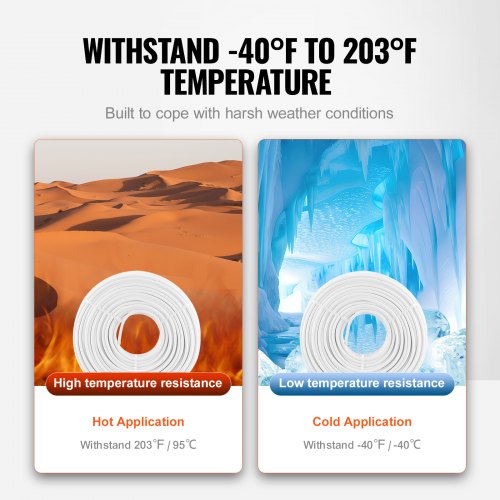
Red EVOH-coated coils in 1/2, 5/8 and 3/4 in sizes stretch from 300 to 1,000 ft and suit sealed boiler and radiant circuits. Unshielded PEX-B for drinking water spans 3/4 to 1 in, sold in white, blue and red for mains and branches. For smaller repipes, PEX-A duo sets bundle one 100 ft red coil with one 100 ft blue coil. Aluminum-core PEX-AL-PEX stays where you bend it, which helps on exposed runs. Labels on most coils cite ASTM F876, F877, F2023 and CSA B137.5, with an 80 psi rating at 200°F. Color is only a marker: red for hot, blue for cold, white for either. DIY owners pick these for bathroom upgrades, while installers buy longer coils for slab heat and well hookups.
Five things decide which one fits:
- Nominal diameter: the bore size that has to line up with your fittings and manifold.
- Coil length: how many feet arrive on a single reel without a splice.
- Oxygen barrier: an EVOH skin that keeps oxygen out of sealed heat circuits.
- Pressure rating: how much psi the wall handles as water gets hotter.
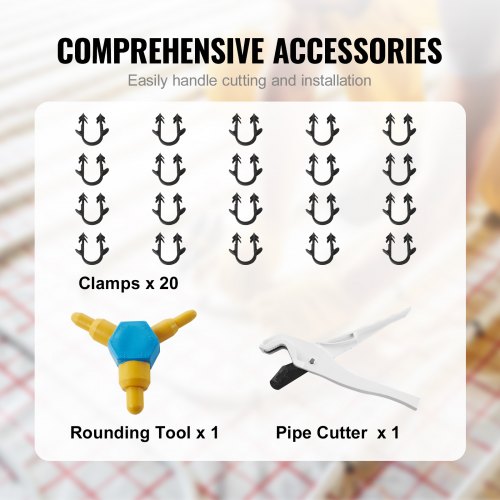
- Included tools: whether a cutter and clamp rings ship inside the box.
Check each pipe coil here against your run lengths, loop type and manifold size before ordering.
Pipe Types at a Glance
Since each pipe family serves its own kind of system, the grid below shows how its wall is built, the linked coil and the system it is built for.
| Type | Wall Build | Linked Coil | Built For |
|---|---|---|---|
| EVOH-shielded PEX | PEX-B with an EVOH outer skin | 1/2 in, 300 ft, red | Radiant floor heating loops |
| Unshielded PEX | Plain PEX-B, no oxygen barrier | 1 in, 500 ft, white | Plumbing and open-loop radiant heat |
| PEX-A duo set | PEX-A, no oxygen barrier | 1/2 in, two 100 ft coils, red and blue | Hot and cold potable water lines |
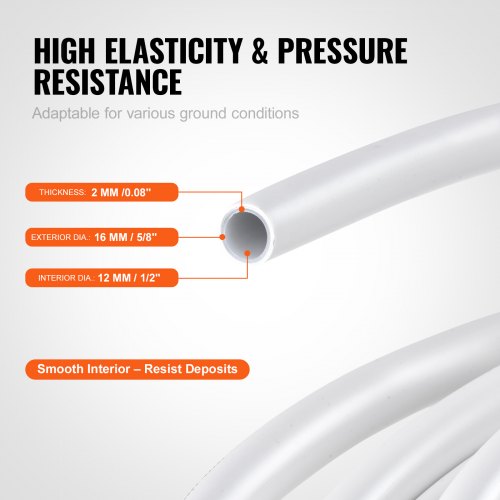
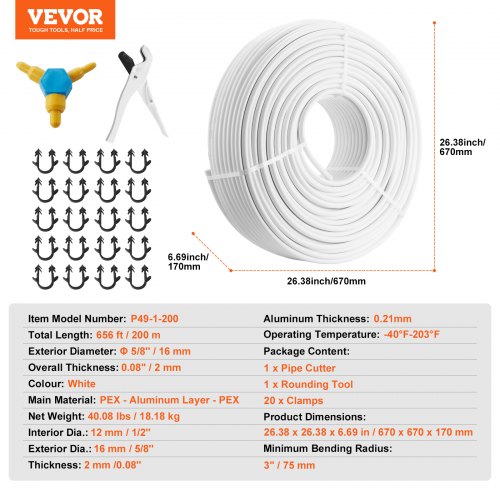
| Aluminum-core PEX | PEX, aluminum and PEX layers, 0.08 in wall | 5/8 in, 984 ft | Radiant floor heat and plumbing |
| 100 ft PEX-B coil | Plain PEX-B, no oxygen barrier | 3/4 in, 100 ft, blue | Potable water branch lines |
VEVOR Pipes for Radiant Heating, Plumbing, and Fluid Transfer Applications
Do you need oxygen-barrier PEX for a closed-loop hydronic floor-heating system, non-barrier PEX for a typical potable water supply line, PEX-AL-PEX tubing with an inner aluminum layer for increased rigidity, or clear braided vinyl tubing for irrigation and aquarium use? Plumbers, do-it-yourselfers, and contractors can choose the appropriate pipe type for each application with VEVOR's wide variety of pipes without going over budget for extra features.
Pipes by Type and Barrier Features
The three types of pipes offered by VEVOR are standard PEX pipes (with and without an oxygen barrier), PEX-AL-PEX composite tubes, and vinyl tubes. These varieties differ not only in material but also in the uses for which each pipe is safe and appropriate.
Non-Barrier PEX Pipes: Flexible Pipe Tubing for Potable Water and Open-Loop Systems
For open-loop radiant floor heating and potable water supply lines, non-barrier PEX pipes are preferred. Since the loops in these systems are either routinely refilled or vented, oxygen intrusion from the pipe wall does not harm system components, and dissolved oxygen in the water is not an issue. PEX-B and PEX-A grades in 1/2-inch, 3/4-inch, 7/8-inch, and 1-inch diameters are offered in 100-foot, 300-foot, and 500-foot coils with red, blue, and white color codes in VEVOR's non-barrier PEX pipe tubing line.
Red denotes hot water lines, blue denotes cold water lines, and white is utilized in situations where color distinction is not necessary. The color coding is a practical installation help rather than a material difference. With a complimentary pipe cutter and clamps included, VEVOR's PEX-B non-barrier pipe coils in 3/4-inch at 500 feet ($163.90 to 61.90) are ready to install without needing to buy extra supplies separately. When replacing separate hot and cold runs at the same time, PEX-A variations in paired red-and-blue sets of 2 x 100 feet ($59.90 for 1/2-inch and $91.90 for 3/4-inch) are ideal for modest home installations and restoration projects.
Oxygen Barrier PEX: EVOH Layer Protection for Closed-Loop Heating Systems
Despite their superficial similarities, oxygen barrier PEX and non-barrier PEX pipes are fundamentally different products. It has an EVOH (ethylene-vinyl alcohol) layer on the exterior of the pipe that significantly slows the rate at which oxygen enters the system's water through the pipe wall. Iron-containing parts, including boilers, manifolds, and cast-iron pumps, corrode internally when oxygen enters a closed-loop hydronic radiant floor heating system, where the same water flows constantly without replenishment. In a closed-loop heating system, using non-barrier pipe causes progressive corrosion damage that, over several heating seasons, can destroy the boiler and pump assembly.
The oxygen barrier pex series from VEVOR includes coils with diameters of 1/2, 3/4, and 5/8 inches, spanning 300 to 1,000 feet. The most economical entry for a single-zone home floor-heating loop is 1/2-inch oxygen-barrier PEX at 300 feet in red (106.90). The 500-foot 3/4-inch barrier coil (152.99) are suitable for larger multi-zone residential or commercial floor-heating applications, where a single large coil minimizes the number of mid-run joints required in the loop.
PEX-AL-PEX Tube: Aluminum-Core Composite for Shape Retention and Oxygen Blocking
The PEX AL PEX tube creates a composite construction that combines the flexibility of PEX with the shape-retention and additional oxygen barrier qualities of aluminum by bonding an inner layer of aluminum between two layers of cross-linked polyethylene. An important installation benefit in exposed or semi-concealed pipework where the pipe must remain formed without clamps at every curve is the aluminum layer's ability to support bends without springing back.
The 5/8-inch diameter, 984-foot roll of VEVOR's PEX-AL-PEX tube ($131.96) has a 0.08-inch wall thickness and an integrated oxygen barrier through the aluminum layer. This feature makes it suitable for applications where a stiffer, shape-holding pipe is preferred over fully flexible PEX, such as radiant floor heating, certain gas piping applications, and standard plumbing where permitted by local code. PEX-AL-PEX can be used directly in closed-loop hydronic systems without an additional EVOH-coated outer layer, as the aluminum layer provides an intrinsic oxygen barrier. Additionally, it is easy to connect to existing manifolds and distribution systems because it is compatible with conventional compression-style PEX-AL-PEX fittings.
Vinyl Tubes: Clear Braided Tubing for Fluid Transfer in Non-Heating Applications
PEX pipe tubing and clear braided vinyl tubing have entirely distinct uses. High-strength PVC with a woven braid reinforcement between the inner and outer layers provides flexibility and pressure resistance, while a completely transparent housing makes flow visible. The clear braided vinyl tubing from VEVOR comes in a 10-foot length, with a 3/4-inch ID x 19/20-inch OD and a 1/10-inch wall thickness, for $18.90.
Aquarium water circulation, garden irrigation, swimming pool plumbing, and general fluid transfer applications that require a lightweight, transparent, non-metallic tube can all benefit from PVC's chemical inertness. It lacks the heat tolerance of PEX pipe and is not suitable for radiant heating loops or hot-water supplies, as it is not cross-linked polyethylene. Its usefulness lies in its transparency and ease of cutting; the tubing can be cut to any length with a utility knife or regular scissors, and its transparent wall allows users to spot airlocks, debris buildup, or discoloration in the fluid stream right away.
Which Pipe Fits Your Job
Pick your project from the left column, confirm the condition, then read across to the coil that matches it.
| Job | Confirm Before Purchase | Matching Specification | Recommended Product | Main Limitation |
|---|---|---|---|---|
| Heating a single room's floor | Sealed loop, total loop length within 300 ft | 1/2 in EVOH coil, 300 ft, 80 psi at 200°F | 300 ft red barrier coil | Ships with only 3 cinch rings |
| Radiant heat across a full floor plan | Sealed loops, total footage within 1,000 ft | 1/2 in EVOH coil, 1,000 ft, cutter and 10 cinch rings | 1,000 ft red barrier coil | Only 10 cinch rings included |
| Manifold with 5/8 in outlets | Manifold outlets sized for 5/8 in tube, sealed loop | 5/8 in EVOH coil, 500 ft, 0.750 in OD | 5/8 in red barrier coil | No wall thickness published |
| Trunk feeding a heat manifold | Manifold trunk sized for 3/4 in tube, sealed loop | 3/4 in EVOH coil, 500 ft, 0.86 in OD | 3/4 in red barrier coil | Ships without cutter and clamps |
| Underground line from the meter | Main sized for 1 in tube, local code for buried service lines | 1 in non-barrier PEX-B, 500 ft, cites ASTM F876 and F877 | 1 in white non-barrier coil | Requires conduit in direct sun |
| Fixing one branch line | Branch run within 100 ft, connectors bought separately | 3/4 in PEX-B, 100 ft, cutter and clamps included | 3/4 in x 100 ft blue PEX-B | Connectors bought on their own |
Pipes by Size and Applications
In any plumbing or heating installation, choosing the appropriate pipe size directly affects flow rate, pressure loss, and the total number of fittings required. The pipe range from VEVOR offers distinct size options that correspond to typical home and business application settings.
Pipe Sizes from 1/2 Inch to 1 Inch: Matching Diameter to Flow Requirements
The four nominal sizes of VEVOR's PEX pipe range are 1/2-inch, 5/8-inch, 3/4-inch, 7/8-inch, and 1-inch. The standard loop size for home radiant floor heating is 1/2-inch PEX tubing, which attaches directly to standard 1/2-inch manifold ports without the need for reducers and provides sufficient flow for typical loop lengths up to 300 feet. For medium-load zones or systems that need a slightly higher flow capacity per loop, the 5/8-inch oxygen barrier PEX pipe at 500 feet ($143.90) bridges the gap between 1/2-inch and 3/4-inch.
The ideal diameter for radiant heating manifold supply lines or main supply and return trunks supplying numerous branch circuits in a residential plumbing system is 3/4-inch pipe. VEVOR's non-barrier coils, available in 300-foot and 500-foot lengths ($162.90 to $245.90) and with a 1-inch diameter, are used for commercial-grade heating distribution and main supply runs where flow volume exceeds what a 3/4-inch can effectively deliver. 1/2-inch non-barrier PEX in 100-foot or 300-foot coils spans the entire route without mid-run joints, making it the preferred choice for most homeowners replacing branch supply lines to individual fixtures.
Coil Length Selection: Matching Footage to Project Scale
Because VEVOR's PEX pipe tubing comes in coil lengths of 100, 300, 500, and 1,000 feet, customers can precisely match the quantity to the project without going over budget. A 100-foot coil is ideal for a small bathroom makeover or a single branch run. In a mid-size space, a 300-foot coil can cover one heating loop or several branch lines. For whole-house plumbing projects or multi-zone heating installations, when reducing the number of joints is important, a 500-foot coil is suitable.
For large-area radiant floor heating projects, the 1,000-foot coil of 1/2-inch oxygen-barrier PEX ($152.99) offers the lowest price per foot in the range. Two 1,000-foot coils cover the entire installation because a 2,000-square-foot heated floor area usually requires between 1,500 and 2,000 feet of 1/2-inch loop pipe. The 10-foot piece of vinyl tubing is ideal for spot applications where a large coil would produce excessive waste, such as running a small irrigation branch or connecting a water pump to an aquarium filter.
Best-Seller Comparison
Here the five top sellers sit side by side on nominal diameter, coil length, oxygen barrier, pressure rating and included tools.
| Product | Nominal Diameter | Coil Length | Oxygen Barrier | Pressure Rating | Included Tools |
|---|---|---|---|---|---|
| VEVOR 1/2 in x 1000 ft PEX Tubing, Oxygen Barrier, Red | 1/2 in nominal, 5/8 in OD | 1,000 ft, longest of the five | Yes, EVOH skin | 160 psi at 73°F, 80 psi at 200°F | Cutter plus 10 cinch rings |
| VEVOR 5/8 in x 500 ft PEX-B Tubing, Oxygen Barrier, Red | 5/8 in nominal, 0.750 in OD | 500 ft | Yes, EVOH skin | 188 to 217 psi at 68°F, 101 to 108 psi at 203°F | Cutter plus 10 clamps |
| VEVOR 1 in x 500 ft PEX-B Pipe, Non Barrier, White | 1 in nominal, largest of the five | 500 ft | No, made for drinking water | 160 psi at 73°F, 80 psi at 200°F | Cutter plus 5 cinch rings |
| VEVOR 1/2 in x 300 ft PEX-B Tube, Oxygen Barrier, Red | 1/2 in nominal, 5/8 in OD | 300 ft, shortest of the five | Yes, EVOH skin | 160 psi at 73°F, 80 psi at 200°F | Cutter plus 3 cinch rings |
| VEVOR 3/4 in x 500 ft PEX-B Tubing, Oxygen Barrier, Red | 3/4 in nominal, 0.86 in OD | 500 ft | Yes, EVOH skin | 188 to 217 psi at 65°F, 101 to 108 psi at 203°F | Coil alone, no tools |
Shop VEVOR Pipes for Every Plumbing and Heating Application
Homeowners, plumbers, and contractors can choose from a wide variety of flexible PEX pipe, oxygen-barrier PEX for hydronic floor heating, PEX-AL-PEX composite tube, and clear braided vinyl tubes from VEVOR's pipe range at competitive prices, in sizes and coil lengths that meet actual project requirements. Purchasing the ideal pipe from VEVOR is easy and affordable, thanks to their dependable after-sales service for all products. View the entire selection of pipes and place your purchase right now.
Frequently Asked Questions
What is the difference between oxygen barrier PEX and non-barrier PEX pipe?
An EVOH layer in the oxygen barrier PEX prevents oxygen from entering the system water through the pipe wall. In closed-loop hydronic heating systems, it is necessary to stop metal components from corroding internally. When oxygen intrusion is not an issue, non-barrier PEX is appropriate for open-loop heating and potable water.
Can VEVOR PEX pipe be used for both hot and cold water supply lines?
Indeed, both potable water supply applications, hot and cold, can use VEVOR's PEX-B and PEX-A pipes. Although the material is the same in both hues, red pipes are often utilized for hot lines and blue pipes for cold lines. When color coding is not necessary, white PEX is utilized.
What advantage does the PEX-AL-PEX tube offer over standard PEX pipe?
Because of the inner aluminum layer, which prevents spring-back, PEX-AL-PEX tubing maintains its shape after bending. It is also appropriate for closed-loop heating systems without an additional EVOH coating, as the aluminum layer provides an intrinsic oxygen barrier. It works well in semi-exposed installations where shape retention is important, as it is stiffer than standard PEX.
Is VEVOR clear braided vinyl tubing suitable for drinking water?
Made from high-strength PVC, VEVOR's clear braided vinyl tubing is ideal for general fluid transfer applications, aquariums, irrigation systems, and swimming pools. Before installation, confirm the product's food-grade certification for usage with potable water. It is not intended for radiant heating loops or hot water.
What coil length should I choose for a radiant floor heating project?
A 300-foot coil is usually adequate for a single heating zone covering about 150 to 200 square feet, using 1/2-inch pipe on 12-inch centers. A 500- or 1,000-foot coil reduces the number of mid-loop joints and the cost per foot compared to buying several shorter coils for multi-zone systems or larger floor spaces.
How do I choose the right length of PEX pipe for my plumbing project?
Walk each route from the water source to the fixture, total the footage, then add roughly 10% for curves and trimming so one reel finishes the job without splices. A 300 ft barrier coil handles a single heating zone of about 150 to 200 sq ft.
Can I connect 3/4 PEX pipe to other pipe sizes easily?
Yes. PEX reducing couplings and reducing tees step 3/4 in down to 1/2 in, and transition adapters join copper and threaded lines. Crimp, cinch, press and compression connectors all work. The 3/4 in EVOH coil accepts each of those four methods.
What are the common uses for 100 feet of 3/4 PEX pipe?
Typical jobs for 100 ft include a trunk branch to a kitchen and bath, water heater hookups, a short feed to a detached garage and manifold supply legs. The 100 ft blue PEX-B reel ships with a cutter and clamps.
How do I choose the right water line pipe for my irrigation system?
Size the line for your gallons per minute, choose tubing that survives burial and frost, and shield anything above grade from UV. The 1 in white PEX-B line can lie in a smooth trench and should sit inside conduit wherever it surfaces.
What are the main advantages of using white PEX pipes in plumbing?
White PEX uses the same resin as red and blue, so one coil handles hot and cold runs and looks tidy where pipes stay visible. The 500 ft white PEX-B coil in 1 in size arrives with a cutter.
How does copper compare to PVC and PEX in water safety?
Copper and PEX are both used for hot and cold drinking water, but standard PVC is rated for cold lines only. Whatever material you pick, confirm a drinking water certification first. The 1 in non-barrier PEX-B cites ASTM F876 and F877.