

Platform Carts


















Results for Platform Carts
A platform cart is a flat steel deck on four to six wheels with a push handle, built to roll heavy boxes and equipment by hand. It comes with the deck, casters, a handle and, on some models, side rails, a cage and a second tier. You load the deck, release the brakes and push it like a trolley. It moves cartons, appliances, building materials, groceries, tools and luggage across rooms and yards. Unlike a two-wheel hand truck it keeps the load flat, and unlike a pallet jack it needs no pallet.
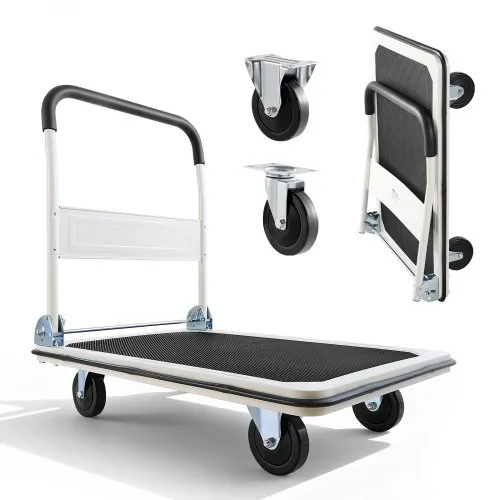
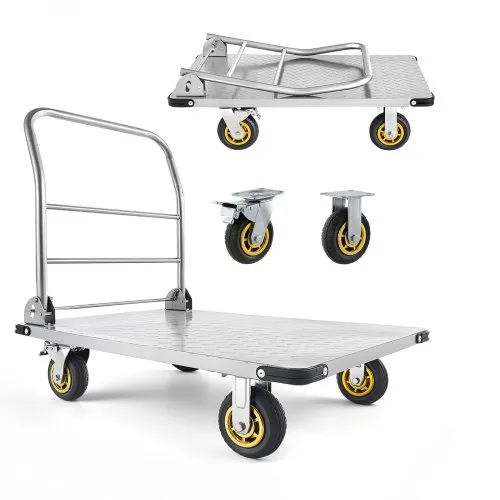
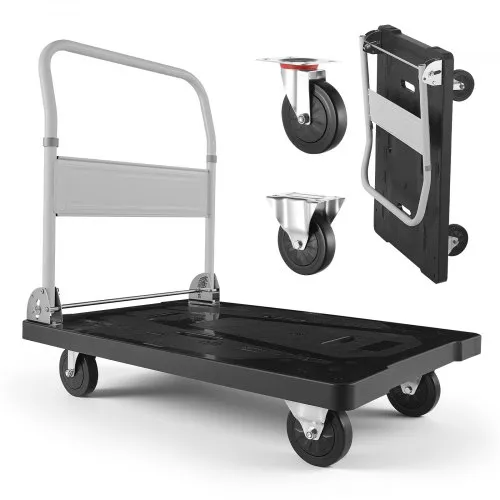
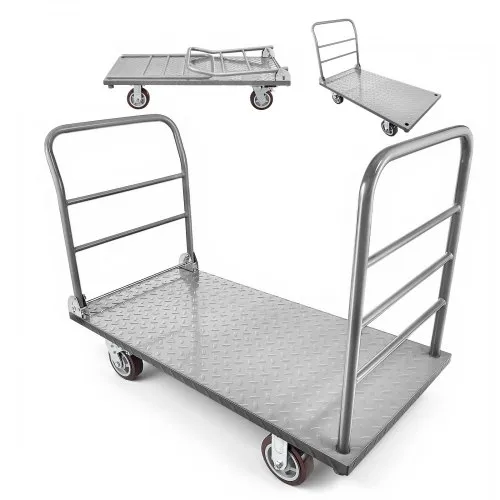
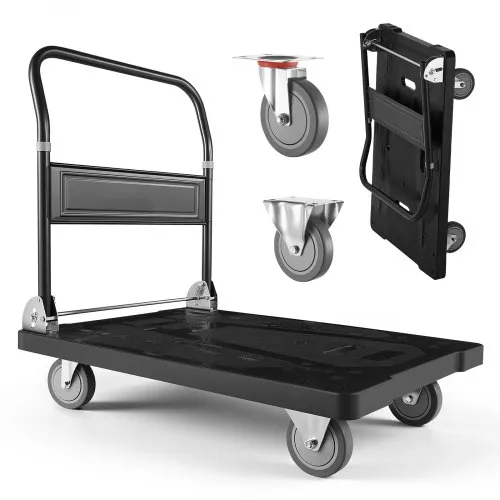
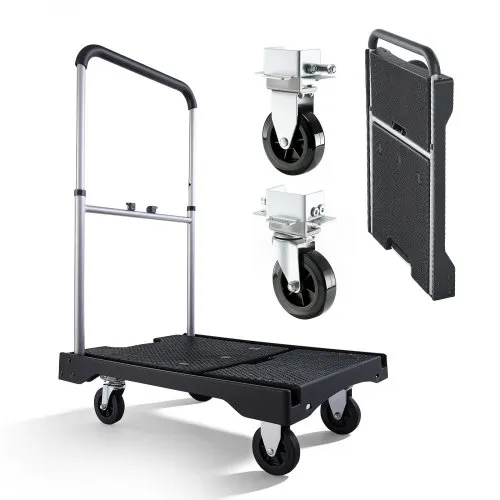
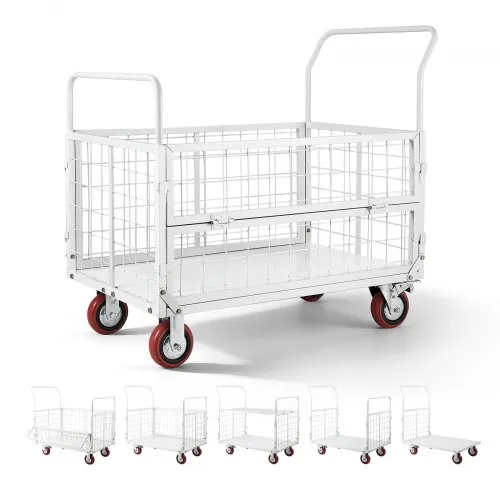
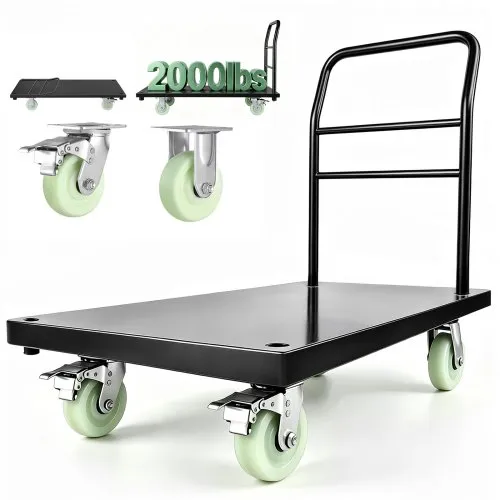
Steel flatbed trucks carry 2,000 lb on 48 and 60 in decks with detachable handles. U-boat dollies stand panels, doors and long stock on a narrow 16 in deck over six wheels. Cage carts switch between flatbed, shelf, three-sided and cage layouts. Folding push carts run from 330 to 1,000 lb and collapse flat for a closet and car trunk, and a two-tier folding cart adds a lower shelf. A guardrail flatbed reaches 2,650 lb. Most heavy models pair two braked swivel casters with two fixed wheels. Warehouse staff, movers, contractors, shop owners and households use them for daily hauling.
Six things decide which one fits:
- Load rating: the most weight the deck carries when spread evenly.
- Deck area: how much floor space the load gets, in square feet.
- Wheel type: what the wheels are made of and how tall they stand.
- Steering layout: which wheels swivel, which hold a line and which brake.
- Handle design: how you grip and push, and whether the handle comes off.
- Storage fold: how compact the cart gets when the work is done.
Browse every platform cart on this page, then explore all platform trucks and dollies for more ways to move heavy loads.
Platform Cart Types at a Glance
Each cart style is built differently, so the table below compares deck layout, wheel setup and storage before you order.
| Type | Deck Layout | Wheel Setup | Storage |
|---|---|---|---|
| Steel flatbed truck | Open 48 x 24 in steel deck, 2,000 lb rating | 5 in nylon, 2 braked swivels, 2 fixed | Deck does not fold, handle lifts off |
| U-boat dolly | Narrow 60 x 16.1 in deck with tall end handles, 2,000 lb rating | Two 8 in PU center wheels, four 3.9 in PU swivels | Dual detachable handles |
| 6-in-1 cage cart | Flatbed with removable wire sides for six layouts, 2,000 lb rating | 5.9 in puncture-free PU, 2 braked swivels, 2 fixed | Cage folds and detaches |
| Folding push cart | Light 35.2 x 23.4 in folding deck, 1,000 lb rating | Swivel wheels | Push handle folds down for storage |
| Guardrail flatbed | 48 x 24 in flatbed with detachable guardrails, 2,650 lb rating | Swivel wheels | Folds, guardrails detach |
VEVOR Professional Platform Carts with Superior Load Capacity and Durable Construction
Are you sick of traveling frequently or fumbling with odd burdens that put stress on your back? Platform carts make material handling more efficient and injury-free by eliminating the need for multiple trips. VEVOR manufactures these carts for companies and individuals who frequently move heavy objects and need equipment that can withstand repeated use. Our lineup covers everything from minor retail stocking to serious industrial hauling.
Weight Capacity and Platform Size Selection
Knowing how load capacity and platform dimensions align with your real transport requirements is the first step in selecting the best platform carts. These standards determine whether you can move safely and whether objects fit without overhanging or stacking issues. Achieving both will result in carts that are effective for your particular uses.
Understanding Weight Capacity Ratings
The maximum safe load that a cart can support while being transported is indicated by its weight capacity. Manufacturers put these ratings through supervised testing. Overshooting them puts operators in danger and destroys carts. Light-duty platform carts can handle 200–400 pounds. These are useful for household chores, transporting office supplies, and retail settings. This category includes packaged products, small appliances, and merchandise boxes.
Medium-duty carts can support 400–800 pounds. This category includes the majority of commercial applications. This type of platform hand truck cart efficiently handles bundled supplies, small machinery, and several boxes stacked together. Serious industrial loads are handled by a heavy duty platform cart rated for 1000 to 2000 pounds. Construction sites, manufacturing plants, and warehouse operations require this capability. Heavy-duty ratings are necessary for palletized products, equipment cases, and engine blocks.
Extreme applications are served by heavy duty platform trucks weighing more than 2000 pounds. Maximum capacity is required when moving industrial equipment, loaded pallets, and safes. For the loads they are designed to carry, these carts have specially designed wheels and strengthened frames. Platform carts rated higher than your maximum anticipated load should always be chosen. Safety margins prevent uneven weight distribution, impact loads during movement, and sporadic overloading. A cart that consistently operates close to its maximum wears out and breaks down sooner than one that runs comfortably within its capacity.
Platform Dimension Requirements
The platform size determines what physically fits on the cart and how the weight distributes during transportation. The loads overhang dangerously because the structure is too small. If the cart is too big, it becomes cumbersome in confined areas. 24 by 36 inches are the typical dimensions of platform carts. This size supports most typical loads, including boxes, small machinery, and bundled items. These dimensions are easily accommodated in warehouse doors and aisles.
Bigger products and heavier weights are carried by larger platforms that measure 30 by 48 inches or 36 by 60 inches. When transporting heavy loads, a platform dolly cart with larger dimensions reduces the number of trips. Decreased mobility in cramped areas is the trade-off. Platforms that are smaller than 24 inches can operate in confined spaces. Smaller footprints are advantageous in narrow aisles, on elevator conveyance, and in retail backrooms. A smaller platform enhances navigation while limiting load volume.
When choosing platform carts, consider your usual load dimensions. No overhang should grab doorframes or shelves; everything should fit completely on the platform. Additionally, when loads change during movement, overhang can pose a tipping risk.
Matching Capacity to Load Types
When choosing platform carts, particular considerations must be made for various materials. Weight alone does not fully convey the story. Shape, density, and fragility all influence the need for safe transportation. Dense materials concentrate weight in small regions, such as machinery, concrete products, and metal stock. To prevent bowing under point loads, platform carts with these loads require a strengthened deck design. Force is distributed over a greater area when weight is distributed.
Tall loads increase the risk of tipping since they boost the center of gravity. When being transported, a platform truck cart with a cage provides retention to prevent it from toppling. Tall stacks need to be loaded carefully and moved more slowly if there are no rails or cages. Platforms that mitigate shock during rolling are necessary for fragile products. Every bump is transmitted straight to the cargo on hard steel decks. Delicate items are protected from damage during transit with rubber matting or padded deck surfaces.
Loads with irregular shapes are difficult to handle. Platform carts with tie-down points are useful for pipes, drums, and strange equipment. By securing goods, carts can avoid shifting that throws them off balance when turning and stopping.
Load Distribution and Balance
Safety and handling are affected by the weight distribution across the platform. Improper loading raises the danger of accidents and makes carts difficult to manage. For the easiest pushing and pulling, evenly distribute the load across the wheels. Leverage created by weight can work against the operator when the weight is positioned too far forward or backward. Balanced loading maximizes the rolling efficiency of platform carts.
Distribute several items across the entire platform. When weight is concentrated in one region, it stresses that area while underutilizing others. Balance is maintained while capacity is maximized through even distribution. When stacking, place heavy items at the bottom. Even when the heaviest objects are placed on the bottom, a heavy duty platform cart stays steady. Top-heavy cargo is prone to tipping while turning or hitting uneven flooring.
If at all feasible, leave clear sightlines. Tall stacks that obstruct forward visibility increase the likelihood of collisions. Operators must be able to view crossings, pedestrians, and obstacles. Use spotters for blind loads or position loads to preserve visibility.
Which Platform Cart Fits Your Job
With the cart styles covered, match your load and floor against the conditions below to choose one cart.
| Job | Confirm Before Purchase | Matching Specification | Recommended Product | Main Limitation |
|---|---|---|---|---|
| Moving-day boxes and furniture | Your doorways and elevator clear a 24 in wide deck | 48 x 24 in deck, 2,000 lb rating, 2 braked swivels | 48 x 24 in steel flatbed | Deck does not fold, only the handle detaches |
| Bulk cartons in a warehouse | Your aisles fit a 27.6 in wide cart on smooth floors | 60 x 27.6 in deck, 2,000 lb rating, 5 in nylon wheels | 60 x 27.6 in steel flatbed | Deck does not fold, only the handle lifts off |
| Groceries, laundry and loose items | Your loose items fit inside the cage walls | Six layouts, 5.9 in puncture-free PU wheels, 2,000 lb rating | 6-in-1 cage cart | Deck size not specified on the product page |
| Doors, drywall and long lumber | Your panels and doors can stand upright on a 16 in wide deck | 60 x 16.1 in footprint, two 8 in PU center wheels, dual detachable handles | Six-wheel U-boat dolly | Brakes not specified on the product page |
| Garage storage and occasional moves | You need the deck to fold down between jobs | 35.4 x 23.6 in deck, platform folds down, 5.7 in solid rubber wheels | 35.4 x 23.6 in folding flatbed | Folded size not specified on the product page |
Wheel Selection and Feature Options
The performance of platform carts in everyday use is determined by features and wheels, as well as capacity and size. Wheel type affects durability, floor protection, and ease of rolling. Features such as handles, rails, and folding capabilities add functionality in certain applications.
Wheel Type and Material Selection
Platform cart performance is mostly dependent on its wheels. Even little loads are difficult to move on bad wheels. High-quality wheels require little effort to roll smoothly under big loads. Rubber wheels protect floors and operate quietly. Smooth surfaces, such as those found in offices, retail stores, and medical facilities, are ideal for these. The rubber absorbs shocks that would harm cargo on hard wheels.
Polyurethane wheels offer both smooth rolling and durability. Polyurethane wheels on a platform hand truck cart are more resilient than rubber on rough terrain, outside pavement, and warehouse floors. Place big loads on these wheels to avoid flat patches. Pneumatic wheels are perfect for challenging outdoor terrain. Air-filled tires are necessary for uneven terrain, gravel yards, and construction sites. Pneumatic wheels on a heavy-duty platform truck allow it to roll over barriers that solid wheels cannot.
Although steel wheels can support heavy loads, they can cause noise and damage floors. Steel wheels are acceptable in industrial settings where the flooring is strengthened. Softer wheel materials are required for completed floors in homes and businesses.
Swivel and Fixed Wheel Configuration
Straight-line tracking and maneuverability are determined by wheel arrangement. Various configurations are appropriate for different settings and operator tastes. Four swivel casters provide maximum maneuverability. Platform carts can easily maneuver through confined places and spin into position. Reduced straight-line tracking necessitates frequent steering adjustments as a trade-off.
Two swivel front casters and two fixed rear wheels balance stability and maneuverability. When pushed from behind, a platform dolly cart in this design turns curves efficiently and tracks straight. To change direction, four fixed wheels must be lifted, but the vehicle continues to track straight. These are effective for long, straight runs with little turning. Fixed-wheel designs are frequently used on production lines and loading docks.
When loads are briefly at rest, locking casters stop them from rolling. Lock it for loading and unloading; unlock it for transportation. For safety, most commercial platform carts have locking mechanisms on at least two wheels.
Handle and Rail Options
Handles affect control and comfort when pushing during transportation. Rail alternatives offer more grasp points and contain loads. One or both ends have fixed handles. Although they offer reliable grasp positions, these permanently lengthen the cart's size. With the stability of a platform, a platform hand truck cart with a fixed handle functions similarly to a conventional hand truck.
When not in use, folding handles fold flat. Keeping the handles down greatly aids storage. In storage spaces, nesting several platform carts conserves floor space. To contain loads, push rails along the edges of the platform serve as handles. A platform truck cart provides a complete enclosure with a cage, which prevents objects from falling off during rough handling.
Configurations can be changed according to load needs thanks to detachable rails. For tall stacked loads, add rails. For large objects protruding past the platform's margins, remove them.
Folding and Storage Features
In locations with limited space, storage efficiency is important. When not in use, platform carts that fold or nest minimize their environmental impact. Platform carts that can be folded down to a small fraction of their original size. Sometimes platforms, handles, and wheels fold flat. It becomes convenient to store several units in truck beds or closets.
Nesting designs can be stacked horizontally or vertically. Z-frame architecture is a common feature of heavy-duty platform vehicles, enabling carts to nest together. Three non-nesting units have ten carts on their floor. Quick-assembly designs disassemble without tools, making them portable. Carts that fit in vehicle cargo bays are useful for field personnel and delivery operations.
Think about how frequently you use platform carts versus how often you store. Folding capability is rarely required for permanent warehouse installations. Compact storage is very important to service businesses that move carts between locations.
Best-Seller Comparison
Before ordering a cart, set the five best sellers side by side on deck area, wheel type, steering layout, handle design and storage fold.
| Product | Deck Area | Wheel Type | Steering Layout | Handle Design | Storage Fold |
|---|---|---|---|---|---|
| VEVOR 48 x 24 in Steel Flatbed Platform Truck | About 8 sq ft (calculated) | 5 in nylon | 2 braked swivels, 2 fixed | One detachable round bar | Does not fold, handle lifts off |
| VEVOR 60 x 27.6 in Steel Flatbed Platform Truck | About 11.5 sq ft, the largest here (calculated) | 5 in nylon | 2 braked swivels, 2 fixed | One detachable round bar | Does not fold, handle lifts off |
| VEVOR 6-in-1 Cage Platform Cart | About 6.6 sq ft inside the cage (calculated) | 5.9 in puncture-free PU, the largest four-wheel set here | 2 braked swivels, 2 fixed | Not specified on the product page | Cage folds and detaches |
| VEVOR Six-Wheel U-Boat Platform Dolly | About 6.7 sq ft on a 16 in wide deck (calculated) | Two 8 in PU center wheels, four 3.9 in PU swivels | Fixed center pair, swivels at each end, brakes not specified | Two end handles | Not specified on the product page |
| VEVOR 35.4 x 23.6 in Folding Steel Flatbed | About 5.8 sq ft, the smallest here (calculated) | 5.7 in solid rubber, puncture-free | 2 braked swivels, 2 fixed | Single push handle | Platform folds down |
Why Choose VEVOR Platform Carts?
VEVOR provides material handling solutions that blend useful jobsite features with significant capacity. For companies and individuals who transfer heavy loads daily, our platform carts offer dependable transportation, smooth rolling, and sturdy construction. Each cart satisfies weight requirements and can withstand rigorous commercial use. The selection meets all of your material handling needs, from small platform dolly cart solutions for confined locations to heavy duty platform cart models for industrial transport. VEVOR gains credibility via honest equipment performance, reasonable pricing, and prompt customer service. Look through our entire inventory now to move your materials effectively.
Frequently Asked Questions
What weight capacity do I need for warehouse use?
The majority of warehouse applications call for a capacity of 800–1500 pounds. During ordinary operations, a heavy duty platform cart in this range may handle several boxes, machinery, and bundled products without reaching its limits.
Do platform carts work on carpet?
On carpet, larger wheels roll more easily than smaller casters. Platform carts easily handle low-pile commercial carpet with wheels 4 inches or larger in diameter. A thick home carpet may still create resistance.
How do I prevent loads from shifting during transport?
For tall stacks, use a platform truck cart with a cage or rails. For unusual goods, add tie-down straps. Heavy things should be loaded at the bottom first. Before transporting, secure any loose things.
Can platform carts handle outdoor use?
Outside, pneumatic wheels perform well on grass, gravel, and uneven surfaces. Larger-wheeled, heavy-duty platform vehicles are more adept at navigating outdoor terrain than indoor carts with smaller wheels.
What maintenance do platform carts require?
Periodically inspect the wheel bearings and oil them if squeaking starts. Check for damage or flat areas on the casters. Secure loose fasteners on platforms and handles. Before worn wheels break under load, replace them.
How do I choose the right heavy-duty platform truck for my warehouse?
Size the deck to your largest cartons, keep the rating well above your heaviest load and check aisle and doorway widths. Pick braked swivel casters for safe loading on concrete. The 60 in steel flatbed truck carries 2,000 lb.
How do I choose the right size of folding platform truck?
Measure your biggest regular load, then the trunk, closet and shelf where the cart will live. Choose the smallest deck that holds the load without overhang. The 35.4 x 23.6 in folding flatbed still carries 2,000 lb.
