Raceways




Results for Raceways
Raceways in this category are channelled housings that carry cables and hoses over a floor or road surface so they stay intact and nobody trips. The range includes rubber cable protector ramps from 1 to 5 channels, speed bumps with built-in channels, TPU flip-top ramps and drop-over covers. Each cable sits in its own channel under a lid, and traffic rolls across the sloped top. Buyers use them across aisles, stages, loading bays and driveways. Compared with clip-on wall raceways, they take wheel loads, and compared with taping cords down, they keep cables uncrushed.
Load ratings set the first split. Single-channel floor ramps take 22,046 lbs in a 1.2 in tall profile, so a hose or EV cable can cross a home driveway. Two-channel rubber ramps rated at 22,000 lbs per axle keep a power lead apart from a data line. Linking 2-channel kits join 5 ramps for a 200 in run, while a 3-ramp kit covers 120 in at a doorway. For stage and site power, 5-channel guards take cables up to 1.6 x 1.4 in, and the hinged-lid ADA model keeps walkways accessible. Where cars need slowing, 40 in speed bumps and 6 ft modular humps carry 2 channels under the hump. TPU flip-top ramps open from above for quick indoor set-up. Common sites are warehouses, festivals and parking lots. Pair them with other items in cable management.
Five things decide which one fits:
- Channel layout: how many separate channels split the cables.
- Cable fit: the widest and tallest cable each channel accepts.
- Traffic rating: the axle load the housing survives.
- Run coverage: how far one pack reaches when linked end to end.
- Cover access: how the lid opens to lay cables in.
Browse all raceways to match the channel count and load rating to your crossing.
Raceway Formats at a Glance
The table below sorts the raceways on this page by format, with each one's channel setup, rated load and the crossing it is built for.
| Raceway Format | Channel Setup | Rated Load | Typical Crossing |
|---|---|---|---|
| Drop-over cable cover | 2 channels of 2.01 x 1.10 in, set down over cables already laid | 17,500 lbs per axle | Indoor walkways where cables are already in place |
| Wide-channel flip-top ramp | 1 channel of 2.76 x 1.97 in under a flip-open top | 22,000 lbs per axle | One thick hose crossing a loading yard |
| Three-channel guard | 3 channels of 2.8 x 2.4 in under a snap-open PVC cover | 6,600 lbs, as listed | Workshop floors with three heavy lines |
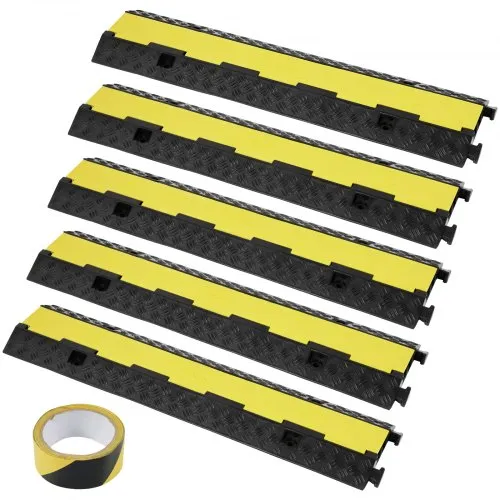
| Interlocking guard with caution tape | 1.18 x 1.18 in channels in 5 pieces that lock end to end | 12,000 lbs per axle | Event walkways that need a long, marked run |
| 72 in speed hump | 2 channels of 1.18 x 0.79 in under a hump with reflective strips | 22,000 lbs per axle | Driveways and lots where cars must slow down |
VEVOR Raceways Designed for Safe, Organized Cable Routing Across Every Floor and Wall Surface
Do you have cables that trail along walls, cross hallways, or create visual clutter and trip hazards in your home, workplace, or event setup? The proper raceway keeps your surroundings safe and presentable, removes trip hazards, and contains and safeguards every cable run. From home offices and retail spaces to warehouses and outdoor event sites, VEVOR offers a wide range of cable management raceways for floor-, wall-, and surface-mounted installations.
Raceway Type and Installation Location to Help You Choose the Right Raceways
The format, material, and mounting technique that best meet your specific cable management requirements depend on the raceway's installation location. Compared to general-purpose cable management options, raceway forms specifically intended for floor and wall installations better meet the unique needs of each.
Floor Cable Raceways for Safe Cable Routing Across Walkways
Floor cable raceways are made to sit flat on floor surfaces and form a safe passageway for cables under a rigid or semi-rigid cover. This way, foot traffic can cross the cable run without coming into contact with it, being compressed, or risking tripping. A floor cable raceway is the primary safety and organization solution in any setting where power, data, or AV cables must cross an open floor. This feature minimizes the risks and cable damage that exposed floor cable runs cause under frequent foot and equipment traffic.
Depending on the model chosen, VEVOR floor cable raceways are available in single- or multi-channel versions that can accommodate 1 to 6 or more cables in a single housing. Wheeled equipment, such as office chairs, trolleys, and light vehicles, can roll over the raceway without touching the edges or causing a surface discontinuity that could lead to tripping, thanks to low-profile designs with beveled entry ramps at both ends. In situations involving temporary installation, non-slip base surfaces on VEVOR floor raceway models prevent lateral sliding on smooth, hard floor surfaces under foot traffic, preserving the raceway's position and alignment throughout high-traffic areas without the need for mechanical or adhesive anchoring.
Wall Cable Raceways for Permanent Surface-Mounted Cable Organization
To provide a flush-mounted cable channel that runs cables around the wall perimeter from outlet to device without the exposed loop and drape of unmanaged wall cables, wall cable raceways mount directly to wall surfaces using screws, adhesive backing, or a combination of both. Wall-mounted raceways turn a mess of exposed cables into a neat, well-organized linear run that matches the wall profile and has a polished appearance in home offices, conference rooms, retail displays, and commercial AV systems.
VEVOR wall cable raceways can be color-matched to the wall surface after installation, creating an almost undetectable effect. They are made of paintable PVC and a rigid polymer composition that accepts common interior paint finishes. For installations where cable configurations change as devices are added or moved, snap-on cover designs offer continuous flexibility by allowing cables to be added, removed, or rerouted at any time without removing the mounting base from the wall. The VEVOR wall raceway range's connector pieces, such as internal and external corners, flat elbows, and T-junction adapters, enable the cable channel to branch to several device locations from a single main cable run, follow wall transitions, and change direction at room corners without the need for custom cutting or fabrication at each direction change.
Cable Protector Ramps for Heavy Traffic and Vehicle-Rated Cable Protection
In situations where traffic crossing the cable run includes not only pedestrians but also wheeled vehicles, forklifts, heavy trolleys, and industrial equipment whose wheel loads could crush or damage cables protected only by lightweight floor raceways intended for foot traffic, cable protector ramps address these cable management needs. Cable protector ramps offer vehicle-rated cable protection in warehouses, loading docks, workshops, outdoor event sites, and parking spaces, ensuring that power and data infrastructure remains intact across the full range of traffic conditions found in operational commercial and industrial applications.
To enable buyers to adapt the ramp specification to the heaviest vehicle or equipment that will cross the installation, VEVOR cable protector ramps use high-density polyethylene or reinforced rubber construction, with load ratings stated per axle. Multiple power cables, extension leads, and data cables can all fit inside a single ramp body thanks to deep internal cable channels that prevent compression or pinching under load. The VEVOR cable protector ramp models' high-visibility yellow and black coloring makes the installation noticeable to forklift operators, car drivers, and pedestrians, reducing the risk of an unintentional collision or of intentionally driving around the ramp onto unprotected cable sections next to the protected crossing point.
Drop Over Cable Covers and Rubber Cable Guards for Flexible Deployment
Because they do not require tools, adhesive, or fasteners to install, drop-over cable covers are one of the most straightforward and fastest‑deployable raceway styles. The cover protects the cable from compression from foot traffic. It prominently marks its location to prevent tripping by simply dropping over the cable run and maintaining its position with its own weight and profile form. Event setups, trade fair booths, film and photography sets, and any other situation where cables require protection for a predetermined period before installation is removed and the area is returned to normal are all suitable applications for VEVOR drop‑over cable covers.
In situations where rigid housing is impractical due to surface irregularities, temperature changes, or the need for a conforming fit around curved surfaces, rubber cable guards offer a flexible, long-lasting alternative to rigid plastic raceways. VEVOR rubber cable guards are made of high-density vulcanized rubber, which is resistant to UV light, chemicals, oil, and temperature extremes that would eventually cause inferior plastic substitutes to break or distort. Rubber's inherent flexibility also allows cable guards to follow small imperfections in the floor's surface without leaving gaps between the guard base and the floor that could allow liquids to enter and contact the cables from the sides, or cause cables to exit the protected channel.
Matching a Raceway to the Crossing
Use the table below to match the largest cable and the vehicles at each crossing to one raceway, and see its main limitation.
| Crossing | Largest Cable | Vehicles Crossing | Recommended Raceway | Main Limitation |
|---|---|---|---|---|
| Office hallway with cords already on the floor | Up to 2.01 x 1.10 in | Foot traffic and office carts | Drop-over cover 3-pack | Marketed mainly for indoor floors |
| Loading yard with one thick hose | Up to 2.76 x 1.97 in | Trucks up to 22,000 lbs per axle | Single wide-channel ramp | One channel, so a second line needs another ramp |
| Workshop with three machine feeds | Up to 2.8 x 2.4 in each | Carts and pallet jacks under 6,600 lbs | 3-channel 2.8 x 2.4 in guard | Listed at 6,600 lbs, too low for trucks |
| Outdoor event walkway that needs marking | Up to 1.18 x 1.18 in | Service carts up to 12,000 lbs per axle | 5-piece guard with 50 ft caution tape | 71.65 lbs for the set, heavy to carry in one trip |
| Driveway entrance where cars must slow | Up to 1.18 x 0.79 in | Cars up to 22,000 lbs per axle | 72 in speed hump 2-pack | Small channels suit thin cables, not garden hoses |
Cable Capacity and Protection Features That Define the Best Raceways for Your Installation
Choosing raceways based on internal cable capacity and specific safety features ensures the system manages your actual cable inventory safely and provides the level of environmental and physical protection your installation environment requires.
Single Channel and Multi-Channel Cable Management Raceways for Different Cable Volumes
A cable management raceway's internal channel layout dictates how many individual cables it can hold and how effectively it keeps various cable types apart inside the housing. Single-channel raceways are appropriate for installations where power and data lines do not need to be separated, and a few wires travel the same path. Multi-channel raceways reduce electromagnetic interference caused by unshielded power cables in nearby low-voltage signal lines when routed in proximity within a shared enclosure, by physically separating the internal housing into two or more compartments.
Channel widths for VEVOR cable management raceways range from 16 mm for light data cable runs to 60 mm and higher for multi-cable AV systems and commercial power distribution. Within a single housing profile, raceway depth dimensions support cable sizes ranging from small USB and HDMI cables to hefty 13 amp power leads and multi-core data trunks. A practical consideration in any installation where the number of connected devices is likely to increase over the installation's service life is choosing a raceway with slightly more internal capacity than your current cable count. This feature allows you to add cables later without having to replace the raceway.
Physical Protection and Environmental Resistance Features in VEVOR Raceways
The material strength of the housing, the safety of the cover retention mechanism, and the integrity of the base-to-cover seal against environmental contaminants such as dust, moisture, and chemical splashes present in workshop and industrial settings all affect how well a raceway provides physical protection. VEVOR raceways use impact-resistant polymers and reinforced rubber, with cover locking mechanisms that prevent unintentional opening from incidental contact while still allowing tool-free operation for deliberate cable access.
All VEVOR cable management raceway products use flame‑retardant material grades that satisfy applicable electrical installation standards that call for cable containment systems in commercial and industrial settings to prevent ignition and restrict the spread of flames in the event of a cable malfunction or overheating incident inside the raceway housing. In exterior cable runs along building facades, across outdoor event areas, and in uncovered industrial yard installations, UV-stabilized exterior finishes on outdoor-rated VEVOR raceway models prevent surface chalking, brittleness, and color fading that unprotected polymers develop under extended sunlight exposure, whereas interior-rated raceways would deteriorate quickly under the same conditions.
Best-Seller Comparison
Compare the five best-selling raceways below by channel layout, cable fit, traffic rating, run coverage and cover access.
| Product | Channel Layout | Cable Fit | Traffic Rating | Run Coverage | Cover Access |
|---|---|---|---|---|---|
| VEVOR Rubber Cable Guard, 5-Channel, 22,000 lbs, Hinged Lid, 1 Pack | 5 separate channels to keep power and data apart | Cables up to 1.3 in wide and 1.2 in high | 22,000 lbs per axle, for trucks and forklifts | 45.08 in long and 31.5 in wide, the widest single guard here | Hinged lid that lifts to add cables, ADA compliant |
| VEVOR 5 Channel Cable Protector Ramp, 18,000 lbs, 1 Pack | 5 channels in a 20 in wide body | Cables up to 1.6 x 1.4 in, the thickest fit here | 18,000 lbs for service vehicles and carts | 35 in per ramp, joins more units end to end | Flip-open cover |
| VEVOR Cable Protector Ramp, 2 Channels, 11,000 lbs, 5 Pack | 2 channels per ramp | Cables up to 1.3 x 1.2 in | 11,000 lbs for cars and light trucks | 200 in from 5 linked 40 in ramps, the longest run here | PVC top over a rubber base, male and slot ends |
| VEVOR 1-Channel Rubber Cable Protector Ramp, 22,046 lbs, 4 Pack | 1 channel for a single line | Cables up to 1.1 x 0.8 in, the smallest fit here | 22,046 lbs, the highest rating here | 160 in from 4 ramps of 40 in, only 1.2 in tall | No lid stated, with holes for M8 bolts |
| VEVOR 2-Channel Rubber Cable Protector Ramp, 11,000 lbs, 3 Pack | 2 channels per ramp | Cables up to 1.3 x 1.2 in | 11,000 lbs for cars and light trucks | 120 in from 3 linked 40 in ramps | Snap-open cover for laying cables in from the top |
Why Choose VEVOR Raceways?
Floor cable raceways, wall cable raceways, cable protector ramps, rubber cable guards, drop-over cable covers, and cable management raceways in single- and multi-channel configurations are just a few of the cable management options offered by VEVOR. Each product is backed by VEVOR's trustworthy after-sales service and is constructed from sturdy, impact-resistant, and flame-retardant materials, with useful installation features, at reasonable prices. Create a cleaner, safer cable environment in every area by perusing the entire assortment right now.
Frequently Asked Questions
What is the difference between a floor cable raceway and a cable protector ramp?
A floor cable raceway provides structured cable containment in homes and offices and is intended for pedestrian traffic. For warehouses, workshops, and outdoor spaces where wheeled equipment crosses the cable line, a vehicle-rated cable protector ramp is constructed from heavy-duty materials with designated axle load ratings.
Can VEVOR wall cable raceways be painted to match the wall color?
Yes, VEVOR wall cable raceways are made of durable polymer that can be painted with regular interior paint and paintable PVC. In both residential and commercial settings, painting the raceway after installation helps it blend with the wall surface, resulting in a low‑profile finish.
How many cables can fit inside a VEVOR cable management raceway?
The width and depth of the raceway channel determine cable capacity. VEVOR variants range in size from 60mm+ multi-channel housings for commercial power and AV installations to compact 16mm single-channel profiles for light data lines. Before choosing a model, compare internal dimensions to your largest wire diameter.
Are drop over cable covers suitable for permanent installations?
Events, exhibitions, and temporary workspaces are examples of deployments where drop‑over cable covers perform best. Floor or wall cable raceways with screw-fixed or adhesive mounting bases offer longer-lasting, more secure cable protection and a more aesthetically pleasing outcome for permanent installations.
How much weight can a heavy duty cable protector ramp handle?
Heavy-duty rubber ramps on this page are rated from 11,000 to 22,046 lbs per axle, while drop-over covers are rated from 2,000 to 17,500 lbs. The single-channel 4-pack carries the top rating of 22,046 lbs.
What is the difference between a drop-over cable cover and a channel cable ramp?
A drop-over cover lies over cables already on the floor, so set-up is fast but loads are lower. A channel ramp holds each cable in its own slot under a lid and takes vehicles, like the 2-channel rubber ramp.
Are rubber or TPU cable protectors more durable outdoors?
Rubber is the stronger choice outdoors, since it grips pavement and flexes over uneven ground. TPU ramps are lighter and suit indoor floors and light traffic. For outdoor runs, a rubber 3-ramp kit with a snap-open cover works well.
What cable protector ramps are best for outdoor events and festivals?
Events need wide channels for thick power and audio feeds, high-visibility colors and ramps that link into long runs. The 18,000 lbs 5-channel guard fits cables up to 1.6 x 1.4 in and joins end to end.
How do I protect hoses and cables crossing a driveway?
Use a low rubber ramp rated for cars, lay the hose or cable in the channel and close the cover before driving over it. A 1-channel driveway ramp sits 1.2 in tall and takes 22,046 lbs.
Can cable protector ramps be connected for longer runs?
Yes, most rubber ramps have male and slot ends that lock together without tools. Keep to one model in a run so channels line up. The 5-ramp linking kit covers 200 in, and ramps should not be cut to length.
What size cable protector do I need for extension cords and hoses?
Measure the cord or hose diameter and choose a channel slightly larger. Household extension cords and garden hoses usually fit 1.1 x 0.8 in to 1.3 x 1.2 in channels, such as the 2-channel 5-pack.
Are cable protector ramps ADA compliant for pedestrian walkways?
Not all are. Look for a ramp listed as ADA compliant, with gentle slopes for wheelchairs and walkers. The ADA-compliant 5-channel guard measures 1.97 in high and 31.5 in wide and is suited to hospitals, malls and parking lots.
What are the best rubber speed bumps for a parking lot?
Choose rubber bumps rated for vehicle axles, with yellow markings and cable channels if wires cross the lane. The 6 ft speed bump 2-pack covers 12 ft of lane at 22,000 lbs per axle with 2 channels in each bump.
Can a speed bump also protect cables running across a road?
Yes. Many rubber speed bumps have channels underneath, so cables or hoses run through the bump while it slows traffic. The 40 in rubber speed bump has 2 channels and a 22,000 lbs per axle rating.
How do I install rubber speed bumps on asphalt or concrete?
Mark the line, lay the sections in place, drill through the mounting holes and fix them with expansion bolts suited to asphalt or concrete. Check whether bolts are included first. Modular 6 ft humps link together across the lane.
What speed bump size is right for a residential driveway?
Measure the driveway width and cover it edge to edge so cars cannot drive around the bump. A pair of 40 in bumps covers 80 in, and a 6 ft bump pair covers 144 in for wider double driveways.
How do I keep cable protector ramps from sliding on pavement?
Use heavier rubber ramps, link sections so they brace each other and bolt them down through the mounting holes on busy sites. The 76 lb hinged-lid guard has pre-drilled holes for expansion screws, which are sold separately.