
Range Hoods




Results for Range Hoods
Discover VEVOR's full line of range hoods, including concession hoods, food truck hoods, concession trailer hoods, school cafeteria hoods, and commercial kitchen exhaust fans. VEVOR offers dependable, well-made range hood solutions for every industrial cooking environment, whether you are installing an exhaust system in a brand-new concession trailer, regulating grease-laden air in a food truck, or ventilating an entire commercial cooking line.
VEVOR Range Hoods for Commercial Kitchens, Restaurants, and Concession Operations
Are you searching for range hoods that meet the requirements of commercial cooking environments for ventilation equipment used constantly throughout full-service kitchen operating hours, in terms of airflow capacity, grease collection efficiency, and construction durability? For any professional foodservice application, VEVOR offers commercial exhaust hoods, commercial kitchen exhaust fans, concession hoods, and commercial cooking exhaust hoods. Choose the ideal hood type, size, and airflow requirements for your kitchen right now.
Range Hood Types and the Ventilation Capacities Each Application Requires
The effectiveness of capturing and eliminating cooking effluent, such as grease, smoke, steam, and odor, from the cooking area depends on the type of range hood and ventilation capacity. For restaurants, foodservice, and concessions, VEVOR's portfolio includes every primary commercial hood configuration.
Commercial Kitchen Exhaust Hoods for Restaurant and Food Service Operations
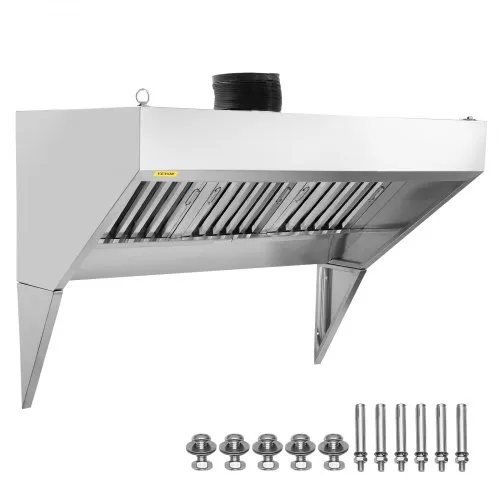
The main ventilation fixture above a commercial cooking line is a commercial kitchen exhaust hood, intended to collect steam, grease-laden air, combustion byproducts, and cooking odors continuously produced by fryers, griddles, ranges, and broilers during a full-service kitchen operating day. The Type I construction of VEVOR commercial kitchen exhaust hoods, with stainless steel interior surfaces and integrated grease filters that capture airborne grease particles before they enter the exhaust ductwork, prevents grease buildup in the ductwork, which poses a fire risk and necessitates expensive, regular professional duct cleaning.
The type of cooking equipment, cooking intensity, hood geometry, and the distance between the cooking surface and the hood capture face, which determines how well the hood draws cooking effluent into its capture zone before it disperses into the kitchen environment, all affect the required CFM for commercial kitchen exhaust hoods. The VEVOR commercial kitchen exhaust hood lineup accommodates both light cooking appliances and high-intensity appliances like heavy-duty fryers and char broilers, which produce the largest heat and grease loads that commercial kitchen ventilation systems must handle. VEVOR commercial exhaust hoods' stainless steel construction throughout the hood interior, filter sections, and grease gutter channels prevents corrosion and surface deterioration caused by cooking grease, steam, and cleaning agents in hoods made of less durable materials, preserving structural integrity and hygienic surface condition even after years of heavy daily use.
Commercial Cooking Exhaust Hoods for Heavy-Duty Equipment
Char broilers, wood-fired pizza ovens, heavy-duty wok ranges, and commercial deep fryers generate grease, smoke, and heat loads exceeding the capture capacity of standard ventilation hood designs designed for lighter cooking equipment. This feature is why commercial cooking exhaust hoods for heavy-duty cooking equipment address the highest ventilation demand in commercial food service applications. To address the high grease loading generated by heavy commercial cooking equipment during continuous service, VEVOR commercial cooking exhaust hoods for heavy-duty applications feature deeper capture depths, higher airflow face velocity targets, and baffle-style grease filters that provide greater grease separation efficiency than standard mesh filters.
The angled stainless steel baffles in VEVOR commercial cooking exhaust hood baffle filter designs direct airborne grease particles through multiple directional changes, causing the grease to separate from the airstream and drain into the grease gutter rather than entering the exhaust ductwork. Regular filter maintenance is feasible for kitchen workers without specialized cleaning equipment, as stainless steel baffle filters can be cleaned in a commercial dishwasher or by hand with hot water and a degreaser. This feature ensures both filter efficiency and fire safety compliance through regular cleaning at the intervals specified by local fire safety and health department regulations for commercial kitchen ventilation systems.
Concession Hoods for Food Trucks and Concession Trailers
Standard commercial kitchen exhaust hoods are not optimized to handle the unique ventilation challenges of mobile food service operations, such as food trucks, concession trailers, festival stalls, and event catering rigs, where limited installation space, mobile use environments, and varying local regulatory requirements create ventilation design constraints. This is where a concession hood comes in. To provide the airflow capture performance required by health department inspections and mobile food vendor operating permits for compliant commercial cooking equipment operation in mobile food service venues, VEVOR concession hoods use lightweight, compact construction that fits within the smaller ceiling height and floor footprint of a food truck or concession trailer's cooking compartment.
VEVOR concession hoods' all-stainless construction protects installed equipment in mobile food service vehicles from vibration and movement stress caused by road transport, preserving structural integrity and filter seal condition despite the frequent loading, unloading, and transit cycles that food truck operations subject all installed equipment to throughout a hectic event and market trading schedule. When designing mobile food service hoods, grease drip prevention is especially crucial. VEVOR concession hoods use forward-sloping grease gutters to direct collected grease to a drain point away from the cooking equipment below. This feature prevents grease from dripping back onto food and cooking surfaces, which could pose a risk to both food safety and fire safety during mobile cooking operations.
Commercial Kitchen Exhaust Fans for Supplementary and Standalone Ventilation
The powered air movement that drives the ventilation system's airflow through the hood capture face, ductwork, and exterior discharge point is provided by a commercial kitchen exhaust fan. The fan's CFM capacity and static pressure rating show if it can provide enough airflow through the whole ventilation system, including all ductwork resistance and filter loading. Both rooftop and inline VEVOR commercial kitchen exhaust fans are available. Rooftop fans are installed at the duct termination on the building roof, where they release exhaust air directly into the atmosphere. In contrast, the inline fans are installed within the ductwork run between the hood and the exterior discharge point.
Because a fan's airflow output decreases as the resistance of the ductwork system increases, choosing a fan based on its maximum free-air CFM rather than its performance at the system's actual operating static pressure results in an undersized installation that fails to capture cooking effluent adequately and creates a non-compliant ventilation system from the first day of operation. Fan sizing for a commercial kitchen exhaust system requires matching the fan's rated CFM at the actual static pressure of the complete ductwork system.
Size and Installation Considerations for VEVOR Range Hoods
How well the range hood collects cooking effluent across the entire cooking equipment footprint, and how it integrates with the kitchen's mechanical and structural systems, depend on the hood's size and installation technique.
Hood Size Selection and Equipment Overhang Requirements
To create the overhang dimensions required by capture standards for the hood to intercept rising cooking effluent before it escapes the capture zone laterally and to the front of the cooking equipment profile, commercial kitchen exhaust hoods must be six inches wider on each side than the width of the cooking equipment they serve and six inches deeper than the front of the cooking equipment. VEVOR commercial exhaust hoods are available in conventional widths ranging from 48 inches to 144 inches and beyond. These hoods can be used to cover everything from single-section cooking equipment to long cooking lines that need numerous joined hood sections or extended hood runs to accomplish the necessary capture coverage.
Capture efficiency is impacted by the hood mounting height above the cooking surface; lower mounting heights require lower airflow velocities to maintain adequate capture, while higher mounting heights require higher CFM to account for the larger dispersal area that cooking effluent covers as it rises farther from the heat source before reaching the hood capture face. The VEVOR range hood specs include suggested installation height ranges that comply with conventional guidelines for commercial kitchen ventilation design, while local ventilation codes specify the maximum permitted hood mounting heights for certain cooking equipment types.
Installation Method and Ductwork Connection
To install a range hood in a commercial kitchen, the hood mounting structure, ductwork connection, exhaust fan specification, and makeup air supply system must be coordinated. The makeup air supply system replaces the exhaust air volume removed from the kitchen, preventing negative pressure buildup that reduces hood capture performance and causes uncomfortable drafts through every kitchen opening when insufficient makeup air is supplied. To facilitate the transition from the hood outlet to the duct run to the exhaust fan and outdoor discharge point, VEVOR commercial kitchen exhaust hoods come with duct collar connections suitable for both round and rectangular ductwork.
The two main commercial kitchen hood installation geometries are covered by the VEVOR range hood lineup's wall-canopy and island-canopy mounting configurations. Wall canopy hoods attach to a wall and have a single open capture face. In contrast, the island canopy hoods mount above a central cooking island with four open capture faces, necessitating a perimeter capture approach rather than the single-face capture permitted by wall-mounted equipment. Larger stainless steel commercial exhaust hoods require ceiling suspension from structural building elements rather than light-duty wall brackets, which cannot safely support the combined weight of the hood body, filters, and accumulated grease over an extended service period. The structural support requirements for commercial exhaust hoods scale with hood size and weight.
Why Choose VEVOR Range Hoods?
For restaurants, food trucks, and commercial food service companies, VEVOR offers a full range of range hoods, including commercial kitchen exhaust hoods, commercial cooking exhaust hoods, concession hoods, and commercial kitchen exhaust fans. Every hood provides commercial kitchen ventilation at every operating scale by combining stainless steel durability, effective ventilation capacity, and affordable pricing. Your range hood is designed for easy servicing, backed by VEVOR's dependable post-purchase assistance. Look over the entire selection now.
FAQs
How do I calculate the CFM I need for a commercial kitchen exhaust hood?
For light cooking equipment, a standard formula multiplies the hood face area in square feet by 100 CFM per square foot; for heavy-duty equipment, such as fryers and char broilers, it can reach 150 CFM per square foot. For a complying design unique to your kitchen layout and cooking equipment, always check with a mechanical engineer and local ventilation codes.
What is the difference between a Type I and a Type II commercial exhaust hood?
Grease filters are part of Type I hoods, which are necessary over cooking appliances that produce grease, such as griddles, stoves, and fryers. Type II hoods are ideal for dishwashers and steam equipment because they primarily manage heat and steam, rather than filtering grease. For commercial cooking applications that produce grease, VEVOR commercial kitchen exhaust hoods have Type I construction.
Can a VEVOR concession hood be used in a permanently installed commercial kitchen?
Yes, as long as the hood's CFM capacity meets the ventilation needs of the installed cooking equipment. The lightweight design and small footprint of concession hoods offer practical installation benefits without sacrificing the ventilation performance required for compliant commercial culinary operations, making them suitable for both mobile and fixed light-commercial kitchen installations.
How often should commercial kitchen exhaust hood filters be cleaned?
Grease filter cleaning for high-volume cooking operations is usually required every two weeks by fire safety and health department rules. Monthly cleaning may be required for lower-volume operations. For kitchen workers without specialist equipment, routine compliance maintenance is feasible since VEVOR stainless steel baffle filters clean well in a commercial dishwasher or with hot water and degreaser.
