
Trailer Jack With Wheels
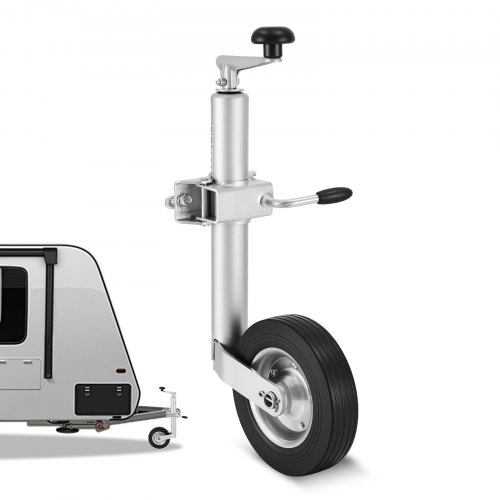


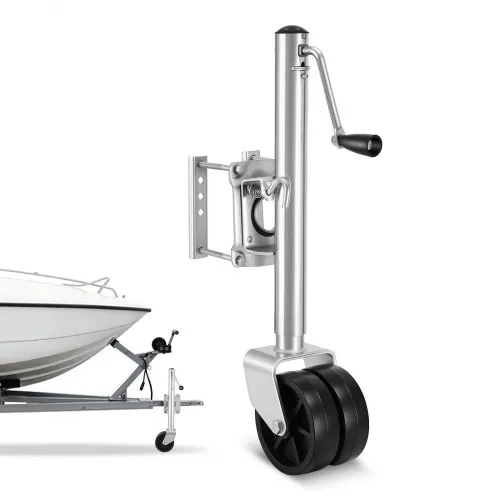


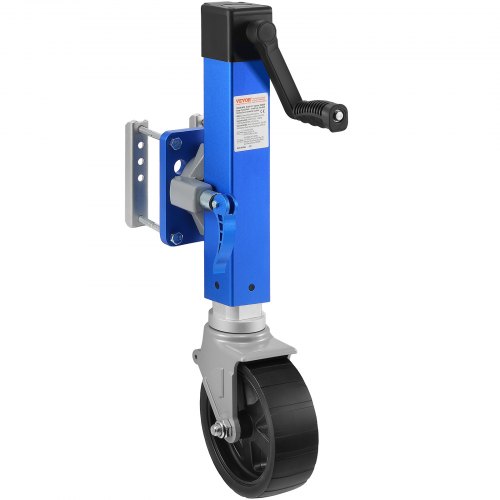


Results for Trailer Jack With Wheels
With the whole line of trailer jacks with wheels from VEVOR, you can easily raise, stabilize, and move your trailer. Across all models, the VEVOR trailer jack with rubber wheels delivers dependable lifting capacity and smooth ground mobility, making it ideal for boat, utility, and RV trailers. VEVOR offers the ideal option, whether you need a boat trailer jack with wheels for frequent launching or a heavy duty trailer jack with wheels for a loaded cargo trailer.
VEVOR Trailer Jacks with Wheels for Effortless Lifting and Smooth Repositioning
Do you have a tongue jack that scrapes into soft ground every time you unhitch, or are you having trouble moving a big trailer by hand? Wheeled trailer jacks solve both issues: they raise the tongue to the proper hitch height while rolling smoothly over grass, gravel, and concrete without digging. The lifting capability, ground clearance, and mobility that actual trailer owners require daily are included in VEVOR's trailer tongue jack with wheels.
Weight Capacity and Lift Height in VEVOR Trailer Jacks with Wheels
The two factors that determine whether a trailer jack can safely support your particular trailer load and reach the hitch height your tow vehicle needs are weight capacity and lift height range. Both factors are the foundation of VEVOR's inventory, which includes models with unambiguous ratings for every type and weight of trailer.
Matching Weight Capacity to Your Trailer's Tongue Weight
The load criterion that establishes the minimum capacity rating needed from a trailer jack with wheels is tongue weight, or the downward force the trailer applies to the jack when it is not hitched. When a jack is overloaded beyond its rated capacity, it can cause frame deformation, weld failure, or abrupt collapse, harming the trailer and posing a significant safety risk during hitching and unhitching. With heavy duty trailer jack with wheel variants rated for 1,000 lbs, 2,000 lbs, and beyond, VEVOR trailer jacks with wheels are available in a practical capacity range to accommodate everything from lightweight utility trailers to fully loaded enclosed cargo and equipment trailers.
Generally speaking, tongue weight accounts for 10–15% of the trailer's gross weight; for example, a loaded trailer weighing 10,000 lbs would produce 1,000–1,500 lbs of tongue weight, which the jack must safely sustain while at rest. Because surface irregularities and dynamic loads while hitching add stress over the static tongue weight value, always choose a jack rated above your calculated maximum tongue weight rather than at its exact limit. To make choosing easier, VEVOR's product pages clearly indicate capacity ratings and compatible trailer types.
Lift Height Range: Matching the Jack to Your Hitch Height
A trailer jack's lift height range affects whether it can elevate the trailer tongue from its ground-resting position to the proper height for coupling with the hitch ball of your particular tow vehicle. The hitch heights of trucks, SUVs, and vans vary, and a jack with inadequate travel cannot accommodate a high hitch receiver and a lowered tongue without requiring risky innovation. The hitch height range of the most popular tow vehicles used with utility, boat, and cargo trailers is covered by the large lift travel of the VEVOR trailer tongue jack with wheel models, which ranges from 10 to 18 inches depending on the model.
With mechanical gearing and a side-wind or top-wind crank design, the lift mechanism on VEVOR jacks allows large tongue loads to be raised with manageable hand effort. In tight tongue-box arrangements where a top-mounted crank handle would obstruct coupler or safety chain attachments, side-wind cranks are the preferred option. Before making a purchase, customers can verify that the entire travel range covers their specific unhitched-to-linked-hitch height gap, as VEVOR explicitly lists the minimum and maximum heights for each jack type.
Heavy Duty Trailer Jack Capacity for Commercial and Equipment Trailers
Heavy enclosed cargo trailers, equipment haulers, and commercial trailers all use tongue weights that are too high for typical residential trailer jacks to support securely. Installing a 1,000-pound jack on a trailer that generates 2,000 pounds of tongue weight is a recipe for structural failure. In commercial hauling operations, trailer jack failures during hitching are among the most frequent causes of trailer damage and operator injuries.
With thicker-walled tube construction, reinforced weld points, and higher-capacity lifting mechanisms, VEVOR heavy duty trailer jack with wheels are designed specifically for these demanding applications. These features ensure safe operation under maximum rated loads without flexing or creeping, which are signs of an overloaded jack. To reduce stress concentration at the mounting point, the mounting flanges on VEVOR heavy duty models use thicker steel plates and wider bolt patterns to disperse tongue load over a larger area of the trailer tongue jack with wheel frame. By purchasing a properly rated heavy-duty VEVOR trailer jack, contractors, landscapers, and equipment rental operators who frequently load trailers to capacity can save on maintenance expenses and downtime associated with using undersized gear in demanding commercial applications.
Stabilization at Rest – Keeping the Trailer Level When Unhitched
Lifting the tongue during hitching and unhitching, and keeping the trailer level and stationary while it is unhitched for loading, unloading, or storage are the two main purposes of a trailer jack with wheels. A jack that does a good job of lifting but lacks the vertical rigidity to keep the tongue steady as weights change makes for a dangerous working platform.
Using positive-lock collar mechanisms that prevent retraction under load, the VEVOR trailer swivel jack with wheel models locks firmly in the extended position, maintaining the tongue at the set height regardless of load shifts during loading. When the jack is in stabilization mode, the wheel on some VEVOR jacks retracts or swings away from the ground, transferring the entire weight to the jack foot rather than the wheel for optimal vertical stability. As crucial as the jack's lifting capacity during the hitch-unhitch cycle is the stabilizing reliability it provides for boat trailer jack wheel owners who load and unload on sloped ramps where the tongue height changes as the boat travels.
Wheel Type and Mobility Features in VEVOR Trailer Jacks with Wheels
When movement rather than stabilization is needed, a trailer jack's wheel type and mobility design dictate how readily it can move the trailer across various ground surfaces and how well it maintains position. To accommodate the wide variety of surfaces and use scenarios trailer owners encounter, VEVOR designs its trailer jacks with wheel options and mobility features.
Rubber vs. Solid Wheels: Choosing the Right Wheel for Your Surface
Wheel material has a direct impact on how smoothly a trailer jack glides over various types of ground and how well it can absorb small surface irregularities that might cause metal wheels to skip, catch, or harm smooth concrete floors. Trailer jack with rubber wheel models cushion ground contact, move smoothly over packed gravel and rough concrete, and prevent surface scarring on finished garage floors and workshop surfaces that bare-metal wheels may cause.
On construction sites and gravel yards, where embedded aggregate can damage rubber wheels, solid steel wheels are more resilient to severe loads and better at resisting cuts from sharp debris. VEVOR offers a trailer jack with rubber wheel and a trailer jack with a solid wheel, with rubber-wheel variants predominating in residential and marina settings and steel-wheel models better suited for more demanding commercial settings. When relocating a trailer, the VEVOR models' tire diameter is sized to roll over small surface barriers like threshold lips, gravel fragments, and expansion joints without the jack body slipping into the space and losing ground clearance.
Swivel Jacks and Directional Mobility for Tight Maneuvering
With a trailer jack with rubber wheel, the trailer tongue can only travel in two directions: forward and backward along the jack's fixed wheel axis. In congested marina parking lots, small garages, and storage yards where the trailer must move at an angle to avoid obstructions or line up with a designated storage place, a trailer jack with rubber wheel requires multiple repositioning cycles. In contrast, a swivel jack can do so in a single fluid motion.
To maneuver the trailer tongue jack with wheel in any direction during repositioning, the VEVOR trailer swivel jack with wheel models features a 360-degree rotating wheel mount. This feature allows the trailer tongue jack with wheel to move diagonally into storage spaces, pivot around obstacles, and precisely align with hitch balls without the tow vehicle having to move. During the lifting and stabilization phase of operation, the swivel mechanism prevents unintentional wheel rotation by locking positively after directional movement is complete. The directional flexibility of a swivel jack avoids the time and physical strain of frequent manual repositioning required by fixed-wheel jacks, which is especially useful for boat owners navigating trailers around a crowded boat yard and RV owners situating trailers in constrained campground areas.
Why Choose VEVOR Trailer Jacks with Wheels?
Boat owners, contractors, and trailer operators rely on VEVOR trailer jacks with wheels to provide the lifting capacity, height range, and ground movement necessary for secure, simple hitching and repositioning. Every model, from swivel designs for tight maneuvering to heavy duty trailer jack with wheel variants for commercial loads, is built for dependable everyday performance. VEVOR is a wise addition to any trailer setup thanks to its affordable prices and trustworthy after-sales service. Check out the entire selection right now at VEVOR.com.
FAQs
How do I calculate the tongue weight my trailer jack needs to support?
Usually, tongue weight accounts for 10–15% of the overall loaded weight of your trailer. To determine the top tongue weight, multiply the loaded trailer's maximum weight by 15%. For a safe working margin, always choose a VEVOR trailer jack with wheels rated higher than this amount.
What is the difference between a side-wind and a top-wind trailer jack?
While a top-mounted handle would obstruct the coupler or safety chains, side-wind jacks have the crank handle on the jack body. Open tongue arrangements with unhindered vertical access above the jack mount are well-suited for top-wind jacks.
Are trailer jacks with rubber wheel models suitable for gravel surfaces?
Yes, VEVOR trailer jack models with rubber wheels glide effortlessly across pavement, grass, and packed gravel. Solid wheel types are more durable against wheel cutting and surface damage when used for large construction site debris or jagged gravel.
Can a VEVOR swivel jack be locked in position during stabilization?
Indeed, a positive-lock mechanism built into the VEVOR trailer swivel jack with wheel models keeps the swivel wheel stationary during lifting and stabilization, preventing accidental rotation that could jeopardize vertical stability under tongue weight.
What mounting style do VEVOR trailer tongue jacks use?
The bolt-on mounting flanges used by the VEVOR trailer tongue jack with wheel variants are compatible with both straight tongue and standard A-frame trailer designs. Before making a purchase, you can verify that the mounting hardware and bolt pattern measurements on each product page match those of your particular trailer tongue.
