Woodworking Height Gauge




Results for Woodworking Height Gauge
Check out VEVOR's full selection of woodworking height gauges, designed for professional woodworkers, hobbyists, cabinetmakers, and furniture builders who require reliable, repeatable measurement precision at the workbench or machine table. VEVOR offers full-scenario coverage with precision instruments designed for genuine workshop demands at every skill level, whether you require a single woodworking height gauge for router table setup or a gauge block set for blade and bit height reference.
VEVOR Woodworking Height Gauge and Gauge Blocks for Accurate Router, Table Saw, and Jointer Setup
Are you looking for a trustworthy woodworking gauge that removes uncertainty from jointer fence configuration, router bit height, and table saw blade depth? The difference between frustrating rework and tight-fitting joinery depends on the use of consistent measurement equipment, regardless of whether you are a professional cabinet builder or a passionate hobbyist. You can set up machines quickly, precisely, and consistently with VEVOR's selection of woodworking height gauges and gauge blocks.
Measurement Range & Precision in VEVOR Woodworking Height Gauges
The key characteristics of any woodworking gauge that a serious workshop can trust are measurement range and precision. From small joinery tasks that benefit from sub-millimeter accuracy to more expansive installations on router tables and dado stacks, VEVOR woodworking height gauges are designed to provide precise, consistent readings across the measurement ranges that woodworkers encounter most frequently.
Measurement Range Coverage for Common Woodworking Applications
Which machine setup duties a woodworking height gauge can consistently undertake depends on its measurement range. The majority of router table and table saw work lies between 0 and about 2 inches in height, covering common bit heights, blade projections, and fence offsets found in regular cabinet and furniture construction. VEVOR woodworking height gauges come in a variety of sizes, ranging from small 0 to 6-inch variants for use on router tables and benches to larger models that can accommodate taller setups on jointer infeed surfaces, drill press tables, and bandsaw guides.
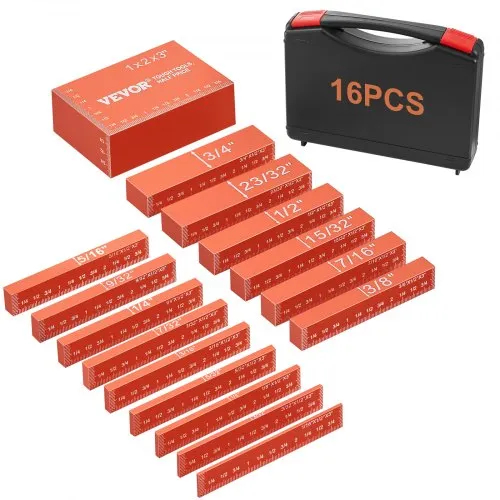
Woodworking gauge blocks approach range coverage differently. Instead of offering a continuous scale, they provide a series of predefined reference heights that match the bit and blade settings most commonly used in cabinet and furniture manufacturing. Woodworkers may set their machines to precise reference measurements repeatedly without having to measure, thanks again to a well-designed gauge block set that covers heights such as 1/4 inch, 3/8 inch, 1/2 inch, 3/4 inch, and 1 inch in precise increments. When compared to using a continuous-reading gauge for every adjustment, VEVOR's gauge block set options cover the most useful woodworking reference heights, resulting in faster, more reliable machine setup.
Resolution and Graduation Increments for Fine Woodworking
How finely you can adjust a router bit, saw blade, or jointer head depends directly on resolution, which is the smallest increment a woodworking gauge can display or reference. Generally speaking, a resolution of 1/64 inch (0.5mm) is adequate for ordinary woodworking operations, such as adjusting a rebate plane stop or setting dado depth. A resolution of 0.01mm or 0.001 inches significantly alters how closely finished measurements match the planned design in precision joinery, exquisite furniture manufacture, and instrument construction, where tolerances are tight.
With LCD readouts as small as 0.01mm, VEVOR digital woodworking height gauges provide woodworkers with a level of accuracy in their setup tools comparable to that of their measuring devices. For dirty workshop settings where electronics need extra protection, analog models with clearly graduated scales offer dependable readings without batteries or electronic components. By providing absolute reference heights that eliminate graduation reading, woodworking gauge blocks are a useful addition to both digital and analog gauges. This feature eliminates the chance of misreading a scale in dimly lit workshops or after a lengthy cutting session due to weariness.
Repeatability and Its Importance in Production Woodworking
The capacity of a woodworking gauge to produce the same measurement result under the same circumstances each time is known as repeatability. Repeatable machine setup is just as crucial as initial measurement precision in production woodworking, because several similar parts must be cut to constant dimensions throughout a project or production run. Variations in a gauge's readings from one use to the next lead to discrepancies that worsen during the joinery, assembly, and finishing phases.
Sturdy reference surfaces and locking mechanisms built into VEVOR woodworking height gauges keep the gauge in its designated position throughout operation. VEVOR's gauge block set products provide the highest level of repeatability because each block is a fixed, machined reference dimension that yields the same setup results all the time, regardless of operator handling or usage frequency. Because of this, woodworking gauge blocks are especially useful in shared workshop settings, educational settings, and small production operations where reliable output across several users and shifts is necessary to maintain quality without constantly re-verifying machine settings.
Compatibility with Common Woodworking Machines and Setups
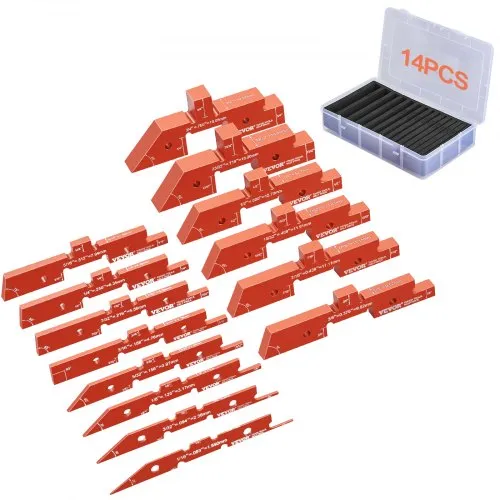
The usefulness of a woodworking gauge depends on how well it works with the equipment and setup situations you employ daily. The base plates of VEVOR woodworking height gauges are flat and sturdy, allowing them to rest firmly without tilting or rocking on router table surfaces, table saw wings, bandsaw tables, and jointer beds. The measuring arm, or reference contact point extends smoothly above the base to make contact with fence faces, router bits, drill bits, and saw blade teeth without interfering with the base geometry.
Because of their straightforward block shape, woodworking gauge blocks can be used against any flat reference surface, regardless of the type of machine or table arrangement, providing even greater machine compatibility. In a well-equipped workshop, the versatility of a single gauge block set from VEVOR makes it a marking gauge reference, a table saw blade projection guide, a drill press depth stop, and a router bit height reference, all in one. VEVOR creates gauge block sets and height gauges with the useful machine compatibility required by actual woodworking workflows.
Material & Features in VEVOR Woodworking Height Gauges
A woodworking height gauge's durability, usability, and dependability over many years of workshop use are all influenced by its construction and integrated features. VEVOR selects materials for its woodworking measurement tools based on their stability, durability, and ability to withstand the harsh conditions of a dynamic woodworking environment.
Frame Materials, Base Construction, and Workshop Durability
Woodworking workshops are rigorous environments for precise tools. Measurement instruments not designed to withstand them suffer from sawdust infiltration, moisture from finishing processes, unintentional drops, and the general harsh handling of a busy bench environment. Hardened steel, anodized aluminum, and engineered polymer components are used in VEVOR woodworking height gauges because of their durability, dimensional stability, and ability to maintain accuracy over time in a workshop setting.
The most important structural element of a woodworking gauge is the base plate, which must be level and sturdy to ensure precise height readings from the machine table surface. On higher-specification models with ground or lapped contact surfaces that lay flush against reference surfaces without detectable rocking, VEVOR precisely manufactures its base plates to meet flatness tolerances. With tight dimensional tolerances and hardened tool steel or precision aluminum alloy manufacturing, VEVOR's gauge block sets guarantee that the reference height of each block will hold up over years of workshop handling, storage, and frequent use without experiencing detectable dimensional change or surface wear that could jeopardize measurement reliability.
Digital Readouts, Locking Mechanisms, and Ease-of-Use Features
VEVOR woodworking height gauges' practical features greatly reduce setup time and boost measurement confidence when performing machine adjustment chores. Large, easily readable LCD screens with metric and imperial switching, zero-reset features that enable relative height measurements from any reference point, and data hold buttons that hold the current reading. At the same time, adjusting the machine or moving the gauge are features of digital models. During multi-step setup processes, these capabilities remove the need to write down interim measurements or memorize values.
Before the gauge is used as a physical stop reference during a machine adjustment, locking mechanisms on adjustable-height gauges allow the measuring arm or reference stop to be fixed at a verified position. As a result, the woodworking gauge becomes an active setup tool that directly directs the machine adjustment, rather than a passive measuring device. Because of their fixed reference dimensions, VEVOR woodworking gauge blocks do not require locking mechanisms by design. They just sit between the machine table and the bit, blade, or cutter to provide an instantaneous, precise height reference that does not require reading, interpretation, or adjustment verification.
Why Choose VEVOR Woodworking Height Gauges?
For consistent, precise machine setups, cabinet makers, furniture builders, and devoted hobbyists require measurement range, precision, material quality, and useful features, which VEVOR woodworking height gauges and gauge blocks offer. With affordable prices and dependable after-sales support, VEVOR's comprehensive line of height gauges, from digital height gauges with fine resolution readouts to adaptable gauge blocks sets, covers the most popular woodworking reference heights. Get VEVOR woodworking height gauges now to improve the precision and reliability of any project you construct.
FAQs
What is a woodworking height gauge used for?
Jointer heads, router bits, table saw blades, and drill press stops are all adjustable in height above the machine table surface using a woodworking gauge. Guaranteeing uniform cut depths and dimensions throughout a project, it removes uncertainty from machine setup.
How are gauge blocks for woodworking different from a standard height gauge?
For quick, reproducible machine setup, gauge blocks—fixed-dimension reference tools—offer preset heights such as 1/4 inch or 1/2 inch. Across a range, a standard height gauge provides constant measurement. Both tools work well together in a spacious woodworking studio.
Can VEVOR woodworking gauge blocks be used on any machine?
Yes, VEVOR woodworking gauge blocks are compatible with router tables, table saws, bandsaws, and drill presses, as well as any other machine that has a flat table surface. They are universally compatible with any arrangement that requires a reference height between the table and the cutter due to their straightforward block design.
Do I need a digital or analog woodworking height gauge for general use?
Both are effective for the majority of woodworking operations. Digital models are easier to read in low light and have finer resolution. Analog gauges work consistently in dusty conditions and do not need batteries. Select analog for regular workshop and production use, and digital for fine furniture manufacturing.