
2 wheel garden cart








Results for 2 wheel garden cart
VEVOR makes a useful line of wheelbarrow carts for landscapers, gardeners, contractors, and property owners who need dependable carrying equipment to move dirt, mulch, debris, and other materials quickly and easily around yards and job sites. Our wheelbarrow carts and specialty carrying solutions can hold more weight and are more stable than standard single-wheel versions. They can help you spread mulch in flower beds, haul construction debris, or move firewood and supplies. Look through wheelbarrow carts and professional carrying tools designed to work well in tough outdoor environments and last a long time.
VEVOR 2 Wheel Garden Carts and 2 Wheel Metal Wheelbarrow Options for Every Task
Are you seeking wheelbarrow carts that can transport heavy loads, quickly move over rough terrain, and dump loads? Using the right hauling equipment makes you more productive, reduces physical stress, and prevents spills and accidents that occur with unsteady or small carts. VEVOR offers a wide range of wheelbarrow carts. They make balanced 2 wheel garden carts that can handle high loads, robust 2 wheel metal wheelbarrows for building sites, and efficient wheelbarrow dump carts that can quickly unload materials.
Capacity and Wheel Configuration: Choosing Wheelbarrow Carts That Handle Your Loads
The amount of stuff you can carry in a wheelbarrow cart, and how well it handles different types of terrain, depend on its size and wheel arrangement. Getting both specs correct means you don't have to make as many journeys, and you don't have to work as hard to move things around on properties.
Understanding Capacity in Wheelbarrow Carts
When talking about wheelbarrow carts, capacity means both volume (in cubic feet or liters) and weight rating (in pounds or kilograms). Most good lists of garden cart wheelbarrow models are intended to help people understand how much weight they can carry.
Wheelbarrow carts with a capacity of 3 to 5 cubic feet and a weight rating of 200 to 300 pounds are good for light garden work, such as carrying bags of potting soil, pruning debris, or small amounts of mulch. They are big enough to do the job but not too big. These small models are easy to move around in established gardens, amongst plants, and on narrow walkways where bigger carts wouldn't fit. A 4-cubic-foot model can hold about 8 to 10 bags of mulch, enough for most home garden mulching jobs.
For typical landscaping tasks, such as moving mulch, gravel, soil, or trash, alternatives with a capacity of 6 to 8 cubic feet and a weight rating of 400 to 600 pounds strike a good compromise between space and ease of movement. For everyday carrying jobs, landscapers and property managers usually prefer 6-cubic-foot carts. a
Models with a capacity of 10 to 16 cubic feet and a weight rating of 800 to 1200 pounds are best for heavy-duty jobs like moving concrete, waste, and building materials. They provide the volume and strength needed for tough work. VEVOR's wheelbarrow carts include information on the weight and volume they can hold.
Wheel Configuration and Terrain Handling
The way the wheels are set up on a wheelbarrow cart determines how stable it is, how much resistance it has to rolling, and how effectively it handles different types of terrain. There are two main types of designs: single-wheel and two-wheel. They have very different performances.
Single-wheel conventional wheelbarrows are the best choice for confined spaces, as they are easy to maneuver and can be dumped in any direction by simply tipping the cart. But single-wheel designs require the operator to keep them balanced at all times, and they can become less stable as the load increases. The single front wheel also dips into soft ground more easily than two-wheel setups.
Two-wheel setups are more stable and are less likely to tip over when they're loaded. The two front wheels spread the weight across a larger area, reducing ground pressure and preventing the vehicle from sinking into soft dirt. Pneumatic tires generally provide a smoother ride, absorb some shock when you drive over rough ground, and can make it easier to roll over obstacles like tree roots or construction debris. The tires compress and grip the uneven ground, providing better traction and reducing bouncing that spills cargo. But pneumatic tires need to be inflated from time to time and can get flat, which means they need to be fixed or replaced.
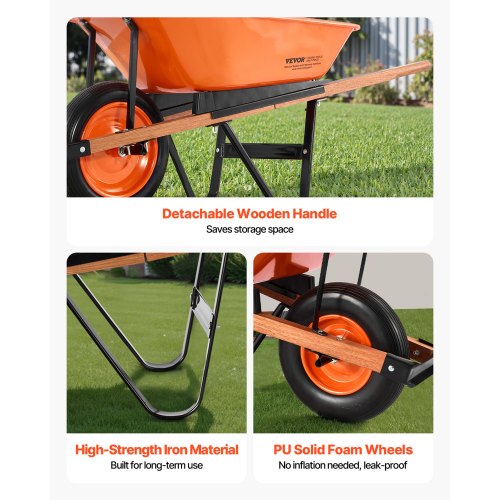
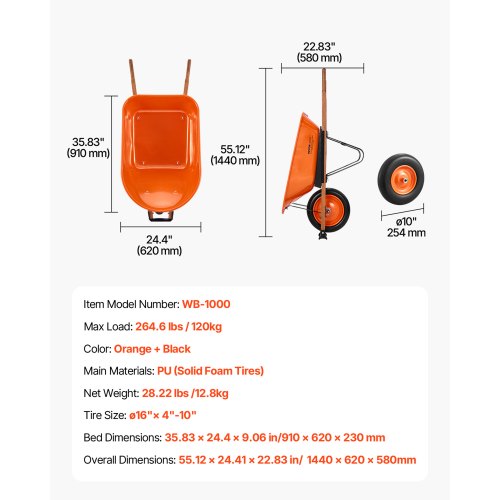
Flat-free foam or solid rubber tires don't need to be repaired for punctures or inflated, but they make the ride harder and don't grip loose surfaces as well. The wheel's size affects how well it rolls over bumps and rough ground. Wheels that are 12 to 16 inches in diameter move over bumps, pebbles, and uneven ground more easily than wheels that are 6 to 8 inches in diameter, which get stuck on things. But bigger wheels make the cart bed taller, so people have to lift things higher when loading. VEVOR's wheelbarrow carts have the right-sized wheels for the job and a loading height that works.
Material and Features: What Makes Wheelbarrow Carts Durable and Practical
The way wheelbarrow carts are made and their features affect how well they handle heavy loads and rough terrain. They also affect how useful they are for everyday use. Quality materials set the options you trust apart from simple models that bend, corrode, or don't work well.
Material Construction in Wheelbarrow Carts
The quality of the material impacts how much weight it can hold, how well it resists rust, and how long it lasts when used outside in tough conditions. Most good carts use metal for structural parts, but they can also be made of other materials.
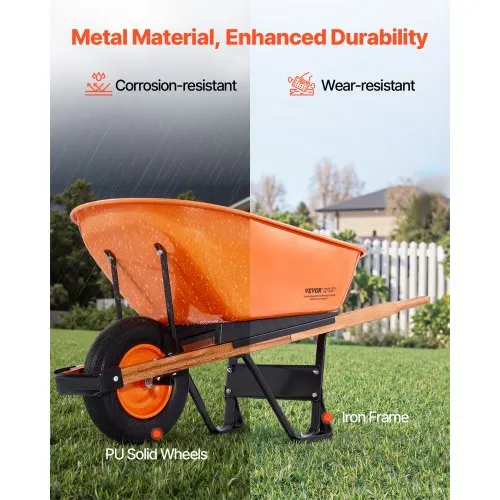
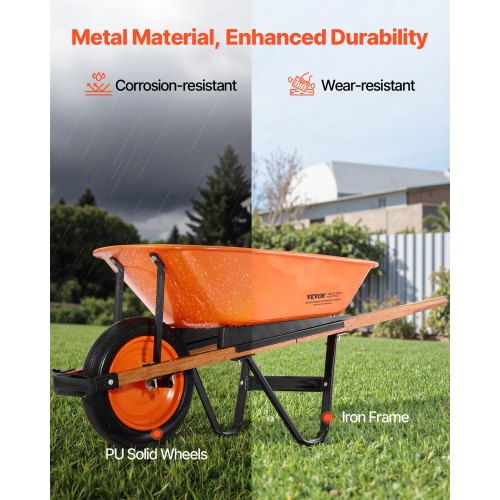
Steel construction in two-wheeled metal wheelbarrows makes them the strongest and most sturdy for carrying hefty loads without costing too much. The heavy-gauge steel tray and frame structure won't bend even when it's loaded over its rated capacity. Powder coating or a galvanized finish on high-quality steel wheelbarrow yard carts protects them from rust better than regular paint.
Poly or molded plastic trays are less likely to rust and are lighter than metal trays. High-density polyethylene construction can take hits that would dent metal and never rusts, even when it comes into contact with dampness, fertilizers, or other corrosive elements. But plastic is not as strong as metal, so poly carts can't hold as much weight as steel carts of the same size. When it's frigid, plastic can also become brittle and break if it's too heavy.
An aluminum structure is corrosion-resistant and has a strength closer to that of steel, but it is more expensive. Aluminum wheelbarrow carts are much lighter than steel ones, making them easier to use for extended periods. The material naturally resists rust and doesn't break down when exposed to chemicals and fertilizers.
The way the frame and handle are built affects how loads are transferred to the wheels and whether the handles flex under stress. Welded or bolted joints on tubular steel frames better distribute weight than stamped sheet-metal frames, which put stress on bends. Cushioning should be built into the handle grips to help keep your hands from getting tired during extended pushing or pulling. The materials used in VEVOR's wheelbarrow carts are right for the rated capacities.
Practical Features in Wheelbarrow Carts
The features of two-wheeled garden carts affect how easy they are to use and whether they can handle tasks beyond moving basic materials. Smartly adding features makes the product more useful and satisfying for users.
With quick-release dump mechanisms, you may let go of things without having to raise and tip big objects by hand. With lever-operated or latch-release methods, the tray can tilt forward to empty its contents and then lock securely for transport. This feature is especially useful for people who have to move heavy items, like wet dirt or stones, which can hurt their backs if they have to tilt them by hand.
Different tasks and terrain types can be handled more easily with convertible handle designs that transition between push and pull operations. Push handles are preferable for navigating tight spaces or backing the cart into place, while pull handles are excellent for long, straight trips or going down hills. Some designs for garden cart wheelbarrows have handles that can be removed or folded, making them easier to store.
Side panel extenders or stake pockets on wheelbarrow type yard carts make it easier to carry small, bulky items like leaves or hay that don't weigh much. Side panels that can be removed usually add 30-50% more volume without permanently altering the cart. The extensions should stay on securely enough to prevent them from becoming lost when moved but be easy to take off when not needed.
Integrated tool holders or accessory mounting points on the frames of two-wheeled metal wheelbarrows let you carry shovels, rakes, or other equipment with loads of material, so you don't have to make separate journeys for tools. Simple tube holders welded to the sides of the frame can retain circular tool handles. More advanced systems use spring clips or magnetic mounts to hold various types of tools.
Some designs for wheelbarrow dump carts have mesh or perforated trays that let water drain out when you are carrying wet materials or rinsing off garden products. The holes prevent water from accumulating, making steel trays heavier and accelerating rusting. Mesh trays can't hold small things like sand or soil amendments, though, because they would fall through the holes. VEVOR's wheelbarrow carts feature design elements that make them more useful for a variety of transport tasks.
Shop VEVOR Wheelbarrow Carts for Reliable Heavy-Duty Hauling
VEVOR offers a wide range of wheelbarrow carts that handle any carrying job, from small ones for home gardens to heavy-duty ones for professional landscaping and construction work. Our wheelbarrow dump cart, garden cart wheelbarrow, and wheelbarrow yard cart alternatives all have high capacity ratings, are made of sturdy materials, and have useful operational features. They are designed to handle demanding loads and provide stable operation, which is what professionals need. Check out the full collection of wheelbarrow carts online and find the ones that meet your individual work and carrying needs.
FAQs
What capacity do I need in wheelbarrow carts?
Two-wheel garden carts with a capacity of 3 to 5 cubic feet are good for small hauling jobs around the garden. For moving mulch and soil, general landscaping needs garden cart wheelbarrow models that hold 6 to 8 cubic feet. For heavy construction, you need wheelbarrow dump carts that can hold 10 to 16 cubic feet of debris and building materials.
Are two-wheel wheelbarrow carts better than single-wheel carts?
When carrying big loads, 2 wheel metal wheelbarrow versions are more stable and won't tip over when you let go of the handles. Single-wheel designs have a smaller turning radius. Most people think that the stability of the wheelbarrow yard cart is worth the loss of mobility, especially when it is full or on a slope.
What wheel type works best for wheelbarrow dump cart models?
For 2 wheel garden carts, pneumatic tires provide the best ride quality and grip on rough ground. Flat-free solid tires don't get flat on construction sites, but they make the ride rougher. Choose pneumatic for uneven ground, and solid for places where sharp debris can cause punctures or damage.
How much weight can garden cart wheelbarrow products carry?
Light-duty wheelbarrow carts typically carry around 200 to 300 pounds. For regular landscaping, mid-range two-wheeled metal wheelbarrows typically hold 400 to 600 pounds. Heavy-duty wheelbarrow yard carts may hold 800 to 1200 pounds for construction and business purposes. Never exceed the rated capacity, as the extra weight will damage the frame.
Do wheelbarrow dump cart models require more maintenance?
To ensure the dump mechanisms lock securely, they need to be lubricated at the pivot points, and the latches checked regularly. You need to check the air pressure in your pneumatic tires. Otherwise, 2 wheel garden carts need the same care as regular ones: clean them off after use, keep them dry, and touch up any paint chips on the steel frame to stop rust.
