

Air Hammers


Results for Air Hammers
An air hammer is a handheld pneumatic tool that turns compressed air into rapid, repeated impacts at a working tip. Air enters the body through a hose fitting and a trigger valve, then drives an internal piston back and forth inside a cylinder. Each forward stroke strikes the back of a removable bit, which passes the blow straight into the workpiece. Because the tool hits rather than spins, it can shear, split, punch or chip material that a saw or drill cannot easily grip. The operator steers the tip and sets how hard it bites through trigger pressure and steady hand force.
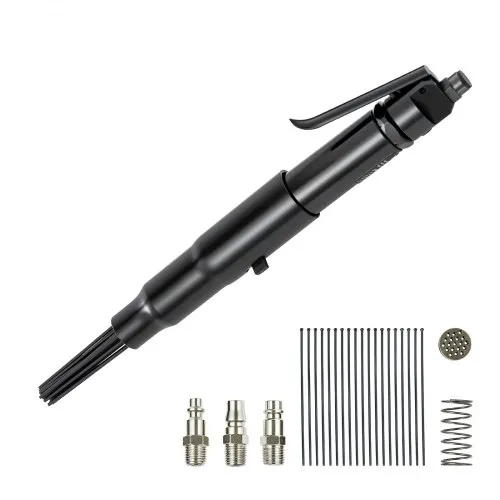
VEVOR air hammers come in five main builds. High-speed short-stroke models run at 4500 BPM with a 1.57 inch stroke for quick, controlled cuts, while long-stroke air hammers pair a 2.76 inch stroke with 3500 BPM for heavier blows on stubborn parts. Long-barrel chisel kits add 6.7 inch chisels at 2500 to 2700 BPM to reach recessed joints. Hammer and needle scaler combo kits bundle a 4500 BPM hammer with a 19-needle scaler, and standalone air needle scalers deliver 3400 BPM with three speed settings for rust and paint stripping. Typical uses are cutting body panels, separating spot welds, removing exhausts and rivets, freeing seized bolts and clearing weld scale.
Five things decide what you need:
- Job type: fast, light blows suit cutting and punching, while a longer stroke hits harder on seized parts.
- Air supply: these tools draw 11 to 14.5 CFM with no load at 90 PSI, so check your compressor keeps up.
- Reach: standard 4.7 inch chisels work in open areas, and 6.7 inch chisels get into deeper bays.
- Shank fit: the hammers take 0.401 inch round-shank chisels, so match any spare bits to that size.
- Surface prep: choose a needle scaler or combo kit if rust and paint removal is part of the job.
Browse the wider air tools range for other pneumatic jobs on the same air line, or explore air compressor tools to complete your workshop setup.
Air Hammer Types at a Glance
Each build trades speed, force and reach differently, so compare them side by side before choosing.
| Type | Impact Character | Working End | Reach | Trade-offs |
|---|---|---|---|---|
| Short-stroke air hammer | Fast, light blows | Chisels for cutting and punching | Compact head for tight panels | Clean, controlled cuts; less force on seized parts |
| Long-stroke air hammer | Slower, heavier blows | Chisels for splitting and breaking | Longer body, standard chisels | More energy per hit; harder to steer on thin metal |
| Long-barrel air hammer | Heavy blows at an extended tip | Long-barrel chisels | Reaches recessed joints | Gets into deep bays; less control right up close |
| Hammer and scaler kit | Fast blows plus needle impacts | Chisels and needle bundle | Two tools on one air line | Cuts and descales from one kit; more parts to store |
| Air needle scaler | Rapid, shallow needle strikes | Hardened needle bundle | Long straight body | Strips rust over contours; cannot cut metal |
VEVOR Professional Air Hammers with High Blow Rates and Versatile Chisel Options
Are you spending too much time fighting rusty parts or having trouble with manual cutting tasks? Air hammers make hard chores easier and faster, saving hours on tough projects. People who use these products a lot and expect them to work the same way every time are the ones VEVOR makes them for. Our lineup can handle everything from delicate panel work to tough demolition jobs.
Blow Rate and Power Specifications
To choose the correct air hammers, you need to know how to balance the blow rate and power output to the work you need to do. These criteria determine the tool's cutting speed, the depth it can penetrate a material, and its overall performance. Getting the numbers right means having a tool that works when you need it and imposes no limits.
Understanding Blow Rate Specifications
Blow rate tells you how many hits the tool makes in a minute. When the blow rate is higher, it cuts and chisels through materials faster. This standard directly influences work speed and surface finish quality.
Light-duty air hammers hit things 2000 to 3000 times per minute. These instruments are great for precise jobs that need controlled material removal. Moderate blow rates are beneficial for panel seam cutting, spot weld removal, and detail work because they stop over-cutting.
Medium-duty pneumatic hammers hit things 3000 to 4500 times per minute. This range works well for most automotive and general fabrication jobs. At these speeds, removing the exhaust system, body panels, and rust scales all go quickly.
Heavy-duty air hammers can hit more than 4500 times per minute to remove tough materials. We need these higher speeds to break up stuck parts, cut thick stock, and tear down buildings. The quick effects break down rust and scale that slower tools struggle with.
The blow rate affects the quality of the finish on the finished surfaces. Higher rates yield smoother cuts with fewer chatter marks. Lower speeds may make edges rougher, requiring more finishing work. Make sure the blow rate matches both the pace and the finish you want.
Power Output and Air Consumption
Compressed air volume and pressure working together give air hammers their power. If you know these needs, your compressor will likely provide enough power for continuous use. Most pneumatic air hammer tools work at 90 PSI of air pressure. Some heavy-duty types operate at 120 PSI to deliver more power. Using tools below their rated pressure makes them work much worse. Pressure above the rated level might cause internal damage and pose safety risks.
You can figure out how much air a compressor needs by looking at how many cubic feet of air it uses every minute. When in use, a common pneumatic air hammer uses 4 to 6 CFM. Your compressor needs to maintain this amount of airflow without dropping pressure.
Real-world compressor needs depend on how often they are used. Using the air hammer for short periods of time lets the tank recover between uses. For heavy, long-term use, you need compressors that can meet the tool's power requirements. Compressors that are too small produce pressure drops that make tools work less well.
When looking into pneumatic hammer tools, think about how much air the whole shop needs. Using more than one air tool at the same time increases usage. A compressor that works fine for one air hammer might not be able to handle spray guns, impact wrenches, and other tools working at the same time.
Matching Power to Application Requirements
The power requirements of air hammers vary depending on the job. Using too little power wastes time, while using too much might damage materials or make it hard to handle. Knowing what the application needs helps you choose the right one. It takes a fair amount of power and controlled distribution to cut sheet metal. A pneumatic air hammer that can handle light to medium-duty cuts and cleanly cut body panels without bending them. Too much force bends metal rather than cutting it.
You need enough strength to dissolve the connections that hold the rust and scale together without hurting the metal underneath. You can use medium-duty air hammers to clean most cars. You may need heavy-duty tools if the structural pieces are really rusty. It takes a lot of power to break bolts and clear jammed parts. Heavy-duty pneumatic hammer tools deliver the shocks needed to release corroded screws. Lighter tools bounce off without breaking the rust bond.
These strong materials require heavy-duty air hammers designed for concrete and masonry work. Standard metalworking tools don't have enough power or strength to break down brickwork for very long. Pick tools designed to handle these challenging jobs.
Stroke Length and Impact Energy
The stroke length tells you how far the internal piston moves with each cycle. Longer strokes usually provide each hit with more impact energy. This standard affects how deep it can go and how quickly it can remove material.
Short-stroke air hammers that deliver precise, controlled blows work well for jobs that require them. Each strike releases a substantial amount of energy, slowly eroding the material. This control helps complete tasks and perform delicate tasks.
Long-stroke pneumatic hammer tools that hit with a force of 4 inches or more are great for tough jobs. Longer strokes make it easier to break apart large assemblies and cut thick stock. The trade-off is that the blow rate decreases because larger strokes take longer.
Impact energy is the actual impacting force resulting from the stroke length and operating pressure. Some companies use foot-pounds or joules to show this. More energy implies that it can go deeper and cut through tough materials faster.
For your main uses, find a balance between stroke length and blast rate. For surface prep and light cutting, a high blast rate with a short stroke works well. A lower blow rate with a longer stroke is better for heavy removal and demolition. Many users have multiple air hammers, each suited to specific jobs.
Matching Bits and Technique to the Job
Once the blow rate is settled, the bit you fit and how you work the trigger decide how clean the result is.
| Job | Bit to Fit | Trigger Approach | Precaution | Why It Works |
|---|---|---|---|---|
| Cutting body panels | Panel cutter | Feather to start, then steady | Clamp the panel to stop flutter | Slanted edge tracks the line without folding thin sheet metal |
| Separating spot welds | Spot weld cutter | Short bursts | Keep the tip off the inner panel | Splits the weld nugget so the panel underneath stays usable |
| Removing exhausts and mufflers | Flat chisel | Full pull | Wear eye protection against flying rust | Splits corroded pipe and clamps faster than sawing underneath |
| Freeing seized bolts and pins | Blunt punch | Full pull in short bursts | Aim the blow along the bolt axis | Repeated shock breaks the rust bond a wrench cannot shift |
| Removing rivets | Rivet buster | Short controlled bursts | Brace the back of the joint | Shears heads cleanly without drilling or enlarging the hole |
| Clearing rust and weld scale | Needle scaler | Low speed first, then raise | Keep needles moving to avoid pitting | Needles follow welds and contours a flat chisel skips over |
Features and Chisel Compatibility
In everyday use, air hammers perform best when they offer useful features and a variety of chisel options. The design of the handle, the retention systems, and the ability to use accessories all affect productivity in the real world.
Handle Design and Control Features
The way the handle is set up directly impacts how well the tool works and how comfortable the operator is when using it for extended periods. A bad handle design makes you tired, less accurate, and more likely to get hurt.
Inline handles put the hand right behind the tool axis. This setup gives direct thrust for large pushing tasks. Inline pushing force helps break apart parts and drive through hard-to-break materials. An inline grip air hammer pneumatic tool moves body weight around well.
Pistol-grip handles tilt the hand so the wrist is in a natural position for light work. Angled grips make it easier to cut sheet metal and chisel with precision. Control from side to side is better than control from inline.
Rubberized grip surfaces make it easier to handle damp hands and reduce vibration transmission. When pneumatic hammer tools are in use, they make a lot of noise. Dampened handles keep your hands from going numb and reduce the risk of long-term harm from prolonged exposure.
The trigger's design affects its accuracy. With variable triggers, you may regulate the speed by changing the pressure. Full-pull triggers only work at their highest speed. Feathering capability is useful for delicate tasks where full power would break things.
Chisel Retention Systems
Chisels need to be locked while in use, but also to switch between bits quickly. Some retention systems are more secure than others, but they are also more convenient.
When you insert a chisel, spring-loaded retainers hold it in place. Pulling back on the collar lets you change the bit. This method works well for quickly changing bits. The security of the collar and spring tension depend on each other.
Collar mechanisms that let you change bits with one hand are used in quick-change systems. In production environments, it is helpful to switch quickly between cutting, chiseling, and specialty bits. Quality quick-change systems keep things safe without making them less convenient.
Threaded retainers screw down over the ends of chisels to lock them in place. These air hammers are the safest choice for heavy-duty labor. The trade-off is that improvements will take longer, and tools or hands will need to be tightened.
Standardizing shank sizes is important for chisels to work together. 0.401-inch round and 0.498-inch round shanks are two common sizes. Your pneumatic hammer tools need to match the chisels you already have, or you'll need new bits. Check the shank specs before you buy.
Chisel Types and Applications
Different chisel shapes work best for different jobs. A good chisel set lets an air hammer handle a wider range of tasks. Flat chisels can be used for general cutting and scraping. Different widths work with different material sizes. Narrow flats fit into small spaces, while wide flats swiftly cover larger areas.
Panel cutters cut through sheet metal in straight or curved lines. These specialty bits feature slanted cutting blades that are perfect for cutting metal of the right thickness for automotive and HVAC applications. A good panel cutter and an air hammer work together to significantly speed up bodywork.
Rivet busters take off screws without drilling. The tip design is made to focus the impact force on the rivet heads, so they break cleanly. The ability to remove rivets is important for fleet maintenance and aviation repair. Spot weld cutters cut the weld nugget to separate welded panels. These pieces are used frequently for panel replacement in auto body repair. Clean cuts do less damage to the structure underneath.
Build Quality and Durability Factors
The quality of the construction affects how long air hammers last when used by professionals. Service life and maintenance needs depend on the materials, assembly, and the choice of parts. Aluminum housings make things lighter, so they don't become tired as quickly. Quality cast aluminum can handle normal use; it can have dents from drops and hits. Keep housing safe from damage that can cause air leaks or misalignment.
Repeated hits would wear down softer materials, but the steel components inside can withstand them. Hardened pistons, cylinders, and valve assemblies don't wear down from millions of cycles. Pneumatic hammer tools with good insides last for years, even when used a lot. Sealed bearings and proper lubrication systems help parts last longer between rebuilds. During use, built-in oilers automatically spread lubricant. Running dry quickly degrades the inside surfaces.
Air hammers are cost-effective to repair thanks to replaceable wear parts. Valve kits, seal sets, and piston assemblies restore worn tools in the long term. Tools meant to be serviced rather than replaced save money.
Best-Seller Comparison
These five VEVOR models show how blow rate, stroke and included bits shift from one tool to the next.
| Product | Blow Rate | Stroke | Air Use (No Load) | Included Bits | Bit Length | Weight | Best For |
|---|---|---|---|---|---|---|---|
| 4500 BPM Air Hammer with Needle Scaler | 4500 BPM | 1.57 in | 11.5 CFM | 4 chisels, 19-needle scaler | 4.7 in | 5.5 lbs | Only kit pairing a hammer and needle scaler; cutting plus rust prep |
| 2500-2700 BPM Air Hammer, 6.7 in Chisels | 2500 to 2700 BPM | 2.76 in | 14.5 CFM | 4 long-barrel chisels | 6.7 in | 5.3 lbs | Longest chisels here; seized parts in deep engine and frame bays |
| 3500 BPM Air Hammer, 2.76 in Stroke | 3500 BPM | 2.76 in | 12 CFM | 4 chisels | 4.7 in | 4.1 lbs | Lightest listed weight; long stroke at mid speed for general bodywork |
| 3400 BPM Air Needle Scaler, 3-Speed | 3400 BPM | 3 mm | 12 to 12.5 CFM | 19 hardened needles | / | 6.4 lbs | Only tool with 3-speed control; stripping rust and paint off contours |
| 4500 BPM Air Hammer, 1.57 in Stroke | 4500 BPM | 1.57 in | 11 CFM | 4 chisels | 4.7 in | 3.4 lbs | Lowest air draw here; smaller compressors and fast panel cuts |
Why Choose VEVOR Air Hammers?
VEVOR provides you with expert chiseling power at an affordable price. Our air hammers have fast blow rates, are well-made, and are designed to operate well in real shops. Every tool meets performance standards and can withstand heavy daily use. The range has everything you need for chiseling, from precise pneumatic air hammers for fine work to heavy-duty options. You can use an air pneumatic hammer for tasks such as demolition. VEVOR builds trust by being honest about how well their tools work, offering responsive customer service, and providing simple warranty coverage. Check out our full range today and get your hardest chiseling chores done quickly.
FAQs
What CFM compressor do I need for air hammers?
Most air hammers use 4 to 6 CFM of air at 90 PSI when operating. Your compressor should be able to maintain this airflow rate. Smaller compressors with sufficient tank space work fine for short periods.
Can I use any chisel brand in my pneumatic hammer?
The chisels must match the shank size on your tool. Round shanks of 0.401 and 0.498 inches are common sizes. In compatible air hammers, any brand with the right shank size works fine.
How do I prevent damage when cutting thin sheet metal?
Use medium-duty air hammers that let you control the force of each hit. Higher blow rates make cleaner cuts. Put the material in the right place and let the tool do its job without putting too much pressure on it, which might cause distortion.
Are air hammers suitable for concrete work?
Heavy-duty air hammers may chip away at light concrete. To tear down masonry for a long time, you need special tools made for these kinds of materials. Concrete and stone wear down standard metalworking hammers quickly.
Can you recommend the best air hammer for heavy-duty chiseling?
A long-stroke air hammer is the better pick for heavy-duty chiseling, because longer piston travel puts more energy into each blow. The VEVOR long-barrel air hammer with 6.7 inch chisels pairs a 2.76 inch stroke with extra reach. Run it at 90 PSI from a compressor that keeps up with its air draw.
What are the main differences between pneumatic and electric air hammers?
Pneumatic air hammers run on compressed air, so they stay compact but need a compressor that supplies enough CFM at 90 PSI. Electric hammers plug into mains power and carry their own motor, which adds weight. For breaking concrete, VEVOR electric jack hammers are the better fit.
What safety tips should I follow when using an air hammer?
Wear safety glasses, hearing protection and gloves every time, because air hammers throw chips and produce strong noise and vibration. Lock the chisel retainer before connecting air, keep pressure at the rated 90 PSI, disconnect the hose when changing bits, and never point the tool at anyone.
How do I choose the right air hammer for my construction projects?
Choose by material and job length. Air hammers suit on-site metal work such as cutting sheet, trimming brackets and clearing weld scale, alongside other pneumatic tools on the same compressor. For breaking concrete or masonry over long periods, use a dedicated breaker, as metalworking hammers wear quickly.
Where can I buy a reliable air hammer for tractor work?
VEVOR offers air hammers suited to tractor work, which usually means rusted pins, bushings and bolts. A long-stroke model hits hardest on these parts. The 3500 BPM pistol-grip air hammer combines a 2.76 inch stroke with a 4.1 lb body and runs at 90 PSI.
What is the difference between an air hammer and an air chisel?
In most cases there is no difference, because air hammer and air chisel are two names for the same pneumatic tool. Air chisel stresses the cutting bit, while air hammer stresses the impact action. Both take interchangeable round-shank bits for cutting, punching and scraping.
