

Bridle Chain













Results for Bridle Chain
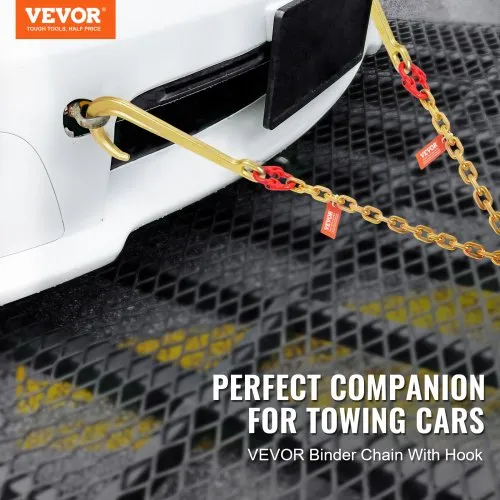
A bridle chain is a short rigging assembly that connects one pulling or lifting point to two or more attachment points on a load. Its legs meet at a common link, ring, or shackle, so a single winch line, tow hook, or hoist can act on the load through several contact points at once. Sharing the force between the legs keeps the load balanced, lowers the strain on each anchor, and helps stop the load from twisting, tipping, or drifting off line while it is pulled or raised. A hook on the end of each leg connects the chain to the load.
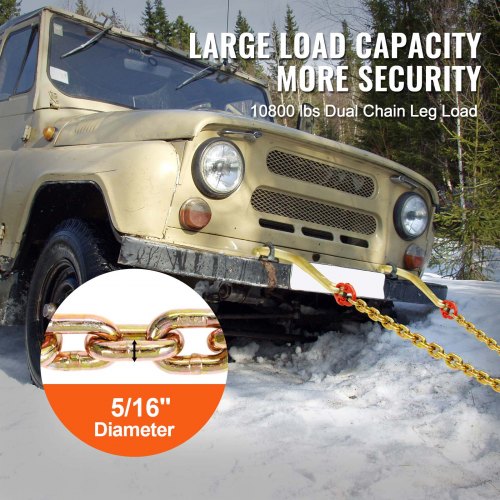
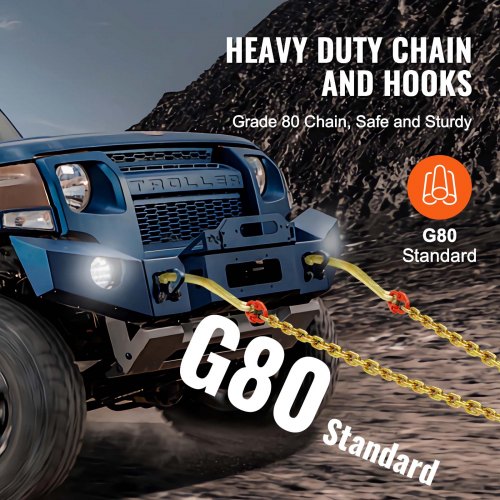
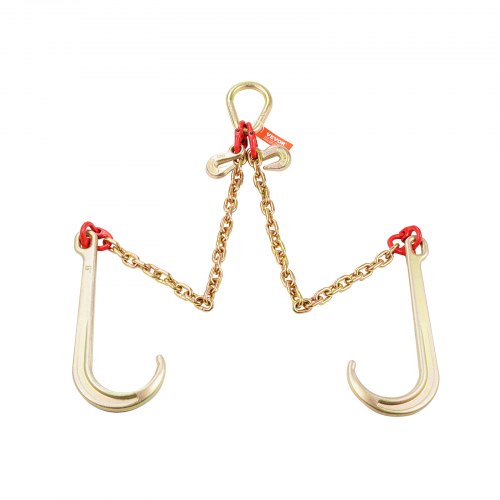
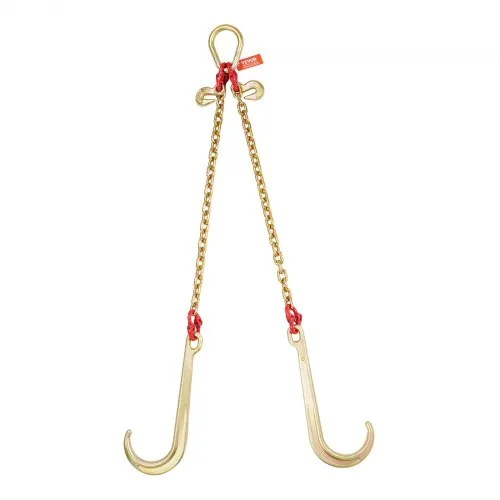
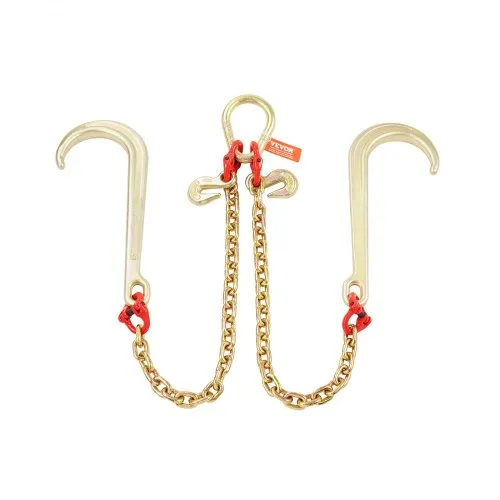
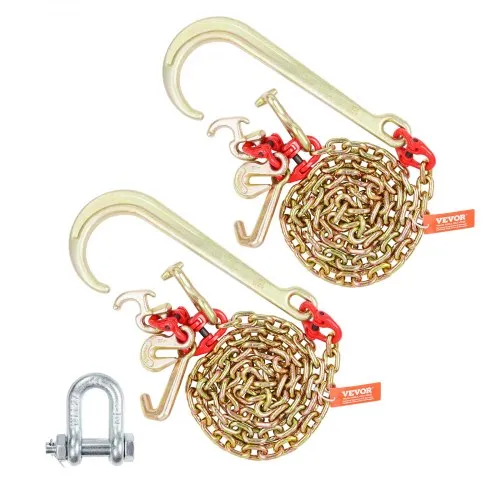
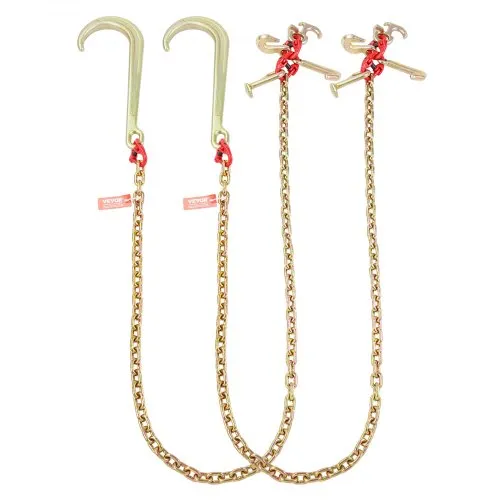
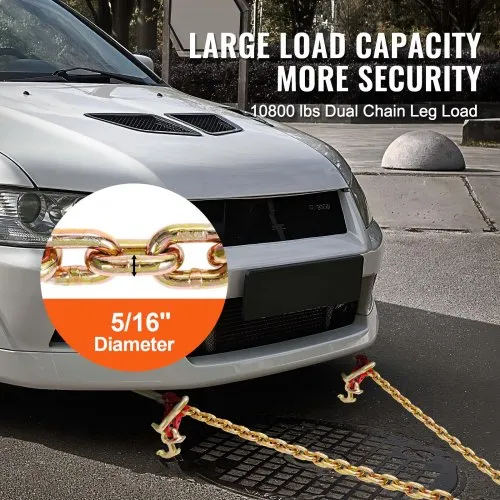
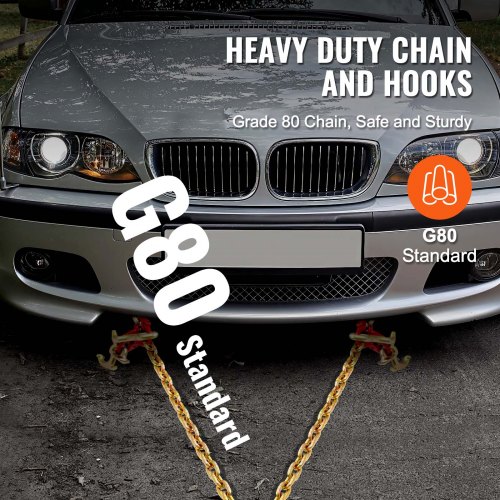
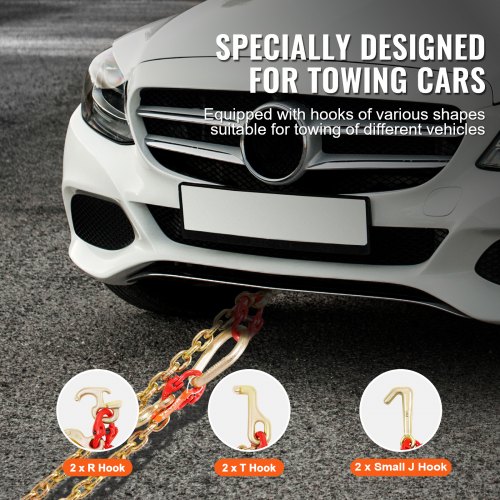
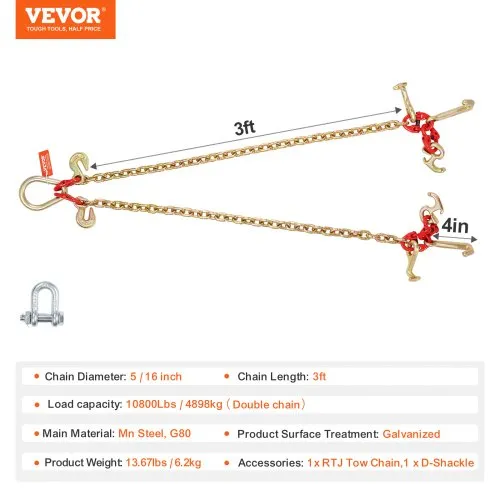
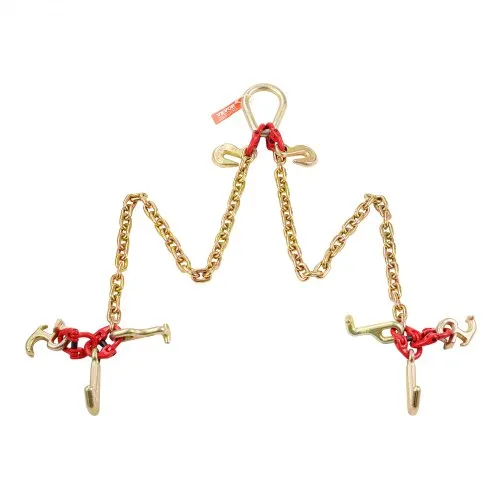
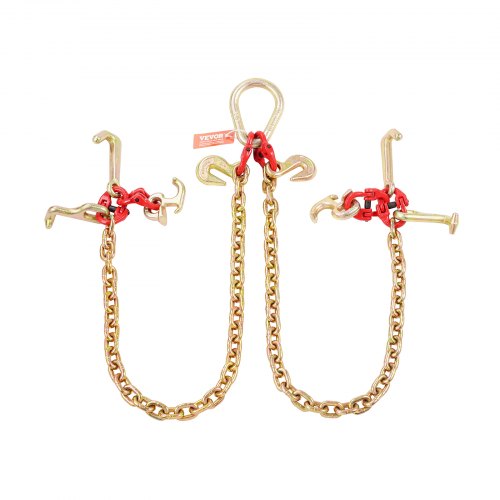
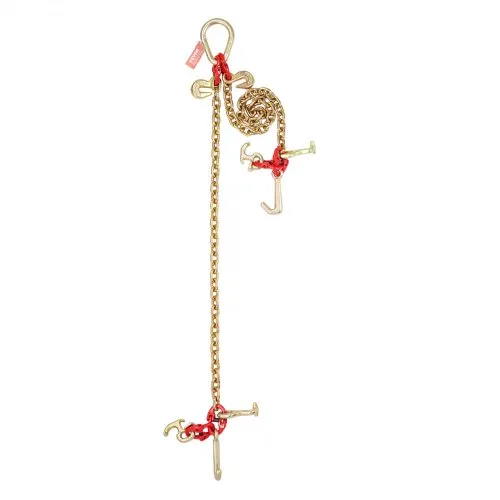
VEVOR bridle chains cover three main layouts. V bridle chains use two short legs of 2 or 3 ft in 5/16 or 3/8 in Grade 80 chain, joined at a shackle and fitted with J, T, R, or grab hooks. J hook chains are single legs of 6 or 10 ft with a 15 in J hook at one end and a cluster or grab hook at the other, giving more reach between truck and vehicle. For overhead work, four-leg chain slings hang from a master ring, while transport binder chains hold the load down once it is on the deck. Typical uses are winching cars onto rollbacks, wrecker recovery, flatbed hauling, and lifting engines or machinery.
Four things decide what you need:
- Attachment points: count the anchors on the load; two frame points suit a V bridle, one suits a J hook chain, and four suit a lifting sling.
- Pull direction: horizontal winch pulls need towing hooks, while vertical lifts need slings rated for overhead use.
- Working load: compare the listed rating with the load weight and leave a margin for shock loading and wide leg angles.
- Hook fit: match J, T, R, or grab hooks to the frame rails, slots, and axles on the vehicles you handle most.
Pair your bridle with the right winch line, straps, and binders from the full towing equipment range, or explore lifting hardware across the chain, wire and rope collection.
Bridle Chain Types at a Glance
Use this overview to match each layout to the anchors and pull direction you deal with most.
| Type | Attachment Points | Hook Ends | Load Direction | Selection Note |
|---|---|---|---|---|
| V bridle chain | 2 legs from one shackle | Large J, T, R or grab | Horizontal winch pull | Spreads pull across two frame points |
| J hook chain | 1 leg | 15 in J plus RTJ cluster or grab | Horizontal pull or tie-down | Most reach; pair two for wide frames |
| 2 leg lifting sling | 2 legs from master ring | Latched hooks, adjusters | Vertical lift | Balanced two-point lifts like engines |
| 4 leg chain bridle | 4 legs from master ring | Grab or sling hooks, adjusters | Vertical lift | Keeps irregular loads level on a hoist |
VEVOR Bridle Chains for Safe, Reliable Lifting and Towing in Any Application
Are you having trouble finding bridle chains that fit your rigging system and load requirements? A poorly selected bridle can transfer loads, put stress on attachment points, and result in hazardous working circumstances. The proper chain configuration influences both capacity and safety. Bridle chains from VEVOR are designed for precise load distribution in large recovery activities, towing operations, and industrial worksites when failure is simply not an option.
Chain Configurations Explained: V, J Hook, and 4 Leg Bridle Chains
The cornerstone of safe rigging and towing is knowing which chain configuration works best for your application. VEVOR offers a variety of configurations, each designed to address specific load-handling challenges across various settings and sectors.
V Bridle Chain for Balanced Two-Point Load Distribution
One of the most popular rigging setups in construction and industrial contexts is the V bridle chain. When suspended under strain, its two chain legs, which are connected at the top by a master link, form a V shape. By distributing weight equally between the load's two attachment points, this design avoids tipping or uneven tension, which could damage machinery or cause mishaps. Because VEVOR's V bridle chains come in a variety of leg lengths and chain grades, riggers may exactly tailor the sling angle to the load geometry.
The sling angle is crucial because each leg's stress increases dramatically as the angle between the chain legs exceeds 60 degrees, thereby reducing the effective working load capacity. Riggers have the information they need to operate safely thanks to VEVOR's product specifications, which include rated capacity at both 30-degree and 45-degree angles. For lifting steel beams, equipment, and prefabricated parts, overhead cranes, hoists, and forklifts frequently use V bridle chains from VEVOR. There is no weak point at the top of the V design because the master link is forged and rated to support the combined leg load.
J Hook Chains and J Hook Tow Chains for Recovery and Towing
J hook chains are designed specifically for flatbed trailer load securement, equipment towing, and vehicle recovery. Without additional hardware, the J-shaped hooks at either end may quickly snag on frame rails, axle housings, tow eyes, and recovery points. The working load limit of VEVOR's J-hook tow chains is far higher than that of conventional proof chains of the same size, as they are made from Grade 70 transport chain, which is the accepted standard for towing and load securement in North America.
Because the J hook profile is forged rather than stamped, it can withstand the stress loads common in vehicle recovery situations without losing its shape. The rapid shock stress on a tow chain during the extraction of a trapped truck or piece of equipment might be significantly greater than the vehicle's static weight. VEVOR accounts for this dynamic loading when rating its J hook tow chains. From small coupler connections between a tow truck and a passenger car to the longer distances required to maneuver large equipment off soft ground, chain lengths range from 4 feet to 20 feet. During the recovery procedure, VEVOR J hooks' safety latches guard against unintentional disengagement.
4 Leg Chain Bridle for Heavy and Uneven Load Distribution
The most powerful configuration in VEVOR's rigging array is the four-leg chain bridle, which can handle loads that are too big, heavy, or irregularly shaped for a two-leg setup. The four-leg bridle, which spreads weight uniformly and offers remarkable stability during lifts, attaches to four spots on the load simultaneously using four separate chain legs that extend from a central master ring. When lifting HVAC equipment, large steel fabrications, industrial tanks, and prefabricated wall panels, loads where any tipping or swaying during the lift poses a major hazard, on building sites, this design is common.
For level lifts, VEVOR's 4 leg chain bridle products feature equal-length legs with grab hooks or sling hooks at each end, depending on use. Riggers can compensate for irregular attachment-point spacing by adjusting the length on-site with adjustable versions, such as shortening clutches. There are no compatibility problems on the crane side of the connection because the central master ring on VEVOR's four-leg bridles is sized to fit typical hook apertures on overhead cranes and hoists. The fabrication of Grade 80 alloy steel offers the strength-to-weight ratio required for large industrial lifts without making the rigging set difficult to handle or store.
Selecting the Right Configuration for Your Specific Job
The number of attachment points on your load, the load's center of gravity, and whether the application is lifting or towing are the three main considerations when selecting among a V bridle, J hook tow chain, and 4 leg chain bridle. J hook tow chains are the best option for towing and recovery because their Grade 70 chain and hook geometry are designed to withstand horizontal pulling forces. A V bridle chain provides clean, even load distribution for overhead lifting with two balanced attachment points.
The only design that offers the required stability for big or unbalanced loads needing four-point control is the four-leg chain bridle. VEVOR's product line covers all three, and each listing has a detailed use-case description that makes it easy for customers to match the configuration to their needs. Even though a V bridle might theoretically carry the load, the four-leg alternative always offers more control when in doubt; in professional circumstances, the additional stability is worthwhile.
Matching Hooks to Anchor Points
Once the layout is chosen, the hook on each leg decides how securely the chain seats, so check the anchor before every hookup.
| Anchor Point | Hook to Use | Watch For | Why It Fits |
|---|---|---|---|
| Frame rail or crossmember | Large 15 in J hook | Load riding on the hook tip | Long shank reaches over thick rails |
| Factory tie-down slots | T hook | Rusted or burred slot edges | Locks into slots made for tie-down |
| Rear axle tube | R hook | Brake lines and sensor wires | Curve wraps the tube without sliding |
| Small slots on light vehicles | Small J hook | Thin sheet metal at the slot | Narrow throat fits where a large J cannot |
| Shortening a leg | Grab hook | Twisted links in the hook | Holds any link to take up slack |
| Winch or crane hook | D-shackle or master ring | Pin not fully seated | One point joins both legs before the pull |
Weight Capacity and Material Quality in VEVOR Bridle Chains
Your bridle chains' ability to function securely over years of rigorous use depends on the chain grade and material, once you have chosen the proper arrangement. VEVOR uses established steel grades to construct its bridle chains, and each product has a clearly defined operating load limit.
Chain Grades and Working Load Limits Explained
Bridle chains are produced in several grades, including Grade 43, Grade 70, Grade 80, and Grade 100, each of which represents the tensile strength and matching working load limit of the steel. Although overhead lifting is not advised, grade 43 proof chain is appropriate for light general-purpose applications. VEVOR's J hook tow chains use Grade 70, the gold standard for transportation and towing, which is about 20% stronger than Grade 43 and has Department of
Transportation accreditation for load securement. For V bridle chains and four-leg chain bridles intended for crane and hoist use, VEVOR uses grade 80 alloy steel, which requires minimal overhead lifting. For essential lifts where minimizing rigging weight is crucial, Grade 100 offers the best strength-to-weight ratio available. All bridle chain items have operating load restrictions clearly marked by VEVOR, and each set is proof-tested before shipment. Never exceed the specified WLL, as actual chain stress can greatly exceed the static load figure under severe sling angles or shock loading.
Material Construction and Corrosion Resistance for Long-Term Use
The alloy steel used to make VEVOR bridle chains has surface treatments that prevent corrosion and wear, which reduces the chain's lifespan in field settings. While the underlying alloy steel retains its specified strength even after prolonged exposure to moisture and dirt, zinc plating and self-colored finishes guard against surface rust during storage and outdoor usage.
There is no weak-link mismatch in the assembly because all hardware parts, including master links, grab hooks, J hooks, and connecting links, are made of the same grade steel as the chain. Heat-treated hooks retain their geometry even after repeated usage because they are resistant to deformation under load. VEVOR advises checking chains after every use and replacing any links that show pitting, straining, or cracking in chemical or marine settings, where the risk of corrosion is greatest. Service life is greatly increased by proper storage, such as coiling on a dry rack instead of heaping on wet concrete. Bridle chains from VEVOR are pre-assembled and ready to use right out of the box.
Bridle Chain Best-Seller Comparison
These five listings show how chain size, length, hook set, and capacity separate bridles that look alike at first glance.
| Product | Layout | Chain Size | Length | Hook Set | Load Capacity | Extras | Best For |
|---|---|---|---|---|---|---|---|
| V Bridle Chain 5/16 x 2 ft, R Hooks | Two-leg V | 5/16 in | 2 ft | Large J, large R, grab | 9,260 lbs | D-shackle | Only large R hook here; axle tube pulls |
| V Bridle Chain 5/16 x 2 ft, T Hooks | Two-leg V | 5/16 in | 2 ft | Large J, T, grab | 9,260 lbs | D-shackle | T hooks on 5/16 chain; slotted tie-down frames |
| V Bridle Chain 3/8 x 2 ft, T Hooks | Two-leg V | 3/8 in | 2 ft | Large J, T, grab | 15,600 lbs (both legs) | D-shackle | Highest capacity here; only 3/8 in chain |
| J Hook Chain 5/16 x 6 ft, RTJ Cluster | Single leg | 5/16 in | 6 ft | Large J, RTJ cluster, grab | 5,400 lbs | D-shackle | Longest reach; single or paired hookups |
| V Chain Bridle 5/16 x 3 ft, DOT | Two-leg V | 5/16 in | 3 ft | Large J, small J, T, grab | 9,260 lbs | D-shackle, manual | Only DOT-certified pick; longest V legs here |
Why Choose VEVOR Bridle Chains?
At low weights, VEVOR bridle chains offer proven safety ratings and professional-grade strength. Every product, from heavy-duty 4-leg chain bridles to V bridle chains and J hook tow chains, is constructed to rated standards and backed by VEVOR's dependable after-sales support. Do not skimp on the hardware that connects you to your load; instead, explore VEVOR's full selection of bridle chains and outfit your operation with reliable rigging for every task.
FAQs
What is the difference between a V bridle chain and a 4 leg chain bridle?
For balanced loads, a V-bridle's two legs allow two-point load distribution. For large, heavy, or irregularly shaped cargo where there is a larger risk of tipping, a four-leg bridle attaches to four places and offers more stability.
Are VEVOR J hook tow chains rated for vehicle recovery?
Indeed, VEVOR J-hook tow chains employ Grade 70 transport chain, the recognized benchmark for load securement and towing. They have forged J hooks with safety latches for a secure fit and are rated for dynamic tow weights.
Can bridle chains be used for overhead lifting?
For overhead lifting, only bridle chains made of alloy steel with a grade of 80 or above are appropriate. Grade 80 steel is used in VEVOR's lifting-specific V-bridle and four-leg chain-bridle products, which have clearly stated working load limits for user safety.
How do I determine the correct working load limit for my lift?
After determining the overall load weight, account for the sling angle. Effective WLL decreases as the legs spread beyond 45 degrees. Never exceed the product's indicated WLL, and always use a bridle chain rated higher than your calculated requirement.
Will a bridle chain sling last longer than a wire rope sling?
In most rough-duty work, yes. Alloy chain slings resist abrasion, heat, and crushing better than wire rope, and wear shows clearly at each link during inspection. Wire rope is lighter and more flexible but frays on sharp edges. Retire either type once parts are stretched, cracked, or gouged.
What compliance and safety standards apply to bridle chain slings?
In the US, alloy chain slings used for lifting fall under OSHA 1910.184 and ASME B30.9, which call for a legible tag showing grade, size, and rated load, plus regular inspection. Road tie-down chain follows DOT cargo securement rules, so look for DOT certified listings.
What chain grade should I use for a V-bridle on a tow truck?
Grade 80 alloy is a common choice, since it carries more working load than Grade 70 transport chain of the same size. Every V bridle in this category is listed as Grade 80, including the 3/8 in V bridle. Match hooks and shackles to the same rating.
What is the difference between a transport tow chain and a V-bridle chain?
A transport chain is one straight length, often 10 to 20 ft with a hook at each end, used for towing and tying loads down. A V bridle has two short legs joined at one shackle, so a single winch line pulls evenly on two frame points.
