Car Mono Amplifiers


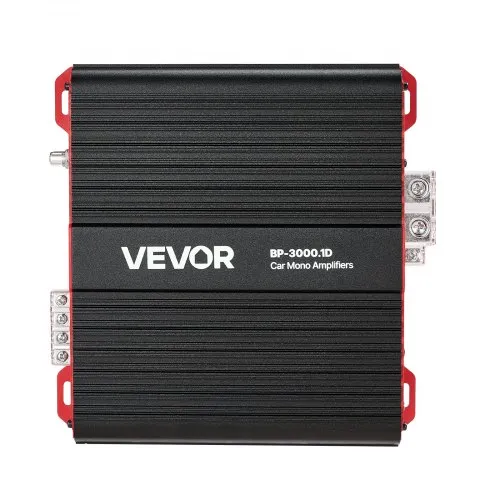
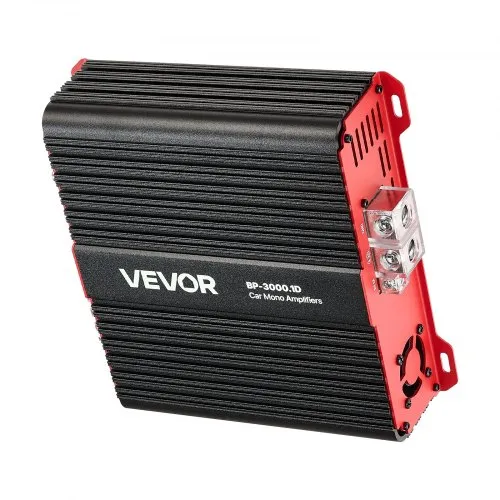
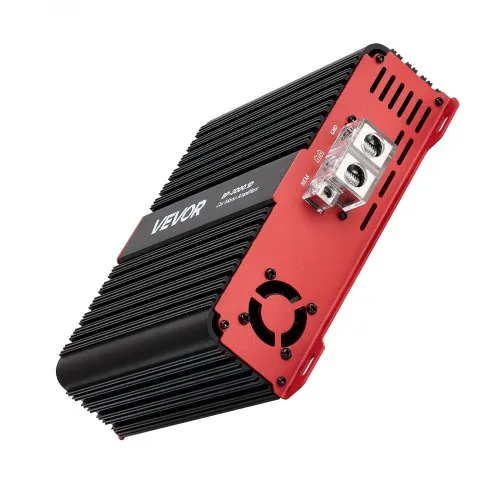









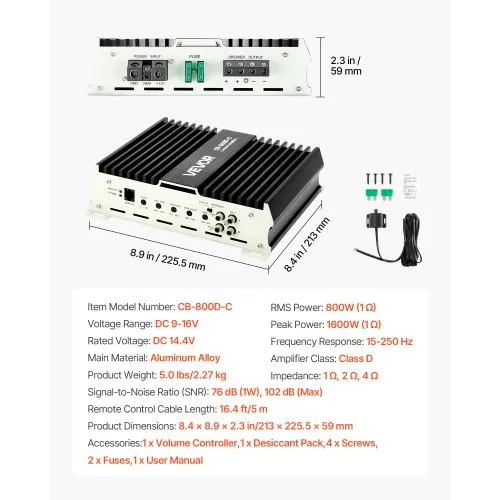













Results for Car Mono Amplifiers
VEVOR offers a wide selection of car mono amplifiers designed to deliver clear, powerful sound to every driver. Our selection of monoblock car amplifiers covers all power levels and vehicle types, whether you are designing a bass heavy system or replacing your factory audio setup. VEVOR's comprehensive coverage ensures you find the ideal mono amplifier for car audio performance, from small installations to high-output setups.
VEVOR Monoblock Car Amplifiers for Deep Bass and Powerful Sound Control
Do you need a dependable monoblock car audio amplifier that consistently delivers crisp, distortion free bass? More than just increasing volume, a quality car audio monoblock amplifier gives you better overall sound staging, clearer low-end response, and precise control over your subwoofer. Whether you are building a competitive audio system or traveling every day, VEVOR's mono car amplifiers are designed for practical performance.
Power Output & Channel Configuration in Car Mono Amplifiers
A solid car audio build starts with selecting the appropriate power output and channel arrangement. Knowing the wattage ratings, impedance loads, and Class D efficiency of car mono amplifiers can determine whether your system performs reliably or not.
Understanding RMS vs Peak Power in Mono Amplifiers
RMS (Root Mean Square) power, not peak power, is the most important specification to comprehend when assessing car mono amplifiers. Peak power is a short-burst rating frequently used for marketing, whereas RMS is the continuous, real-world power the amplifier can deliver without distortion. For instance, during typical listening sessions, a 500W RMS mono car audio amplifier will reliably deliver that power to your subwoofer. A device marketed at 1000W peak, on the other hand, may reach clipping at around 400W. Over time, clipping can harm subwoofer voice coils and cause distortion.
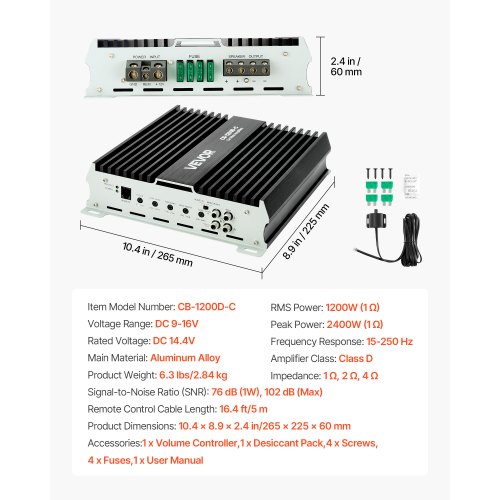
The VEVOR car mono amplifiers have conservative, realistic ratings. On a VEVOR monoblock amplifier for car applications, the RMS rating represents tested, continuous performance under actual working conditions. As a result, your subwoofer receives a steady, clear signal, yielding a precise, tight bass response. A mono vehicle amplifier in the 300W to 600W RMS range is adequate for a single 10" or 12" subwoofer in the majority of typical daily-driver systems. 1000W RMS or more is often used for dual-sub installations or performance builds. To prevent underdriving or overpowering your subwoofer, always match the RMS output of your amplifier to its RMS power handling.
Class D Technology and Efficiency in Monoblock Amplifiers
For good reason, Class D amplification is now the norm for car audio monoblock amplifiers. Class D amplifiers achieve efficiency ratings of 70–90% or more by converting audio signals into high-frequency pulse-width modulated (PWM) waves, in contrast to traditional Class A/B circuits.
Because great efficiency results in less heat generation and current draw from your car's electrical system, this is important for car audio builds. Compared to a similar Class A/B device, a monoblock car amplifier operating at 85% efficiency will use substantially less current, lowering the possibility of alternator strain or battery drain during prolonged listening sessions.
Modern Class D topology is used in VEVOR's mono car amplifiers, enabling small chassis designs with significant output.
A standard VEVOR car audio monoblock amplifier can power a subwoofer with authority while fitting beneath a seat or in a small corner of the trunk.
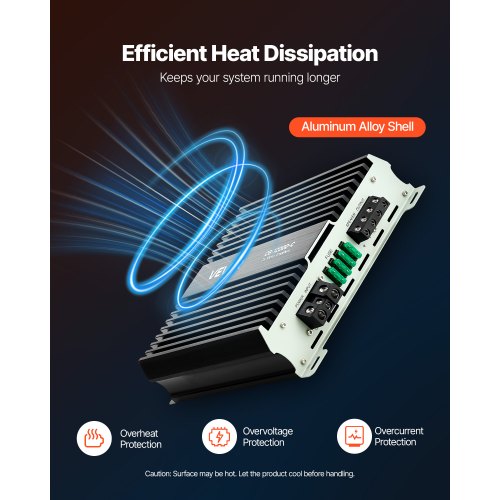
Longer operational lifespans are also associated with lower heat output. Class D designs lessen the thermal load on internal parts, such as capacitors, MOSFETs, and the PCB itself. Choosing an effective monoblock amplifier for car use is one of the best choices you can make if you are designing a system that will last years rather than months. This is reflected in VEVOR's designs, which include heat-protection circuits that automatically reduce gain before damage occurs.
Impedance Matching and Ohm Load Compatibility
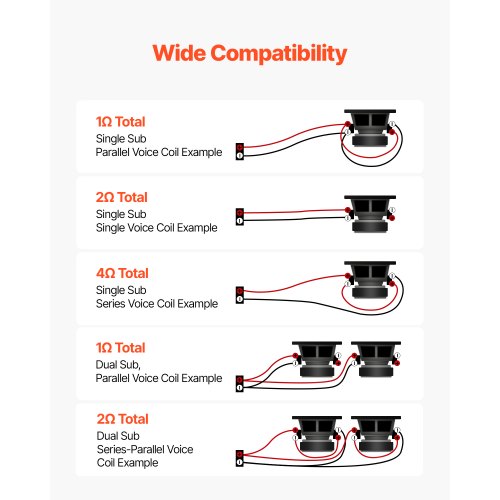
One of the most overlooked factors in choosing a car mono amplifier is impedance matching, despite its direct impact on longevity and performance. The majority of subwoofers have an impedance rating of either 2 or 4 ohms, and for your amplifier to function properly, it must be stable at that load.
Depending on the impedance, many car mono amplifiers have variable power ratings. A monoblock car amplifier, for example, might be rated at 500W RMS at 2 ohms but 300W RMS at 4 ohms. You will get additional power if your subwoofer is connected to a 2-ohm load, but only if your amplifier is "2-ohm stable."
The minimum stable impedance and power output at each load of VEVOR's car audio monoblock amplifiers are explicitly stated. Customers may better match their subwoofer wiring layout to the appropriate amplifier gain stage thanks to this openness.
Additional flexibility is provided by dual-voice-coil (DVC) subwoofers, which enable parallel or series wiring to achieve various impedance loads. The amplifier sees a 2-ohm load from a parallel-wired DVC 4-ohm sub, which may provide more headroom. You can get the most out of your VEVOR system without risking damage to your equipment by understanding the interaction between your subwoofer and your mono car audio amplifier.
Gain Structure and Signal to Noise Ratio
One of the most commonly misinterpreted controls on any vehicle mono amplifier is the gain setting. Many people use the gain knob as a volume control, turning it up to increase output. The gain control is actually a sensitivity adjustment that synchronizes the output voltage of your head unit with the input level of your amplifier. Your car audio monoblock amplifier will receive the strongest possible signal from the source without clipping if you set the gain correctly. This feature leads to the cleanest bass reproduction and the highest signal-to-noise ratio (SNR).
A high signal-to-noise ratio (SNR), commonly measured in decibels (dB), indicates that the amplifier generates very little background noise, hiss, or hum relative to the audio signal. The wide input sensitivity ranges of VEVOR mono car amplifiers allow for both high-voltage preamp outputs (4V+) and low-voltage head unit outputs (200mV). They are compatible with digital signal processors (DSPs), aftermarket head units, and factory radios due to their adaptability. Before modifying the amplifier gain, set your head unit volume to 75–80% of its maximum for optimal results. Find the clipping threshold on your monoblock amplifier for car use with a multimeter or oscilloscope, then take a step back from there. A proper gain structure ensures your VEVOR vehicle mono amplifier performs at its best every time you drive, protects your subwoofer, and reduces noise.
Features & Installation of VEVOR Car Mono Amplifiers
Your automobile mono amplifier system will be more dependable, easier to tune, and sound better over time with the correct features and a clean installation. Both novice and seasoned installers will find it easier to set up VEVOR's monoblock amplifiers thanks to their useful controls and protective circuits.
Key Features to Look for in a Monoblock Car Amplifier
A variety of integrated features found in contemporary car mono amplifiers significantly enhance both usability and sound quality. You can select the ideal VEVOR monoblock amplifier for your particular setup by knowing which qualities are most important.
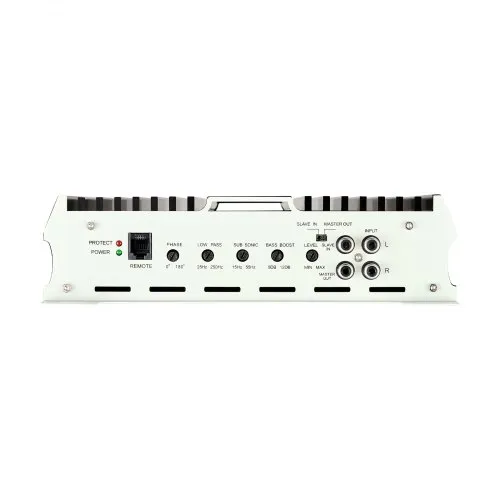
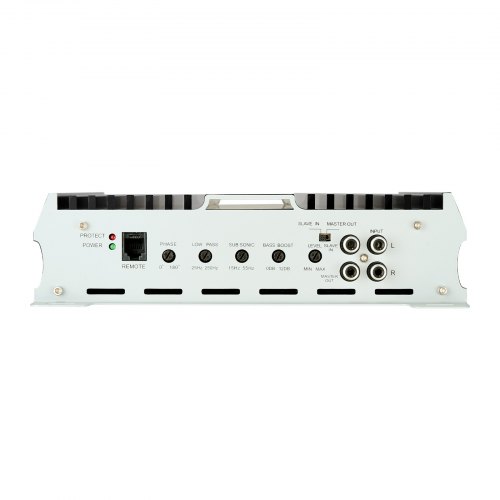
Any subwoofer amplifier must have a variable low-pass filter (LPF). This crossover control lets you set your subwoofer's frequency ceiling, usually between 50 and 250 Hz, so it reproduces bass sounds exclusively. Your sub will try to replicate midrange material without an LPF, which can cause distortion and decreased clarity.
Equally crucial is a subsonic filter, particularly when employing ported enclosures. It removes frequencies that can overexcite a subwoofer cone and result in mechanical damage below 20 Hz, which is beyond the range of human hearing. For complete safety, several VEVOR car audio monoblock amplifiers feature subsonic filter settings.
You can add 0–6dB of amplification at a chosen bass frequency using an optional bass boost control. When used sparingly, it gives bass guitar lines and kick drums more force. With VEVOR mono car amplifiers, drivers may modify bass output from the dashboard without climbing into the trunk, thanks to remote bass level controls.
Protection circuits, such as DC offset protection, thermal shutdown, and short circuit protection, are not negotiable. These characteristics ensure that, in the event of a malfunction, your monoblock car amplifier will shut down safely rather than damaging your subwoofer or car wiring.
Installation Tips for Car Mono Amplifiers
It is just as crucial to install a mono amplifier for car audio effectively as it is to select the appropriate one. Inadequate installation lowers performance, produces noise, and may even pose a risk to public safety. Your VEVOR vehicle mono amplifier will function precisely as intended if you follow a clean, methodical procedure. Power and ground wiring should come first. For the amplifier's rated output, use the appropriate AWG (American Wire Gauge) wire. Usually, a 500W RMS monoblock amplifier needs a 4-gauge power and ground connection. To avoid interference, run the battery's power line through a firewall grommet and keep it away from signal cables. Within eighteen inches of the amplifier, the ground wire should attach to a bare metal surface on the car's chassis rather than a painted bolt or bracket.
Place an inline fuse on the power wire within eighteen inches of the battery. In the event of a short circuit, this device safeguards the wiring in your car. The fuse rating should be equal to or marginally higher than the maximum current demand. To reduce alternator whine and ground loop noise, signal cables or RCA interconnects should run down the other side of the car from the power connection. For the purest signal transfer, use high-quality, shielded RCA cables. Install your VEVOR monoblock car amplifier in a well-ventilated area. Keep it out of enclosed areas where heat can build up. Before completing the installation, make sure all connections are secure, check the polarity twice, and test at low volume. Every watt that your automobile mono amplifier is intended to produce can be unlocked with a rigorous installation process.
Why Choose VEVOR Car Mono Amplifiers?
At low costs, VEVOR car mono amplifiers offer professional-grade features, Class D efficiency, and honest power figures. Our selection includes monoblock constructions with high output and entry-level mono car amplifiers to suit every setup and price range. VEVOR makes it easy and confident to improve your subwoofer system with dependable after-sales support and a commitment to construction quality. Take your in-car music to the next level with our entire selection of car mono amplifiers.
FAQs
What is the difference between a mono amplifier and a 2-channel amplifier for car audio?
A mono amplifier is designed for subwoofers and provides a single channel of power. A two-channel amplifier powers two speakers. For dedicated subwoofer applications, mono amplifiers are the recommended option because of their superior bass control and higher RMS output.
How do I know what size monoblock car amplifier I need for my subwoofer?
Align the amplifier's RMS output with your subwoofer's RMS power handling. Select a monoblock amplifier rated 400W–600W RMS at the subwoofer's impedance if your sub can withstand 500W RMS. Steer clear of severely underpowering or overpowering the subwoofer.
Can I use a car mono amplifier with a factory head unit?
Indeed. The majority of VEVOR car mono amplifiers are compatible with factory head-unit speaker outputs via a line output converter (LOC) and offer a wide range of input sensitivity levels. Just route the RCA output to the amplifier and attach the LOC to the rear speaker wires.
What gauge wire do I need to install a monoblock amplifier?
The amplifier power draw determines the wire gauge. Use a 4-gauge power and ground cable for amplifiers up to 500W RMS. Use 1/0-gauge wiring for 1000W RMS and higher. Install an inline fuse within eighteen inches of the battery at all times.
Do VEVOR mono car amplifiers have built-in protection circuits?
Indeed. Thermal shutdown, short circuit protection, and DC offset prevention are features of VEVOR mono car amplifiers. These circuits provide long-term dependability by preventing harm to the amplifier and the associated subwoofer under fault conditions.