Drill Jigs
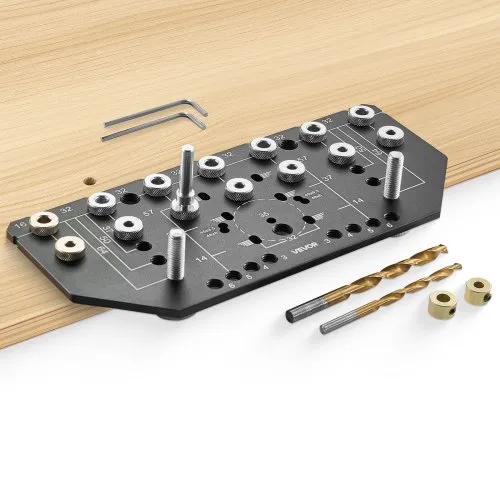


Results for Drill Jigs
VEVOR offers top-notch drill jigs for straight holes designed to guarantee reliable, repeatable drilling accuracy for a wide range of construction, furniture assembly, and woodworking tasks. Our extensive selection includes accurate 45 degree angle jigs, dependable dowel-drilling jigs, adaptable angle-drill jigs, and useful straight-hole drill jigs, removing uncertainty from any drilling activity. VEVOR addresses a wide range of drilling scenarios, whether you are putting together cabinet boxes, joining furniture frames, installing hardware, or making accurate dowel connections. For amateurs, woodworkers, and contractors who want consistently accurate results, VEVOR's sturdy construction, adjustable guides, and hardened-steel bushings make expert-grade drilling accuracy accessible and affordable.
VEVOR Professional Drill Jigs for Consistent and Accurate Hole Placement
Do you want to drill holes that are accurately positioned and reliably straight without the need for costly equipment or years of experience? For woodworkers, cabinet builders, and do-it-yourselfers who require consistent accuracy across several workpieces without having to mark, measure, and realign for each hole, drill jigs are the ideal tool. VEVOR drill jigs solve the fundamental problem of achieving precision drilling without specialized training or expensive workshop equipment, whether you are building furniture that requires precisely aligned dowel joints.
Size Range & Application Types: Matching Your Jig to Every Project
To ensure accurate results across a range of woodworking and construction projects, choosing the appropriate drill jigs requires knowledge of available size configurations, suitable drill bit diameters, and application compatibility.
Drill Bit Diameter Ranges and Size Compatibility
Which joinery techniques and hardware installations your drill jigs can handle efficiently depends on their diameter compatibility. From tiny pilot holes to large-diameter shelf pin bores and structural dowel holes, VEVOR drill jigs are compatible with standard woodworking bit sizes (e.g., 3mm to 25mm, depending on the model). When driving fasteners close to corners where grain direction increases splitting susceptibility, smaller-diameter guides (3-6mm) are ideal for pilot-hole drilling for screws and hinges in cabinet construction. Standard dowel drilling jig designs for 8mm and 10mm dowels are the most commonly used sizes in furniture construction, producing strong mechanical joins without the need for adhesives. Mid-range diameters (6–12mm) handle the most popular woodworking applications.
Larger-diameter guides (12–25 mm) facilitate specialized applications such as large-diameter shelf pin systems, lock installation holes, and structural timber connections that may require larger dowel sizes for adequate load-bearing strength. Because switching between diameters just needs changing the steel bushing insert rather than buying separate jigs for each size, bushing sets with numerous diameter options within a single jig kit offer excellent adaptability. Instead of finding discrepancies after committing to workpiece placements, VEVOR's clearly marked diameter guidelines ensure proper bushing selection before drilling, reducing setup uncertainty.
Workpiece Thickness and Material Compatibility
Which drill jigs offer dependable performance without slipping, damaging surfaces, or producing unreliable results depends on the workpiece dimensions and material properties. Because VEVOR drill jigs feature changeable clamping mechanisms that securely hold jigs regardless of workpiece thickness within predetermined ranges, many models can handle material thicknesses from about 12mm for thin panel applications to 100mm or more for substantial timber joinery. Applications for thin materials, such as laminated panels, MDF shelving, and plywood cabinet sides, call for jigs with wide contact surfaces that distribute clamping pressure to avoid veneer damage or surface compression that detracts from the final product's appearance.
Because softer jig bodies flex during drilling, causing bits to stray from intended places and creating oblong holes that result in loose, weak joints, solid hardwood applications require jig designs that are stiff enough to withstand deflection under drilling pressure. Particleboard and MDF, two composite materials frequently used in low cost furniture and cabinet building, pose unique challenges due to their uniform structure, which reduces the natural grain resistance that helps guide bits in solid wood and requires more precise bushing alignment than in natural wood. Whether dealing with premium hardwoods, engineered panels, or softwood construction lumber across a range of project requirements, VEVOR's material specific usage guidance helps users choose the right clamping pressures and drilling rates for different workpiece compositions, ensuring consistent precision.
Specialty Jigs and Project Specific Configurations
Specialized configurations go beyond common perpendicular drilling applications to meet project-specific needs. By eliminating the need for individual measurements for entire rows of adjustable shelf support holes, shelf pin jigs with pre-spaced hole patterns at the widely used cabinet industry standard 32 mm increments convert laborious layout work into quick, reliable production fit for professional cabinet shops. For well-known slide brands, installation jigs for drawer slides place mounting holes at manufacturer-specified depths and heights, eliminating the need for time-consuming, costly trial-and-error fitting.
Without measuring each door separately, hinge boring jigs place European-style cup hinges at the required depths and separations from door edges, guaranteeing uniform door gaps and appropriate overlay dimensions throughout complete cabinet lines. VEVOR's jig kit line includes Kreg-style pocket hole jig configurations with self-clamping designs that automatically adjust drilling angles for varying material thicknesses and adapt to workpiece dimensions without user modification. These specialized applications demonstrate how focused drill-jig investments can significantly increase production speed and consistency beyond what is typically possible with careful hand layout, by eliminating the most time-consuming measurement and layout tasks in furniture and cabinet construction.
Angle Drill Jig Applications and Joint Types
Your drill jigs will give you the most value for your money across all woodworking methods if they can handle a wide range of projects. If you want to drill straight holes perpendicular to the sides of your workpiece, you need a reliable jig. Without one, you would have to carefully measure and mark each hole to get clean, precisely placed bores for shelf pins, dowel joints, and hardware mounting. Standard 90-degree arrangements are the building blocks of all furniture and cabinets. Angled applications open up a lot more artistic and structural options. For instance, a 45-degree angle jig enables drilling at compound angles for chair frames that need to be strong at angles other than straight on, for mitered corner joints that are strengthened with angled dowels, and for decorative leg to apron connections in table building.
When making face frames, drawer boxes, and furniture, where speed and ease of use are just as important as structural strength, pocket hole jigs are specialized angle-drill jigs that create joints that hold workpieces together as they are assembled. VEVOR's application-specific designs include registration stops and indexing systems that exactly position jigs relative to the edges of the workpieces. This way, the joint placement remains the same across multiple identical components, eliminating the need for separate measurements.
Material & Accuracy Features, Ensuring Precision and Long Term Reliability
Drill jigs made from suitable materials with precise features are essential for maintaining alignment during repeated use in demanding professional applications, thereby maximizing drilling accuracy and tool longevity.
Steel Construction and Bushing Quality
The quality of the material dictates whether drill jigs retain accuracy over hundreds of repeated uses or experience wear that destroys tolerance and impairs hole placement accuracy. The most important part is the hardened steel drill bushings, which are cylindrical guides that come into direct contact with revolving drill bits and face high abrasion forces that quickly erode unhardened materials. Over thousands of drilling cycles, high-quality VEVOR drill jigs maintain precise internal diameters within a tolerance of ±0.02mm thanks to hardened bushings with a hardness of 58–62 HRC (Rockwell Hardness). Because carbide-tipped bits readily erode softer brass or aluminum bushings used in economy jig designs, this hardness level prevents wear.
Cast aluminum or steel alloys used to manufacture the jig body give it the strength to resist flexing under drilling pressure while maintaining a reasonable total weight for handling. Since even slightly misaligned bushings routinely yield improper hole angles, which add up to considerable joint misalignment across multi-component assemblies, precise machining of bushing holes in jig bodies guarantees perpendicularity and accurate positioning. Instead of depending on users to make up for manufacturing errors during project work, VEVOR's manufacturing quality controls include post-machining inspection, which confirms bushing alignment within designated tolerances and guarantees delivered goods function to published accuracy criteria.
Registration Systems and Repeatability Features
Drill jigs go from being one-time positioning tools to production systems with repeatability features that deliver consistent results across large batches of parts. No matter how much the nominal and actual thicknesses differ, self-centering mechanisms in doweling jig kit designs automatically place the guides along the workpiece's centerlines. Automatic centering ensures that the opposite dowel holes line up perfectly, even if the two pieces that fit together have slightly different thicknesses. This prevents the pieces from misaligning, which can lead to uneven surfaces on finished furniture. When moving similar parts, edge registration fences prevent misalignment by keeping them away from the workpiece edges.
Cabinet shops that produce dozens of identical door frames or drawer fronts greatly benefit from indexed stops that reposition jigs identically without measuring between components. Indexing stops and repetitive positioning systems allow production drilling where identical hole patterns repeat across multiple workpieces. The drill jig models from VEVOR feature locking mechanisms that prevent angle drift during drilling and provide positive stop angle settings at common woodworking angles (15°, 22.5°, 30°, 45°, 60°, and 90°). Together, these precision features ensure that drill jigs deliver their main selling point.
Why Choose VEVOR Drill Jigs?
For woodworking and construction tasks, VEVOR provides a comprehensive range of drill jigs that combine precision engineering, long-lasting materials, and exceptional pricing. Our selection includes accurate 45 degree angle drill jigs for angled applications, adaptable angle-drill jig solutions for compound joinery, dependable dowel-drilling jig systems for furniture assembly, and a useful straight-hole drilling jig for common daily tasks. VEVOR makes professional-grade drilling precision affordable for all skill levels with all-inclusive jig kit configurations and hardened-steel bushings that retain accuracy over time. Explore our entire collection now to achieve consistently accurate results that elevate the caliber of your projects. Buy today!
FAQs
What drill jig size do I need for standard furniture dowel joints?
The majority of furniture dowel joints require matching bushing sizes since they use 8mm or 10mm dowels. The VEVOR doweling jig kit combinations cover most common furniture joinery applications, from delicate decorative pieces to larger structural assemblies, and come in both sizes, plus guides for 6mm and 12mm dowels.
Can I use a 45 degree drill jig on both wood and metal?
Yes, high-quality hardened-steel bushings can handle both materials well. Use the proper drill bits: HSS or cobalt bits for metal, and brad point bits for wood. For metal applications, lower the drilling speed and use cutting fluid to avoid overheating, which can harm the jig bushings and the workpiece.
How do I maintain consistent hole depth with drill jigs?
Set the collar stops or drill bit depth stops to the necessary depths before drilling starts. Using tape as a backup reference, mark the depth of the bits. In repetitive production drilling applications, the VEVOR jig for drilling straight holes model provides uniform depth across all holes by accommodating conventional depth-stop collars.
What makes a doweling jig kit more accurate than freehand drilling?
Hardened bushings physically limit the drill bit's movement, preventing it from straying, even when using a cautious freehand technique. Self-centering systems ensure that opposing holes align spontaneously. By eliminating positioning errors between components, consistent edge registration ensures joints assemble without gaps or misaligned surfaces.
Are VEVOR drill jigs suitable for beginners?
Yes. Beginners especially benefit from drill jigs, as they eliminate the need for practiced technique to achieve precise freehand drilling. Insightful clamping mechanisms, clear markings, and comprehensive instructions ensure precise results from the start. With VEVOR drill jigs, many users can achieve very accurate hole placement even on their first project.