F-Clamps






































Results for F-Clamps
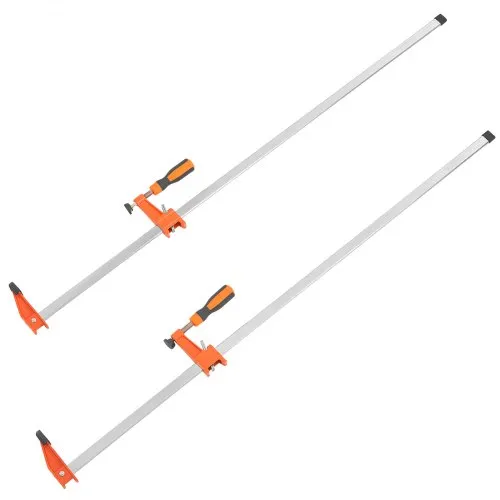
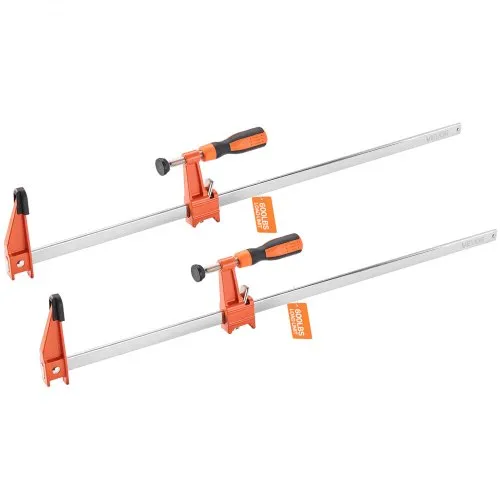
An F clamp is a hand-operated clamping tool named for the F shape its two arms make against a sliding bar. One jaw is fixed at the top of the bar, while the second jaw slides freely along the bar's length. That moving arm carries a threaded screw and a handle at its end. Once both jaws rest against the workpiece, turning the screw drives the sliding jaw inward and applies steady, adjustable pressure that holds the parts still. Backing the screw off releases the grip so the jaw slides away and the clamp opens fast. The sliding-arm design lets a single tool grip many different thicknesses securely.
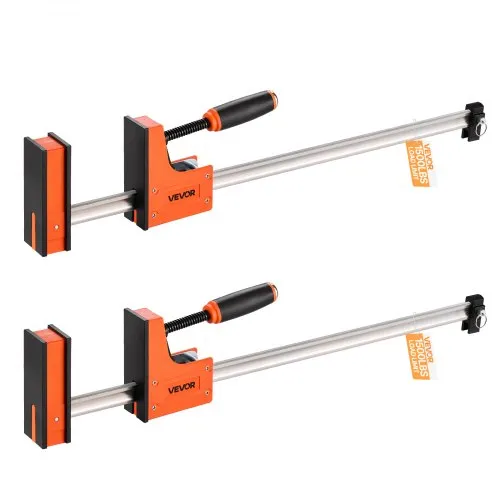
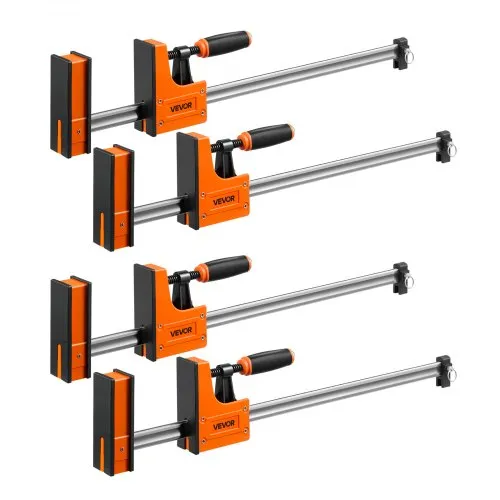
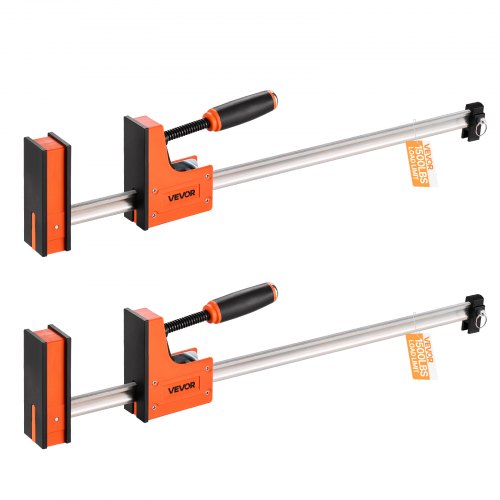
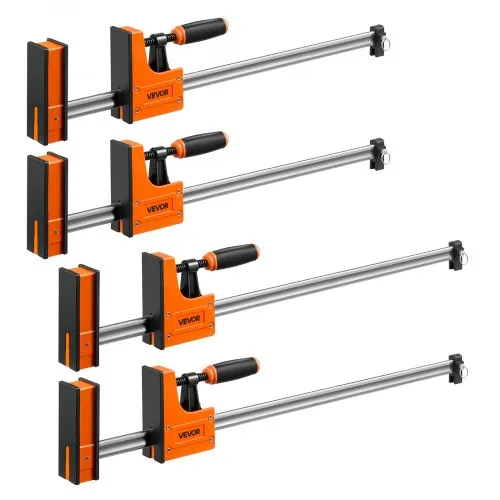
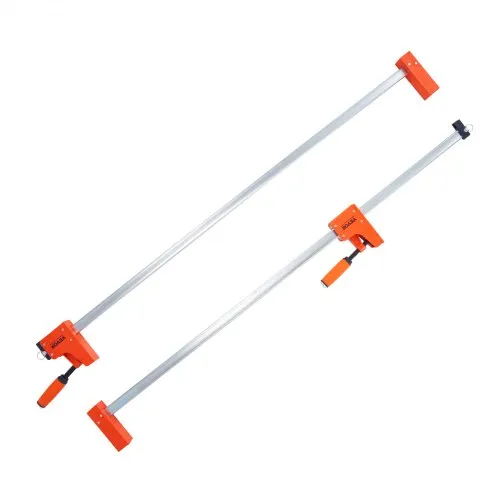
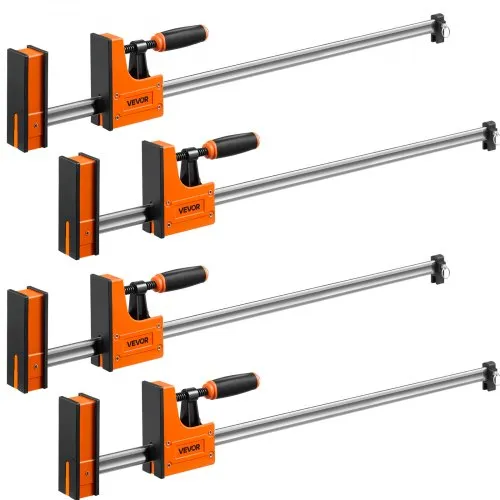
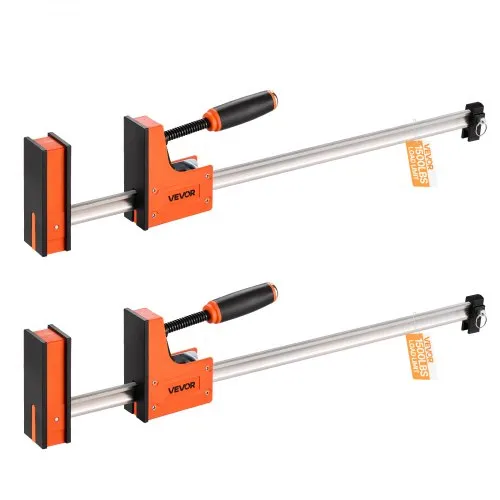
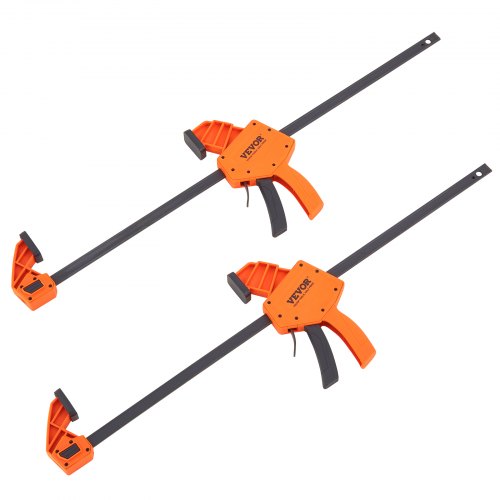
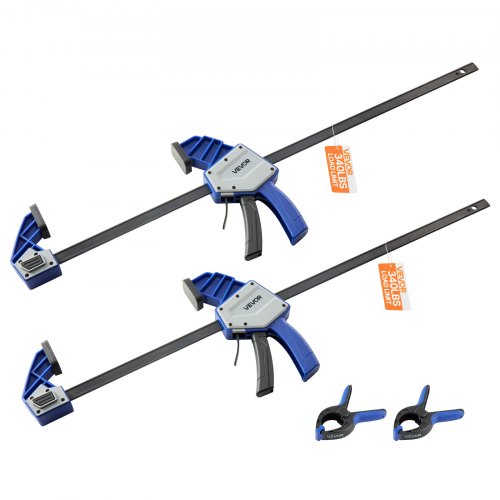
VEVOR F clamps come in a few core styles so you can match the tool to the task. Lockable screw F clamps in cast iron and carbon steel cover roughly 6 to 36 inch openings for everyday holding and glue-ups. Reversible clamp and spreader models add a second mode that pushes parts apart as well as drawing them together. One-handed trigger F clamps let you squeeze and release with a single hand for fast, light-duty holds. Parallel clamp sets use wide flat jaws and reach up to 50 inches to spread even pressure across large panels. Across the range, openings run from about 6 to 50 inches and load limits climb to around 1,500 lbs. Typical uses are woodworking glue-ups, cabinet and furniture assembly, jig and fixture setups, and light metal fabrication.
Four things decide which F clamp you need:
- Bar length and opening: measure your widest workpiece, then add a few inches of margin so the screw never bottoms out.
- Throat depth: deeper throats reach past the edge to clamp mid-panel, while shallow throats suit edge work, trim, and jigs.
- Clamping force: light trigger clamps handle delicate parts, while screw and parallel clamps supply the force hardwood glue-ups demand.
- Operation style: choose one-handed triggers for speed, locking screws for unattended cures, and parallel jaws for flat, even pressure.
Browse the full F clamp range to compare openings, jaw styles, and set sizes, then build a kit that covers your most common projects. Keep a few short clamps and a couple of long bars within reach so every repair and glue-up starts with the right tool.
F Clamp Types at a Glance
The four styles below work in different ways, so compare how each applies pressure before you pick a set.
| Sub-type | Operating Method | Opening Range Offered | Pad / Jaw Face | Selection Note |
|---|---|---|---|---|
| Lockable screw F clamp | Screw with locking handle | 6 to 36 in | Rigid cast faces, plastic pads | Holds corners unattended while glue cures |
| Clamp and spreader | Reversible screw, two modes | 24 to 36 in | Soft rubber pads | Doubles as a spreader to push parts apart |
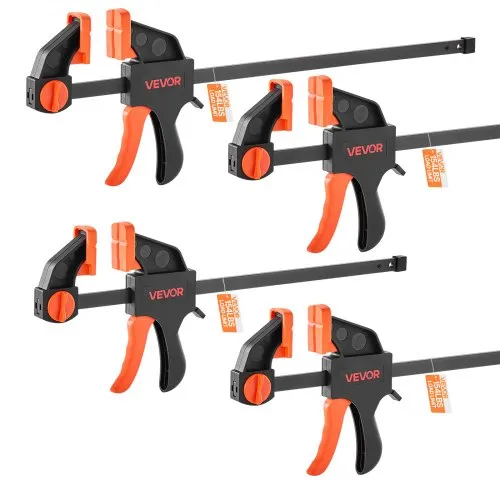
| One-handed trigger clamp | Single-hand trigger | 6 to 24 in | Compact plastic jaws | Frees your other hand to position the work |
| Parallel clamp | Screw with wide parallel jaws | 24 to 50 in | Wide flat faces | Keeps big panels flat under even pressure |
VEVOR F Clamps for Precise Woodworking and Metalworking Projects
Do you need to keep metal panels, frames, and other parts in place while drilling, welding, or gluing them? Adjustable bar reach, secure jaws, and reliable pressure make VEVOR F style wood clamps ideal for positioning workpieces correctly and locking them in place. Getting coordinated clamp sets is the best way to make sure you have the right tools for everyday jobs and bigger projects, whether you're upgrading your home workshop or stocking a busy professional bench.
Choosing F Clamps by Size, Throat Depth & Capacity
Choose F style clamps with the right bar length, throat depth, and binding force for your shop. This will make every glue-up, repair, and assembly go more smoothly. Instead of just picking the first clamp available, take a moment to make sure the tool is right for the material thickness and the project size.
Matching Bar Length to Workpiece Size
First, consider how far the jaws need to reach across your frames, panels, or stock. For small items like picture frames, drawer fronts, or boxes, 10–14-inch short F clamps are usually enough to span the work and still fit on a busy workbench. Medium-sized jobs like cabinet doors, shelves, and edge-glued boards work best with bars that are 20 to 30 inches long. This provides the extra reach needed to secure diagonal or cross-grain joints effectively. For longer worktops or stair treads, use longer bars so you can span the full width without pulling the clamp too far. It not only makes the hold stronger, but it also lets you place more than one F clamp along a joint to spread the pressure and keep it from breaking. You can depend on the same set of clamps more often if you choose bar lengths based on the sizes of your most frequent projects.
Throat Depth for Reach and Stability
The throat depth tells you how far in from the edge the clamp can grab. This has a big effect on how stable and flexible the clamp is. You can quickly glue up edges with shallow-throat F clamps, hold trim in place while you pin-nail it, or secure jigs to a table. When you need to clamp the middle of a wide panel, frame, or case side without crushing the edge profile, deeper-throat types are the best choice. As you review your choices, consider how often you work with face frames, wide drawer sides, or casework. Having a mix of shallow and deep-throat F clamps lets you get into tight spaces without having to make do with temporary setups. Giving the fixed jaw a little more throat depth also helps keep it straight to the work. This prevents cracking and helps evenly distribute pressure across the glue line during long cures.
Clamping Capacity, Pressure, and Safety Margins
For the bar length and throat depth, the clamping capacity (the largest space between the jaws) changes. If the stock is thin and the job is easy, you might only need a few inches of space. Torsion-box tops, laminated beams, or stronger workbench edges, on the other hand, need more clamping force and longer-lasting pressure. Check both the maximum opening and the clamping force of F clamps to make sure they can hold hardwoods and multi-layer glue-ups firmly without slipping.
Give yourself a measure of safety. Like, if you always clamp 3-inch material, pick clamps that can open to 4–5 inches without any trouble. You won't always be at the end of the screw that way. Using more than one woodworking F clamp across a joint spreads the force more evenly than tightening a single clamp too much. This keeps the surface from getting dents and keeps the glue from squeezing out too much. Make sure your clamps' pads are always clean so they apply the same amount of pressure.
Building a Versatile Clamp Set for Your Bench
It makes sense to build a small family of tools that can handle light assembly, deep reach, and heavy-duty glue-ups. That's because no single clamp size can handle every application effectively. Start by getting sets of clamps in the bar lengths you use most often. Then, for tabletops or casework, add a few longer models so you can clamp across the grain without stretching. If you keep a rack or wall mount close to your bench, you can quickly find matched pairs during a glue-up without having to dig through drawers. You will learn which combinations you use most often over time, and then you can strategically add to your collection rather than getting random sizes you never use.
Matching F Clamps to the Job
Once you know the sizing basics, this table pairs common projects with a clamp style and shows how many to keep on hand.
| Project | Recommended F Clamp Type | Clamps Typically Needed | Why It Fits |
|---|---|---|---|
| Edge-to-edge panel glue-ups | Parallel clamp | One every 6 to 8 inches | Flat parallel jaws spread pressure so panels stay flat |
| Cabinet and drawer assembly | Lockable screw F clamp | Four or more for square frames | Locking screw holds joints while glue cures unattended |
| Trim, jigs, and quick repairs | One-handed trigger clamp | Two to four near the bench | Trigger grip frees the other hand to align |
| Welding and metal fabrication | Heavy-duty reversible clamp | Two per seam minimum | High force locks plates before you tack weld |
| Long worktops and stair treads | Long-bar parallel clamp | Several across the span | Extra reach spans the full width without slipping |
Materials, Rails, and Applications for F Clamps
If you want to know how long a clamp will last with daily use, you should carefully look at the bar stock, jaws, and pads before you buy it. Many F clamps have stainless steel rails that don't rust. This provides the rigidity required to securely fasten hardwood panels or thick laminations when tightened. Heads that are cast or forged can withstand multiple tightening cycles, and the replaceable plastic or rubber pads help prevent dents and black lines on the finished surfaces.
For light automotive work, metal fabrication, and woodworking jobs where you need to move along the bar quickly while keeping the pressure constant, these clamps are a good choice. Heavy-duty tools are best for cutting metal and building. Keep lighter clamps on the bench for trim, jigs, and sensitive assemblies, though, where control is more important than force. Over time, you'll learn which brands of wood and rails work best for your favorite shop tasks.
Best-Seller F Clamp Comparison
These five sets appear in the catalog shown on the category page, compared on the specs that most affect how they work.
| Product | Opening | Load Limit | Pack Size | Operation Mode | Pad / Jaw Material | Best For |
|---|---|---|---|---|---|---|
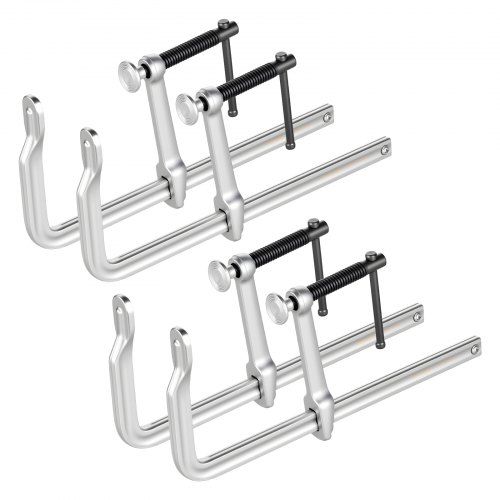
| Swivel-Jaw F Clamp, 12 in, 1200 lbs | 12 in | 1,200 lbs | 4-pack | Screw, T-handle, swivel jaw | Forged steel and casting | Only forged swivel-jaw set here; angled or uneven work |
| Clamp/Spreader F Clamp, 36 in, 1500 lbs | 36 in | 1,500 lbs | 4-pack | Reversible, clamp or spread | Soft rubber pads | Longest reach at full force; wide panels and spreading |
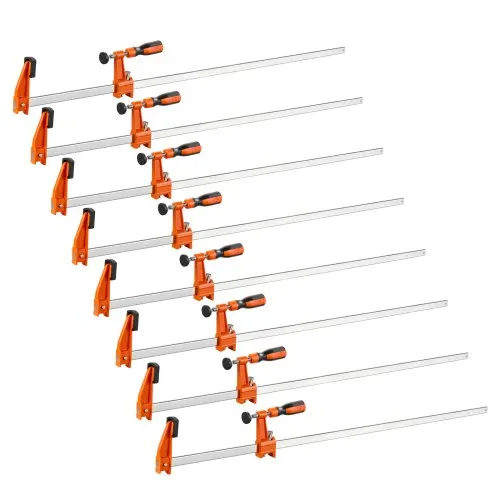
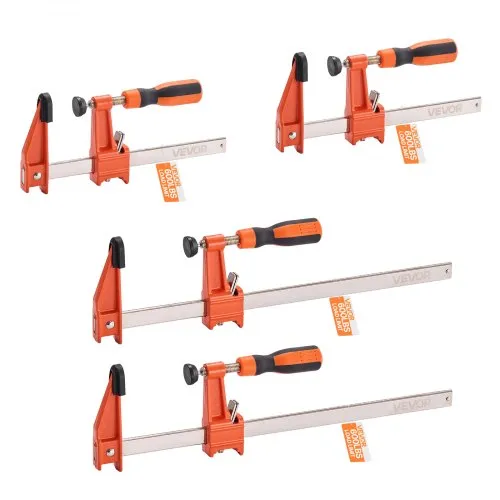
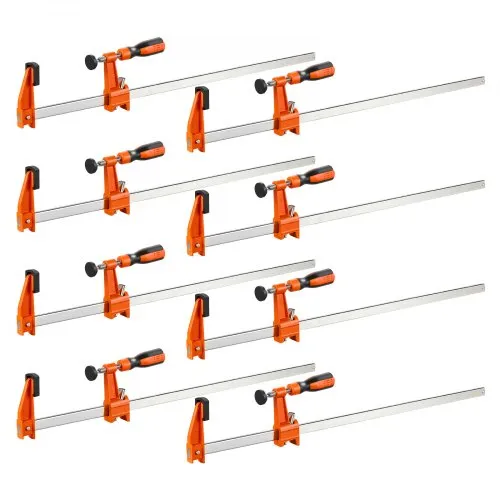
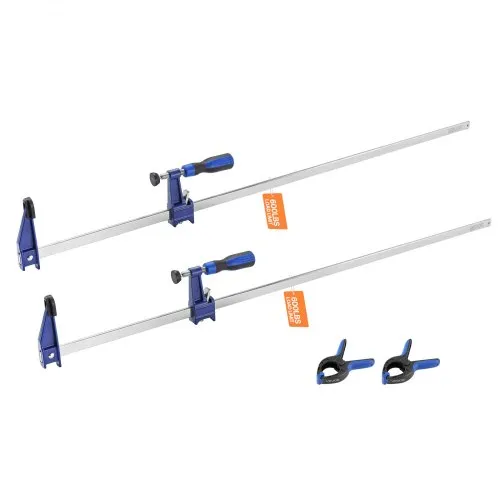
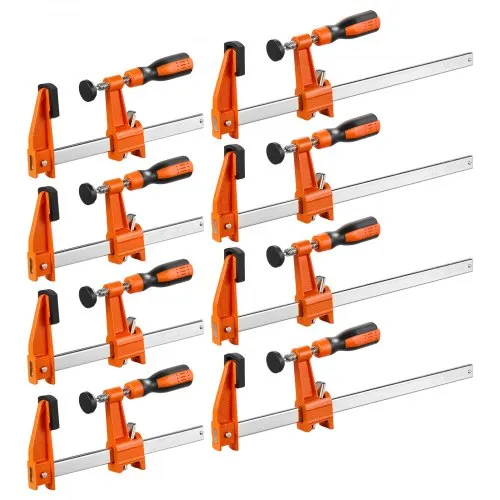
| Self-Locking F Clamp, 36 in, 8-Pack | 36 in | 600 lbs | 8-pack | Self-locking screw | Plastic pads, cast iron body | Most clamps in the group; big glue-ups needing many holds |
| Clamp/Spreader F Clamp, 24 in, 1500 lbs | 24 in | 1,500 lbs | 4-pack | Reversible, clamp or spread | Soft rubber pads | Highest force at mid reach; cabinets and metal fabrication |
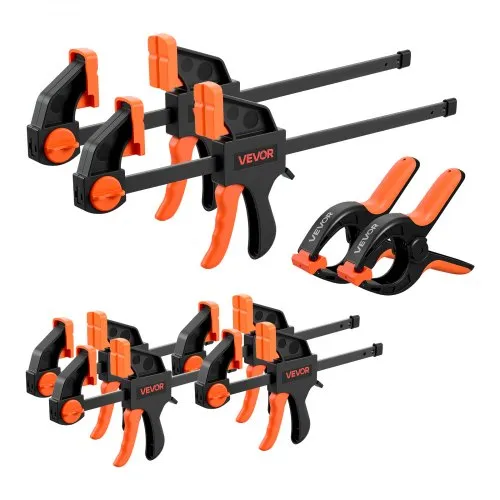
| One-Handed F Clamp, 6 & 12 in, 8-Pack | 6 and 12 in | 154 lbs | 8-pack | One-handed trigger, quick release | Plastic jaws, spring clamps | Only one-handed set with spring clamps; fast light holds |
Why Choose VEVOR F Clamps?
VEVOR offers a wide selection of F clamps featuring durable rails, smooth-threaded screws, and reliable clamping force for everything from quick repairs to precision glue-ups. It's easy to put together a clamp collection that works for your projects thanks to low prices, strong construction, and online ordering. Right now, you can browse the entire collection, choose the best sizes and sets, and ensure that every piece stays steady from start to finish.
FAQs
How do F clamps work?
An F clamp works by sliding its movable jaw along a flat bar until both jaws meet the workpiece. Turning the screw on the sliding arm then forces that jaw inward, building steady pressure. Releasing the screw opens the jaw again so you can reposition the clamp quickly.
What is the difference between an F-clamp and a C-clamp (or G-clamp)?
An F clamp has a long sliding bar, so it opens much wider and adjusts faster than a fixed C clamp, also called a G clamp. A C clamp offers a deep, rigid frame and high spot pressure, but only a limited, fixed opening range for smaller work.
How do I choose the right F-clamp size, throat depth, and clamping force for my project?
Match bar length to your widest workpiece plus a few inches of margin, choose deeper throats for mid-panel reach, and higher force for hardwoods. For large flat glue-ups, parallel clamps spread even pressure, while lighter assemblies need far less force.
What materials are heavy-duty F-clamps made of?
Heavy-duty F clamps use carbon steel or cast iron bars and jaws for rigidity under load. Malleable or forged heads survive repeated tightening, and replaceable rubber or plastic pads protect the workpiece surface from dents and marks during long glue cures.
When should I choose an F-clamp over a quick-grip trigger clamp or parallel clamp?
Choose a screw F clamp when you need firm, lasting pressure that holds unattended, such as hardwood glue-ups. One-handed trigger clamps suit fast, light holds, while parallel clamps win on wide flat panels. Many benches keep all three for different jobs.
Are F-clamps good for woodworking and glue-ups?
Yes. F clamps are a woodworking staple for glue-ups, edge joints, and assembly because they adjust fast and apply firm, even pressure. Padded jaws guard finished surfaces, and spacing several clamps along a joint spreads force so panels dry flat and tight.
Can F-clamps be used for welding and metalworking?
Yes. F clamps hold metal panels and frames steady while you drill, weld, or grind. For heat and heavy loads, pick heavy-duty lockable F clamps with steel or iron jaws rather than soft-padded models, since bare metal jaws resist sparks and keep parts aligned.
What size F-clamp do I need for my project?
Pick an opening a few inches wider than your workpiece. Short 6 to 12 inch clamps suit frames and boxes, 20 to 30 inch bars fit cabinet doors and shelves, and 36 to 50 inch bars handle wide tabletops and worktops with room to spare.
What should I look for when buying an F-clamp?
Look for a rigid steel or cast iron bar, smooth threaded screws, and a comfortable handle. Check the maximum opening, throat depth, and load limit against your projects, and favor replaceable pads so you can renew the clamping faces as they wear.
How many F-clamps do I need for woodworking or furniture making?
A starter kit of four to six clamps covers most assemblies, with one every 6 to 8 inches along a glue joint. Furniture makers often keep eight or more across several lengths; multi-pack F clamp sets make building that collection easier.