Clamps
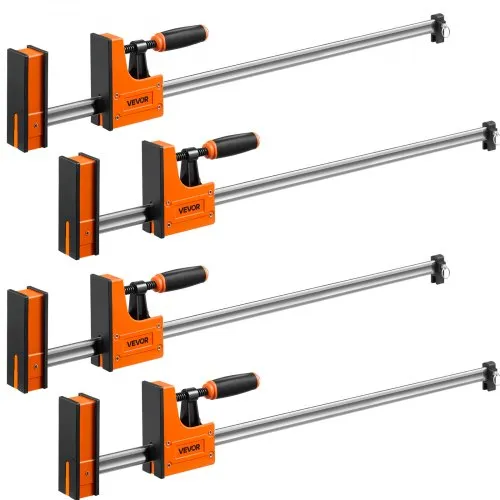

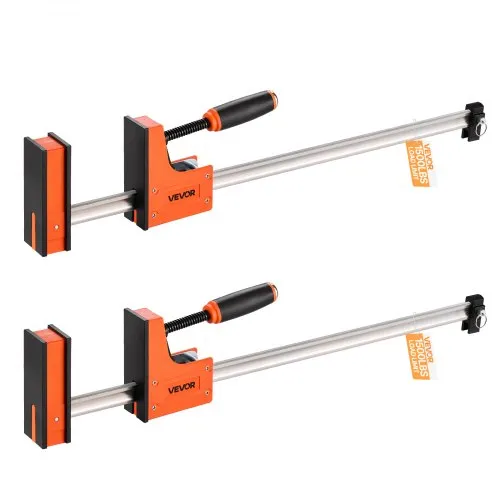


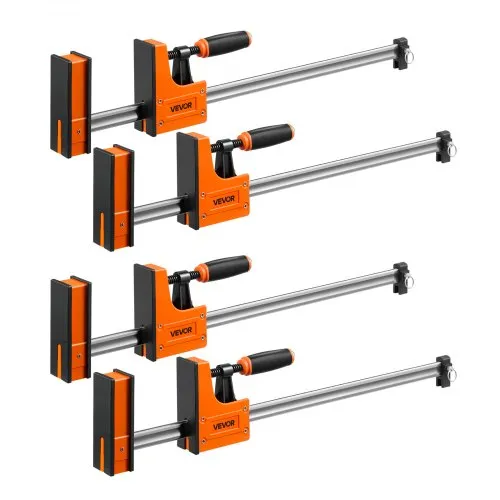


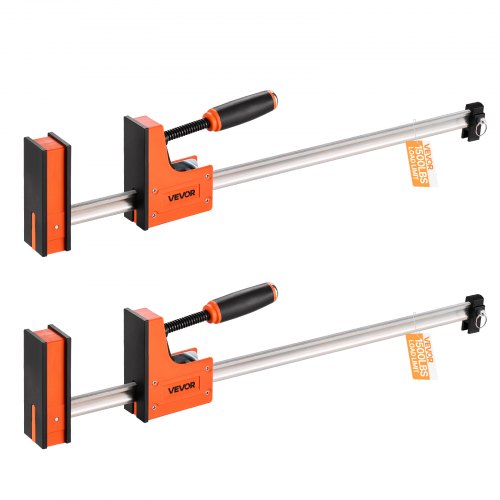
































Results for Clamps
A clamp is a mechanical holding device that applies controlled compressive force to grip a workpiece and hold it firmly in a fixed position. It works by drawing two jaws together, usually through a screw, lever, or ratchet mechanism, so the material held between them cannot shift, lift, or rotate. By converting hand effort into steady, concentrated pressure, a clamp frees both hands for other work and keeps parts aligned while they are joined, cut, shaped, or left to set. The clamping force stays applied until the work is finished and the mechanism is released.
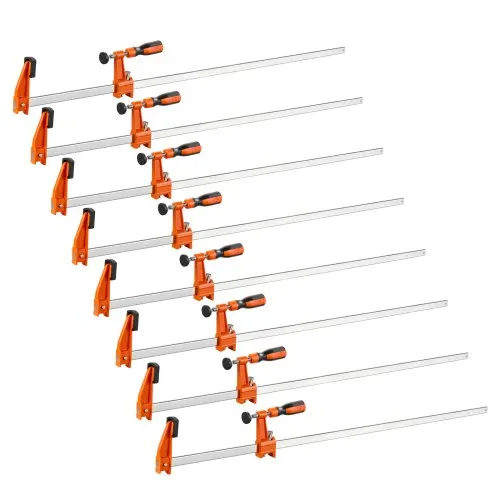
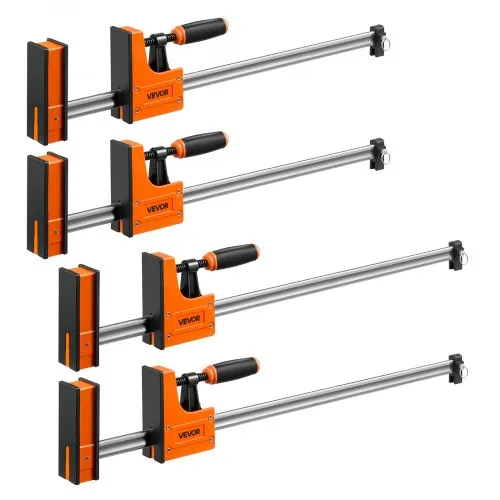
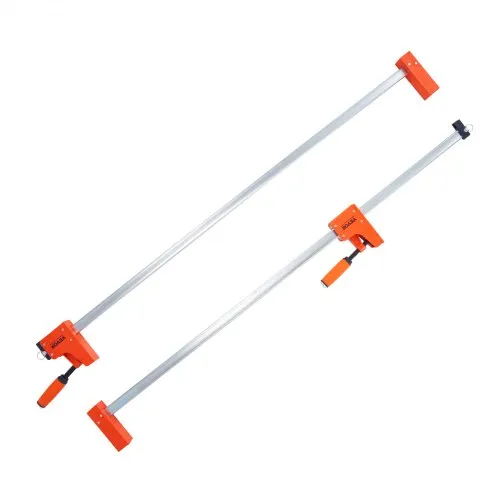
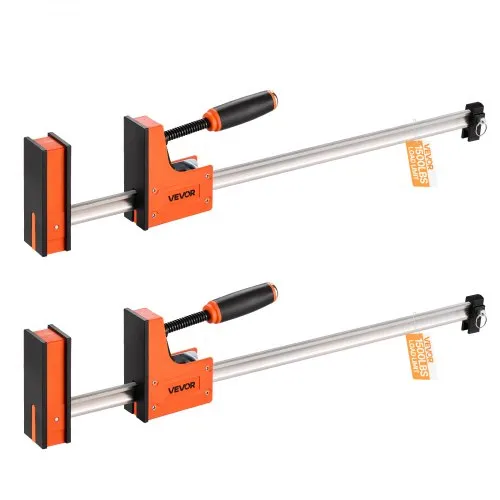
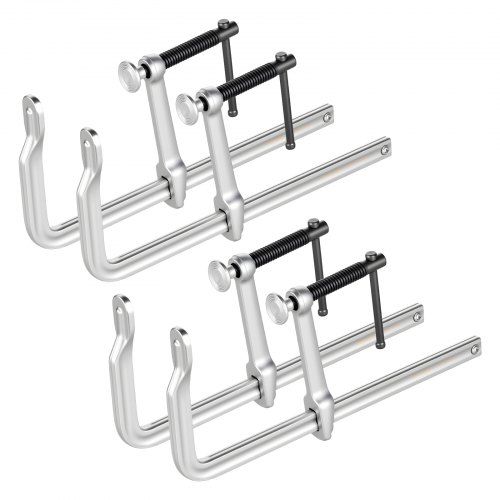
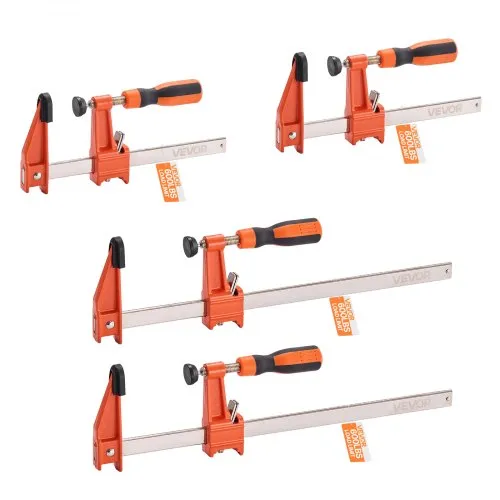
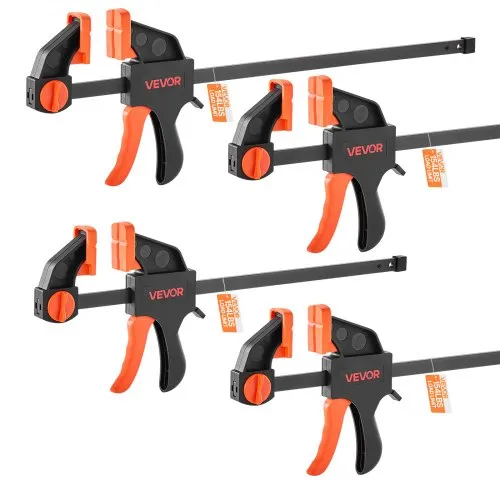
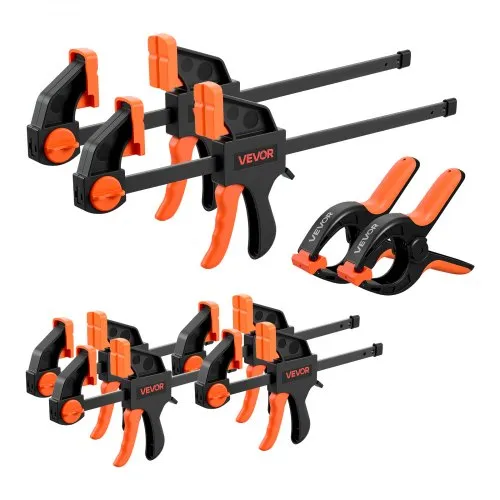
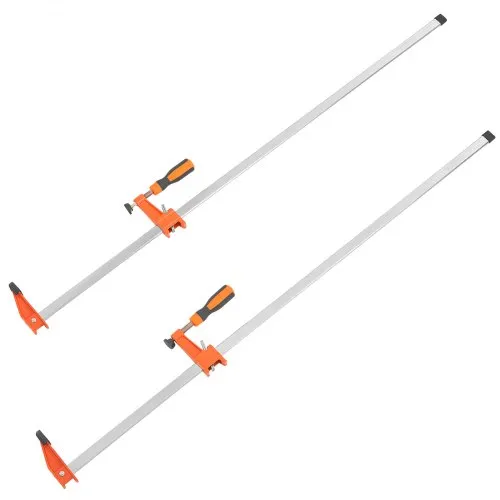
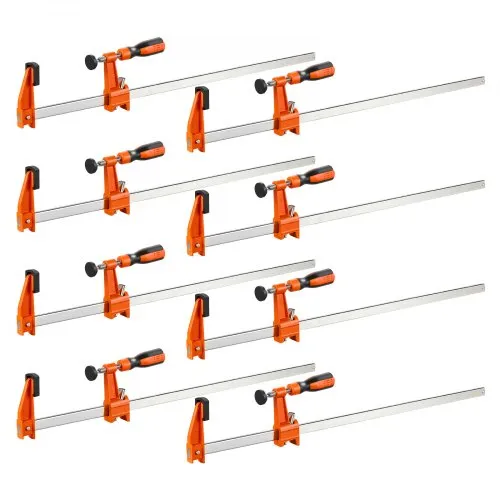
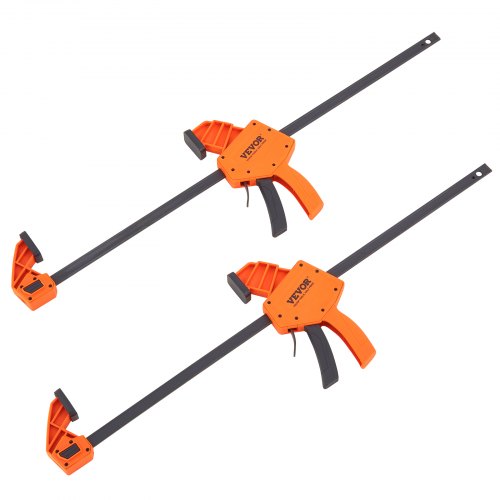
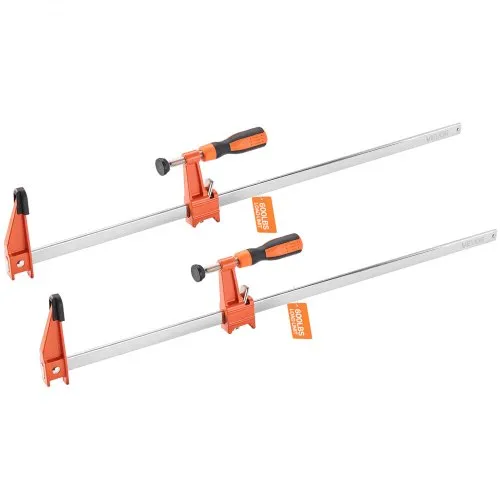
VEVOR builds clamps for general holding, panel assembly, and pipe work, so the grip can be matched to the job. F clamps use a screw on a sliding jaw for quick, versatile workshop holding across 6 to 36 inch openings. Bar clamps carry even pressure across wide 24 to 50 inch spans for flat glue-ups, while one-handed clamp and spreader models trade force for fast, single-hand adjustment. For round stock, pipe alignment clamps hold two pipe or flange ends true before welding rather than squeezing an assembly. Typical uses are furniture and cabinet glue-ups, metal fabrication, general carpentry, and welding fit-up.
Four things decide what you need:
- Clamp type: match the mechanism to the task, a screw F clamp for mixed jobs, a parallel bar clamp for wide panels, or an alignment clamp for pipe.
- Clamping force: heavier glue-ups and metalwork need higher load limits, while light holding is fine on lower-force one-handed clamps.
- Capacity: measure the widest workpiece plus the jaws so the opening or pipe diameter range comfortably covers it.
- Throat depth: check how far in from the edge you must apply pressure, since a shallow throat only reaches near the rim.
Explore the complete selection of clamps to match force, reach, and jaw style to your projects, or compare parallel bar clamp sets sized for full-width panel glue-ups.
Clamp Types at a Glance
The table below sums up how the main clamp types differ in mechanism, force, and reach so you can shortlist a style before comparing products.
| Clamp Type | Clamping Mechanism | Typical Clamping Force | Capacity Range | Selection Note |
|---|---|---|---|---|
| F-clamp | Screw tightened on a sliding jaw | 600 to 1500 lbs | 6 to 36 in opening | Throat depth limits how far from an edge it can reach |
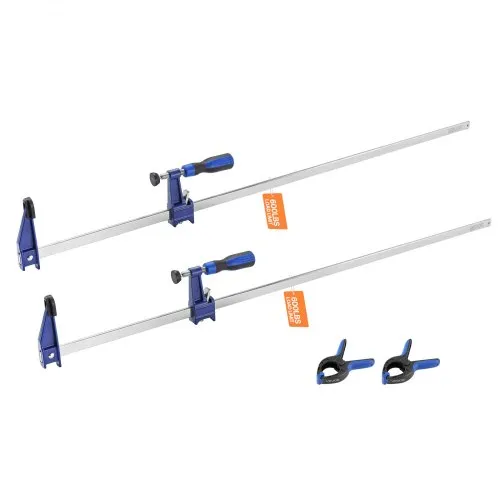
| Parallel bar clamp | Even-pressure screw along a wide bar | 1100 to 1500 lbs | 24 to 50 in opening | Keeps wide panels flat and square, but heavier to handle |
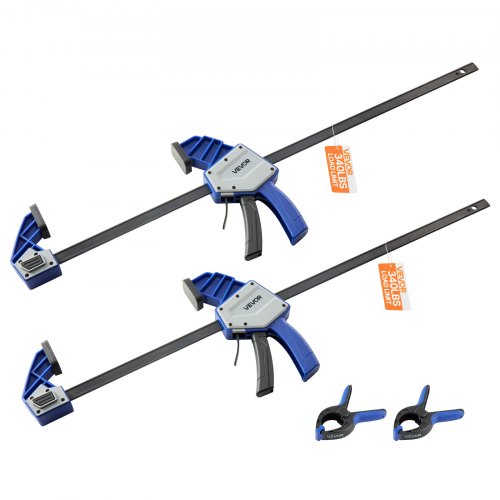
| One-handed clamp and spreader | Trigger ratchet with quick release | 150 to 340 lbs | 6 to 24 in opening | Lower force than a screw clamp; frees a hand and also spreads |
| Pipe alignment clamp | Three-point screws on a wrap frame | Positioning tool, not load-rated | 1 to 20 in pipe OD | Trues a joint before welding, then comes off before final weld |
| Pipe fit-up and flange clamp | Cam or screw lugs inside or around the joint | Positioning tool, not load-rated | 1.5 to 12 in pipe OD | Sized to a pipe band; confirm your pipe falls in range |
VEVOR Clamps for Secure, Precise Workholding on Every Project
Are you looking for dependable F‑clamps that will hold workpieces firmly during assembly, welding, cutting, and gluing? VEVOR offers the appropriate clamp type and capacity for your application, whether you need holders for general workshop use or woodworking pipe holders for extended panel glue-ups. Explore our assortment designed for robust clamping force, long-lasting frame construction, and useful jaw variants for all workshop and trade applications.
Clamps by Type & Application
The two factors that most directly determine whether a clamp provides the proper clamping geometry, force, and reach for the specific workholding task at hand are clamp type and intended application. For the most common workshop and trade applications, VEVOR offers F-clamps, bar holders, and pipe alignment tools.
F Clamps – Versatile General Workshop Clamping
The sliding jaw design that gives the F clamp its name allows quick adjustment over the entire opening range before final tightening via the screw mechanism, making holders one of the most adaptable and popular clamp types for general workshop use. Holders are useful for a wide range of workpiece thicknesses and clamping positions in common carpentry, joinery, and metalworking applications, where a single clamp type must serve several tasks due to their fast gross adjustment and accurate fine tightening.
To maintain a rigid clamping geometry under the torsional stress induced by tightening the screw mechanism, VEVOR's F-clamp models use cast-iron or steel fixed-head bodies and hardened steel bars. By distributing clamping pressure uniformly throughout the workpiece contact area rather than concentrating it at the jaw corner that makes initial contact, swivel jaw pads on VEVOR's holders allow for small workpiece surface angles without the point-load contact that rigid flat jaws create on non-parallel clamping faces. The opening capacity and clamping force of VEVOR's grips meet most general workshop clamping requirements with a single clamp type, making them a dependable all-purpose clamping solution.
Bar Clamps for Woodworking – Panel Glue-Ups and Assembly
When wide, even clamping pressure across a broad workpiece face is required for woodworking, bar clamps meet the specific clamping requirements of panel glue-ups, cabinet assembly, and furniture construction without causing the jaw distortion that narrower clamp types cause when applying high force across a wide span. This type of clamp is characterized by a robust bar that resists bending under clamping strain, maintaining jaw parallelism and applying uniform pressure across the entire joint width rather than concentrating it at the jaw center.
To offer the bending stiffness required for high-force wide-span woodworking clamping without the weight of solid bar alternatives at equal rigidity, VEVOR's bar clamps employ T-bar or I-bar cross-section profiles. During the time-pressured glue-up assembly stage, when several holders must be positioned and tightened before the adhesive starts to set, VEVOR's bar clamp models with quick-release jaw mechanisms enable quick opening adjustment. A set of VEVOR bar holders in various lengths provides the uniform, controlled clamping pressure required for high-quality glue joints, ideal for woodworkers who frequently glue panels, assemble cabinet carcasses, and construct furniture frames.
Pipe Clamps and Woodworking Pipe Clamps – Long-Reach Clamping
By threading the jaw fittings onto a cut pipe of the required span, they can be constructed to any length using conventional threaded pipe as the clamp bar. For very long clamping spans, such as large door panels, tabletops, and boat hull assemblies, where fixed-length bar fixtures of equal span would be costly, pipe clamps are the most cost-effective option because of their user-configurable length.
VEVOR's woodworking pipe clamp fixtures provide the specific span each project requires from a single set of jaw fittings that are threaded onto ordinary ¾-inch black iron pipe that the customer finds and cuts to the desired length. VEVOR's pipe clamp models feature swivel-action head fittings that compensate for pipe flex under clamping stress, ensuring flat jaw contact on the workpiece surface even with modest pipe bowing over extremely long unsupported spans. VEVOR pipe clamp fixtures with user-supplied pipe offer the most length-flexible, affordable, wide-span clamping solution in the standard workshop clamp category for woodworkers who frequently join wide solid wood panels and large furniture items.
Pipe Alignment Clamps – Precision Positioning for Pipe Welding
Unlike typical workshop fixtures, which apply compressive stress to a workpiece during assembly or machining, pipe alignment tools precisely align pipe sections both before and during welding. In structural applications, misaligned pipe connections create welds that fail pressure testing, necessitate grinding and rewelding, and pose safety issues that can be completely avoided with proper initial alignment.
To position the connecting pipe ends in exact axial alignment while tack-welding repairs the junction before the clamp is withdrawn for complete weld completion, VEVOR's pipe alignment clamp models employ chain-wrap or hinged-band designs that wrap around the pipe's outside diameter. Instead of trying to correct multiple alignment dimensions at once, the fitter may progressively bring misaligned sections into specification using the adjustment mechanisms on VEVOR's pipe alignment tools, which independently correct angular and axial offsets between pipe sections. VEVOR's alignment fixtures offer the positioning precision required by excellent fitup practice before the start of weld deposition for welding fabricators and pipe fitters who work with structural and process piping, where dimensional accuracy directly influences system performance and safety.
Matching Clamp Contact to the Workpiece
Beyond choosing a type, the jaw contact you use decides whether a clamp marks or holds a given surface, as summarized here.
| Workpiece Surface | Recommended Jaw Contact | Clamping Pressure Approach | What to Watch |
|---|---|---|---|
| Softwood framing | Swivel rubber or plastic pad | Firm, pads spread the load | Pads stop the bar end denting soft grain |
| Hardwood or veneered panel | Soft pad with a sacrificial caul | Moderate, spread across the caul | A caul prevents jaw marks and keeps glue lines even |
| Painted or finished metal | Cushioned or protected jaw face | Light to moderate | Bare steel jaws can scratch coatings, so cushion contact |
| Bare structural steel | Swivel steel jaw | High, full screw force | Square the swivel pad so force stays on the joint |
| Round pipe or tube | Swivel V or wrap contact | Alignment only, not squeezing | Match the clamp band to the pipe outside diameter |
Clamps – Throat Depth & Material
How deep a clamp can reach into a workpiece and how long it can remain clamped during regular workshop operation depend on the throat depth and the frame material. As with regular quality standards, VEVOR constructs its fixtures using durable materials and appropriate throat depths.
Throat Depth – Reach Into the Workpiece
The distance between the clamp bar or frame and the clamping jaw's midline is known as the throat depth, and it establishes how far the clamp may apply clamping force from the workpiece edge. A deeper throat enables clamping pressure to be applied farther from the edge, where joint lines, dowel placements, and lamination zones occasionally call for force application well inboard of the accessible perimeter; a shallow throat depth restricts the clamp to near-edge use only.
The most common near-edge and mid-workpiece clamping situations encountered in both domestic and professional woodworking are addressed by VEVOR's F clamps and bar clamps, available in standard throat depths. Choosing a VEVOR model with sufficient throat depth for the precise inboard distance required avoids the insufficient reach that necessitates improvised clamping solutions that apply force at the incorrect position for applications requiring clamping force at a significant distance from the workpiece edge, such as biscuit joint assembly across the center of a wide panel or cleat attachment across a broad workbench top. Each product includes a list of VEVOR's throat depth parameters and jaw opening capacity for thorough dimensional verification before purchase.
Frame Materials for Long-Term Clamping Performance
The resistance to the combined mechanical stresses of repeated high-force tightening, the bending load on the bar, the torsional load on the fixed head, and the compressive stress on the jaw pads that daily workshop clamping applies throughout the clamp's entire service life is determined by the material of the clamp frame. Both steel and cast iron frame materials have unique mechanical properties that are appropriate for various clamp types and levels of use intensity.
To provide high yield strength that resists permanent bending deformation under sustained high clamping forces from glue-up and assembly clamping over extended dwell periods, VEVOR's clamp frames use steel bar construction on bar- and F clamp types. The heavier-duty cast iron jaw heads from VEVOR offer the stiffness and compressive strength at the screw contact required by the highest clamping forces without the thread stripping that occurs when unskilled operators overtighten weaker head materials. All of VEVOR's clamp line's surface treatments, black oxide, powder coat, or zinc plating, resist the workshop corrosion that exposed steel accumulates under glue, finishes, and moisture from daily use of these clamps for metalworking and woodworking.
Best-Seller Comparison
These popular clamps, shown in the catalog, line up the specifications that most affect which one suits your bench.
| Product | Clamp Format | Capacity | Clamping Force | Pieces in Set | Frame and Jaw Build | Best For |
|---|---|---|---|---|---|---|
| Bar Clamp 4-Pack, 12 in, Swivel Jaw | Bar clamp | 12 in opening | 1200 lbs | 4 | Steel forging and casting, swivel jaw | Only swivel-jaw model here; clamps angled or uneven faces flat |
| Pipe Flange Aligner, 4 to 8 in | Flange aligner | 4 to 8 in pipe | Positioning, not load-rated | 2 clamp sets | High-strength steel, internal fit-up | Only internal aligner; trues flange bores before welding |
| F-Clamp 4-Pack, 36 in, 1500 lbs | F-clamp | 36 in opening | 1500 lbs | 4 | Carbon steel bar, soft rubber pads | Highest force at full 36-inch reach; big panel glue-ups |
| Ultra Pipe Clamp, 2 to 6 in | Pipe clamp | 2 to 6 in pipe | Positioning, not load-rated | 1 | Steel, quick-acting screws | Smallest-bore welding clamp here; quick portable pipe tack-ups |
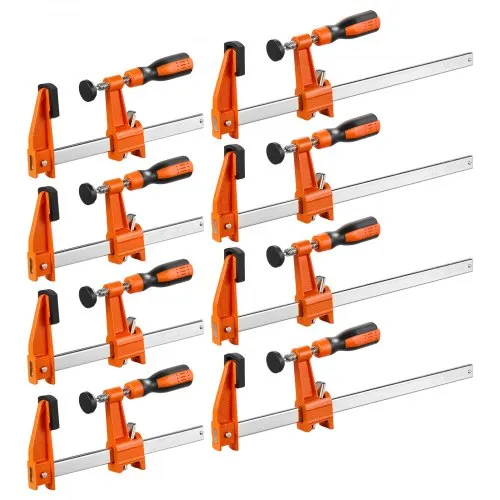
| Bar Clamp 8-Pack, 36 in, 600 lbs | Bar clamp | 36 in opening | 600 lbs | 8 | Cast iron and carbon steel, plastic pad | Most clamps per set; many light glue-ups at once |
Why Choose VEVOR Clamps?
For every workshop and trade application, VEVOR's clamps offer a suitable gripping geometry, sturdy frame construction, and a useful throat depth that spans holders, bar clamps, and pipe alignment tools. Every clamping operation and workpiece has a VEVOR clamp, from pipe alignment tools for perfect welding fit-up to woodworking pipe clamps for large panel glue-ups. Dependable after-sales support is available for every transaction. Explore the entire selection of VEVOR clamps now to hold each workpiece precisely in place.
FAQs
What is the difference between F-clamps and bar clamps for woodworking?
These are ideal for general-purpose workshop clamping because of their movable jaw, which allows rapid adjustment across a range of workpiece thicknesses. Bar clamps, which are ideal for panel glue-ups and cabinet assembly where uniform pressure across a wide face is crucial, feature a robust T- or I-bar profile for high-force, wide-span clamping. In a whole workshop clamp collection, each has a different function.
What pipe size do VEVOR woodworking pipe clamp fixtures require?
The woodworking pipe clamp fixtures from VEVOR are made for ordinary ¾-inch black iron pipe, which users must find and cut to the desired length. To ensure proper contact between the fixture jaw and the pipe bar without thread mismatch, always verify that the fixture's pipe thread specification meets the standard ¾-inch pipe threading before making a purchase.
How much throat depth do I need for panel glue-up clamping?
A standard 2- to 3-inch throat depth is sufficient for edge-joint panel glue-ups where clamping pressure is applied close to the joint line at the panel edge. Choose bar clamps with a throat depth that reaches the required inboard distance, with extra space if you want to apply clamping force at cleats, biscuits, or laminations farther inboard from the panel edge.
Are VEVOR pipe alignment clamps suitable for welding stainless steel pipes?
Yes, VEVOR's pipe alignment clamp models are compatible with carbon steel, stainless steel, and other common pipe materials; the clamp's purpose is mechanical alignment rather than engagement specific to a particular material. Before purchasing a specific stainless or custom pipe-welding application, always make sure the clamp's appropriate pipe-diameter range includes your specific pipe size.
What are the different types of clamps used in construction and DIY projects?
Common construction and DIY clamps include screw-driven F-clamps for general holding, parallel bar clamps for wide assemblies, fast one-handed clamp and spreader models, and pipe alignment clamps for welding fit-up. Choose by the task, the force needed, and how wide the workpiece is.
What are some tips for using clamps safely and effectively?
Tighten only until the joint is firm, since over-tightening can crush soft workpieces or distort metal. Spread pressure with jaw pads or a sacrificial caul, keep the bar square to the work, and use enough clamps so the force stays even across the whole joint.
What are the different types of clamps used in woodworking and metalworking?
Woodworking leans on parallel bar clamps and F-clamps for panel glue-ups and assembly, while metalworking uses heavy F-clamps and swivel-jaw clamps that grip bar and plate. One-handed clamps suit quick holds in both trades where lighter force is acceptable.
Can clamps be used for holding objects during gluing or welding?
Yes. For gluing, bar and F-clamps hold parts aligned under steady pressure until the adhesive sets. For welding, pipe alignment clamps position two ends true for tack-up, then release before the weld is completed. Match the clamp to the material and the joint.
Can clamps be used for electrical or plumbing installations?
Clamps in this range are built for workholding during fabrication, assembly, and welding rather than as permanent fixings. For plumbing, pipe alignment clamps true pipe joints before welding, but they are removed afterward. They are not a substitute for dedicated electrical or pipe mounting hardware.
How do I choose the right clamp for my specific task?
Start with the clamp type that fits the job, then confirm the opening or pipe range covers your workpiece and the throat depth reaches where pressure is needed. Check the load limit for the material, and browse the full clamp range to compare options.