Grating Ruler




Results for Grating Ruler
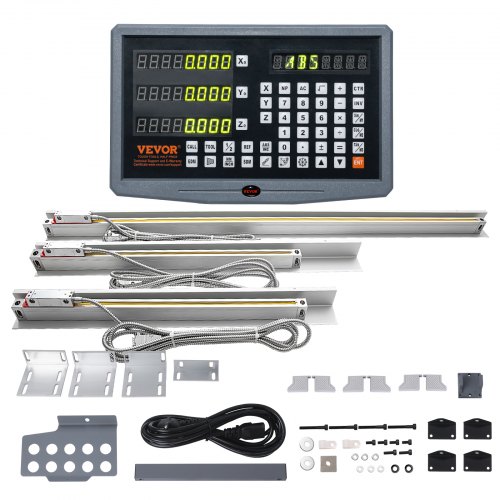
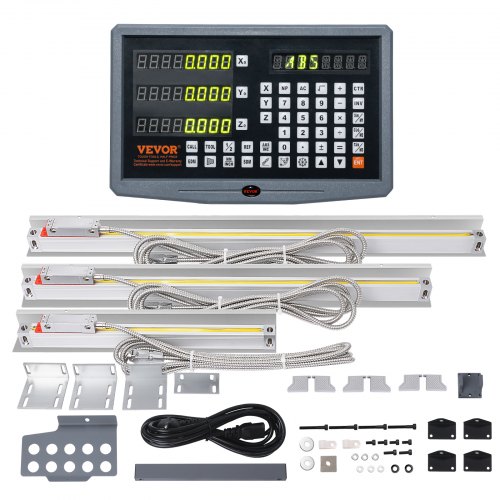
For lathes, milling machines, surface grinders, and other machine tools where exact axis positioning dictates product quality, VEVOR's digital readouts provide accurate, real-time position data. Our selection includes display units compatible with a wide range of machine tool brands and sizes, linear encoder scale options, and 2-axis and 3-axis configurations. VEVOR offers the precision and dependability your machining requires, whether you need digital readouts scales for a surface grinder, a digital readout for lathe work, or a digital readout for milling machine operations.
VEVOR Digital Readouts for Accurate, Confident Positioning on Every Machine Tool
Do you still position your lathe or mill using handwheel counts and manual dials? Digital readouts provide precise axis location at a glance, reduce cumulative positioning errors, and expedite setup time. With clear multi-axis displays, high-resolution linear scales, and wide machine tool compatibility, VEVOR's digital readouts systems enable accurate placement for both professional shops and hobby machinists.
Measurement Type and Accuracy in VEVOR Digital Readouts
How accurately a digital readout records axis position and how confidently a machinist maintains tight tolerances throughout a wide range of cutting processes depend on measurement precision and scale technology.
Linear Scale Technology and Resolution Specifications
Depending on the model, optical or magnetic linear encoder scales are used in VEVOR's digital readouts to convert physical axis movement into precise electrical position signals that are continuously sent to the display unit. Optical encoders achieve resolutions of 1 to 5 microns by using a precision optical sensor to read a finely ruled glass or steel scale. To better withstand coolant, chips, and contaminated shop conditions, magnetic encoder scales use a magnetized strip and Hall-effect sensor configuration.
The specification most pertinent to machining precision is resolution, the smallest incremental movement the system recognizes and reports. Higher-specification models of VEVOR's digital readout scales offer resolutions as low as 0.001mm, providing fine position feedback for surface grinding, close-tolerance turning, and precision boring. The precision of standard 0.005mm resolution models greatly outperforms dependable manual dial readings over the course of a full session, covering most general machining jobs such as drilling bolt circle patterns, turning diameters, and milling slots.
Axis Count Options and Matching Configuration to Your Machine
The initial compatibility decision in the purchasing process is selecting the appropriate count for your machine tool. Digital readout systems are available in 2-axis and 3-axis versions. A 2-axis system with an X-axis cross slide and a Z-axis carriage is often needed for digital readouts in lathe applications. Left-right table travel, front-back travel, and vertical quill or knee movement are the three axes that a 3-axis system must cover for a digital readout for milling machine applications.
To avoid buying a 2-axis unit for a milling application that requires 3-axis feedback, VEVOR offers both 2-axis and 3-axis display units with the correct number of scale inputs, clearly marked by axis count. Three-axis digital readouts scales that simultaneously track table traverse, cross feed, and vertical wheel position are commonly used on surface grinders. Instead of settling for an undersized configuration, VEVOR's display units are available in the appropriate scale count for each application, making them ideal for machinists who operate many machines.
Accuracy Grades and Real Machining Tolerance Requirements
In a digital readout system, accuracy and resolution are different. Accuracy indicates how closely the displayed position matches the actual physical axis position over the full scale range, whereas resolution represents the smallest perceptible change. Even if the display appears precise, a system with fine resolution but poor accuracy would deviate from the true location over longer journeys, resulting in dimensionally incorrect parts.
The accuracy grades used in the manufacturing of VEVOR's digital readout scales describe the maximum permitted error across the entire scale length. For standard-grade scales, this is usually ±0.005mm per 300mm, and for precision-grade models, it is ±0.003mm per 300mm. Standard-grade scales perform well for most hobby and small professional shop tasks, such as drilling precise hole patterns, milling slots to tight tolerances, and turning to within approximately 0.001 to 0.002 inches. Precision-grade scales are the best option for jig boring and toolroom applications where the machine must maintain positional accuracy during complete travel to the strictest tolerances possible.
Scale Length Options and Covering Machine Travel Range
Selecting linear encoder scales requires that they be long enough to cover the entire usable travel without exceeding the scale's measurement limit during regular operations, and that they match the actual travel range of each machine axis. Z-axis carriage travel for a standard 9x20 or 12x36 engine lathe typically runs from 16 to 20 inches, necessitating a scale of at least 500mm. Usually traveling 6 to 8 inches, the X-axis cross slide is appropriate for a 200 to 250mm scale.
On mid-size knee mills, the X-axis table travel typically exceeds 20 to 30 inches, necessitating 600 to 800mm scales. To help buyers identify the appropriate scale lengths for their machine model, VEVOR publishes scale lengths in both millimeters and inch equivalents, along with machine compatibility guidance. This feature helps buyers avoid a serious error: buying scales that reach their measurement limit before the machine reaches its useful travel range.
Display Features and Compatibility in VEVOR Digital Readouts
The machinist accesses all underlying scale precision through the display unit, and the degree of useful support it offers beyond simple position readout depends on its feature set.
Display Clarity, Unit Switching, and Machinist Calculation Functions
Large, high-contrast LCD or LED panels that clearly depict axis location in both metric and imperial measurements are a feature of VEVOR's digital readout display units. These screens can be switched at the touch of a button to suit designs dimensioned in either system. When working with mixed-unit drawings or working to differing customer standards, switching between millimeter and inch displays in the middle of a job eliminates manual conversion errors.
VEVOR's systems go beyond basic position indicators thanks to integrated built in calculation functions. By using a circle diameter and hole count as inputs, the bolt hole circle calculation automatically determines the X-Y coordinates of each hole, removing the need for manual trigonometry and layout calculations. The machinist can touch off both sides of the workpiece, and the display will automatically zero at the centerline, thanks to centerline finding. Throughout a full day of varied work, these features reduce setup time, minimize calculation errors, and keep the machinist's attention on cutting rather than on mathematics.
Scale Input Compatibility, Mounting Hardware, and Machine Tool Fit
Only if a digital readout system is compatible with the machine it is mounted on, that is, if the mounting hardware suits the machine's physical geometry and the display can accept the encoder signal type from the supplied scales, will it be helpful. Across all models in the range, VEVOR's digital readout for mill and lathe systems uses conventional TTL or differential signal encoder inputs that interface consistently with VEVOR's linear scales.
Scale body brackets, read head mounting arms, and display column mounts that fit typical machine surfaces are among the common machine tool configurations covered by the mounting gear that comes with VEVOR systems. VEVOR's mounting components are made of aluminum and machinable steel, allowing adjustment with common shop tools for many non-standard configurations. VEVOR digital readout systems are a useful improvement for a variety of machine tool makes and ages found in home shops and small professional facilities, as the cable length between the scale and display is sufficient for conventional machine geometries without typically requiring extension cables.
Why Choose VEVOR Digital Readouts?
VEVOR digital readouts minimize setup time and help reduce positioning mistakes on lathes, mills, and surface grinders by combining high-resolution linear encoder scales, defined accuracy grades, 2- and 3-axis display options, and useful machinist calculation features. VEVOR enables every machine shop to achieve precise placement with a wide range of scale lengths, clear, unit-switchable displays, low prices, and dependable after-sales support. Visit VEVOR today to view the entire selection of digital readout scales.
FAQs
What is the difference between a 2-axis and a 3-axis digital readout?
Lathes that cover X and Z axes can benefit from a 2-axis digital readout that tracks two linear axes. A 3-axis system provides milling machines that require X, Y, and Z feedback with a third axis. Before making a purchase, make sure the axis count matches your machine tool's configuration.
What scale length do I need for my lathe or mill?
Choose a scale that is at least 10% longer than the measured travel distance for each axis. To make choosing the right common machine tool model easier, VEVOR offers scale length options in both metric and imperial units, along with machine compatibility recommendations.
Can I install a VEVOR digital readout myself?
Indeed, VEVOR systems come with mounting hardware and installation instructions that are suitable for do-it-yourself installation. There is no need for specialized electrical knowledge because scales connect using common connectors. The majority of installs on typical mill and lathe configurations take two to four hours.
What resolution do VEVOR digital readout scales offer?
For ordinary machining, VEVOR scales are 0.005mm, whereas precision-grade units have a 0.001mm range. For most operations, 0.005mm resolution is sufficient for typical turning, milling, and drilling. Toolroom and close-tolerance production work benefit from higher resolution.
Are VEVOR digital readouts compatible with all machine tool brands?
VEVOR systems use conventional mounting and encoder signal interfaces, making them compatible with many popular machine tool brands. Before making a purchase, ensure the mounting surface geometry and axis travel measurements meet VEVOR's compatibility requirements.