Hand Winch




























Results for Hand Winch
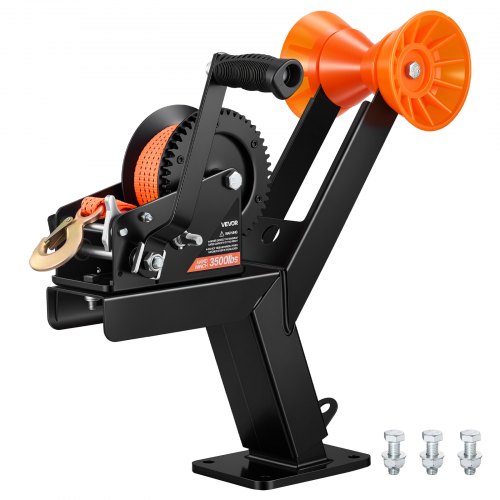
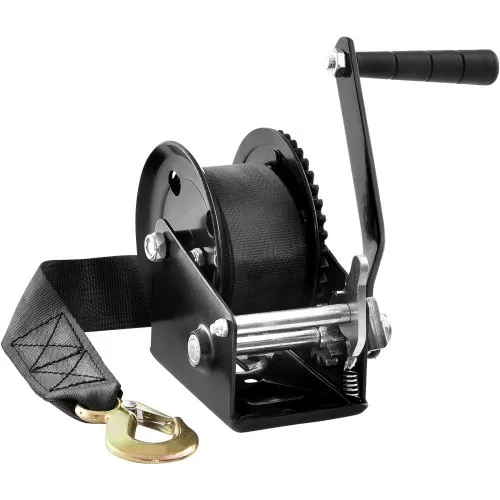
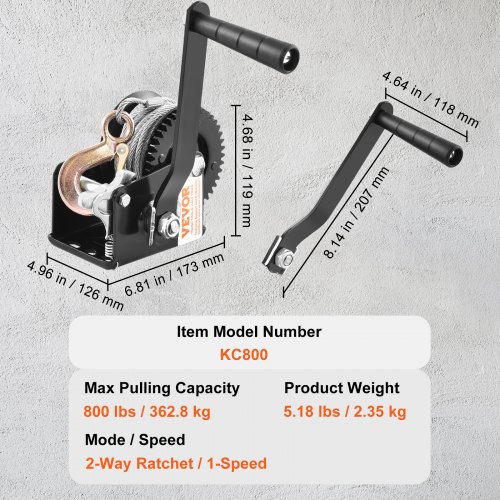
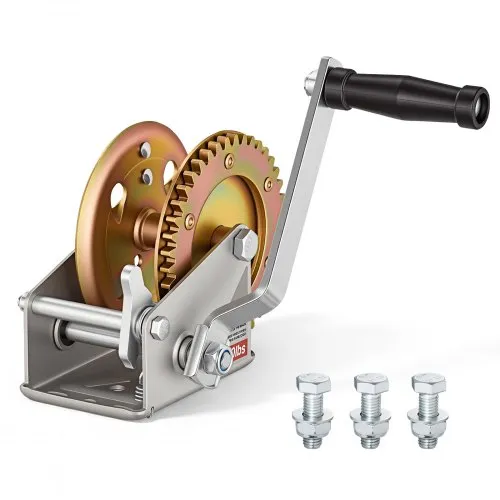
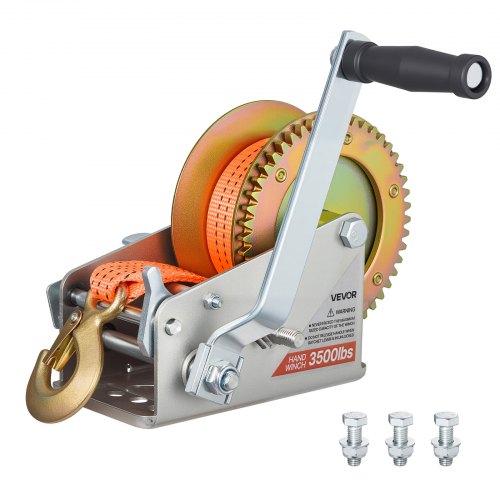
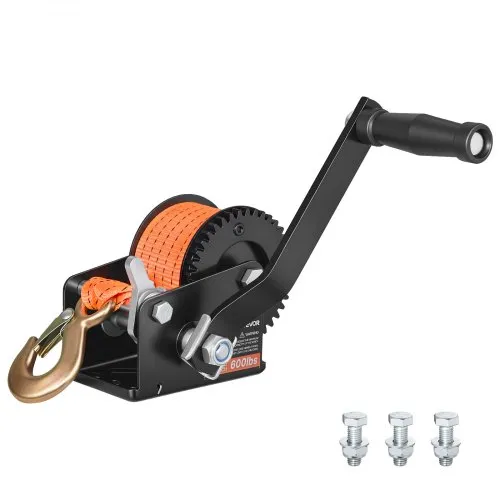
With pulling capacities ranging from 800 to 3500 pounds, VEVOR's hand winches can handle both light trailer jobs and loaded boat pulls. Each winch has a two-way ratchet crank, and depending on the type, it comes with a synthetic polyester strap or a steel wire cable. The handle and gear are shipped ready to mount. The mechanism can handle anything within its rated weight, including building materials, downed trees, and stuck equipment, though its primary applications include towing boats, ATVs, and utility trailers. Choose the capacity that matches your heaviest load, not your typical one.
VEVOR Hand Winches for Boats, Trailers, and Manual Load Pulling
Does every pulling job really need an electric winch with a battery and wiring back to a vehicle? A hand crank manual winch, which requires only gearing and your own arm, no battery, no motor, and no connection back to a vehicle, earns its reputation, since not all jobs call for an electric winch. Boat trailers, ATV recovery, and general-purpose hauling are all covered by VEVOR's hand winch for lifting and lowering. Its two-way ratchet locks the cargo in place as soon as you stop cranking, even in the middle of a lift.
Hand Winches by Pulling Capacity and Cable Type
Once you've chosen a manual winch, the two specifications that really matter are capacity and cable type. This is a breakdown of VEVOR's hand winches by line type and size.
Light-Duty Capacities: 800 and 1200 lb
For tasks like loading a small utility trailer, tensioning a tarp line, or pulling a jet ski the final few feet onto a trailer bunk, VEVOR's lightest option is the 800 lb hand winch. It is compact enough to be classified as a small hand crank winch; it is lightweight, convenient to keep in a truck bed toolbox, and easy enough for a novice user to operate without reading the entire handbook.
For slightly heavier trailer work, such as small boats, ATVs on a ramp, or garden equipment that is too heavy to handle by hand but not so heavy that it requires significant mechanical advantage, upgrade to the 1200 lb hand winch. Since most owners bolt them to a detachable stand or a trailer tongue plate rather than a solid structure, both capacities are designed as portable manual winches without a permanent mount. At this end of the range, VEVOR's hand winches are not designed for daily use on a job site, but rather for sporadic pulls around a house, driveway, or boat ramp.
Mid to Heavy Capacities: 1600, 2000, and 3500 lb
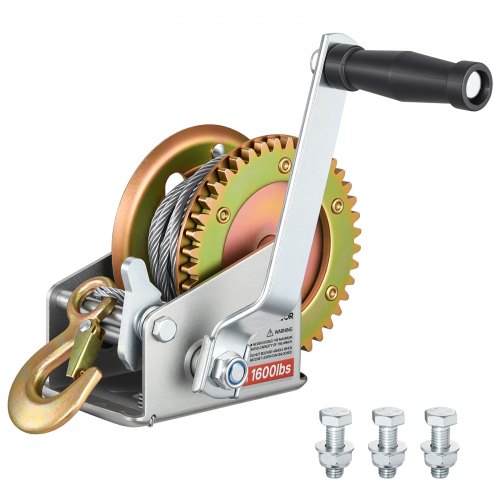
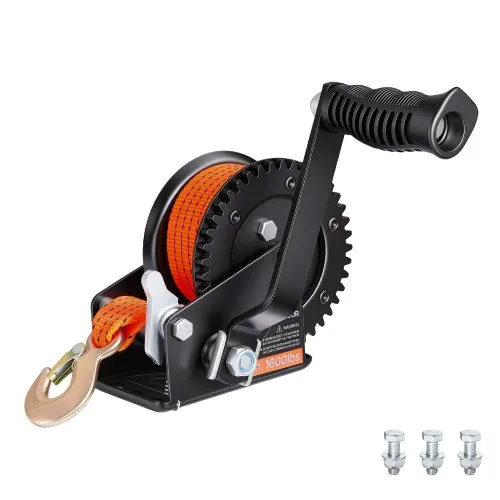
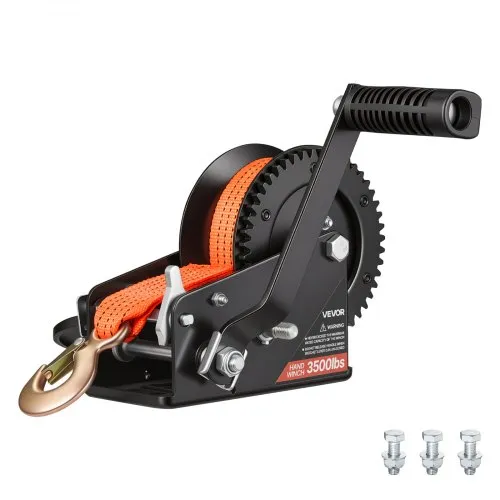
In the middle of VEVOR's range, the 1600 lb hand winches and 2000 lb hand winches are designed for towing duties, light equipment trailers, and mid-size boat trailers where an 800 lb hand winch model would be too small. A 4:1 gear ratio, which exchanges crank speed for pulling force, provides more handle rotations per foot of cable but considerably less arm effort per pound pulled in several 1600 lb models. VEVOR's heavy duty manual winch, suited for larger boat trailers, loaded utility trailers, and ATV or small vehicle recovery, is the top model in the collection, rated at 3500 pounds.
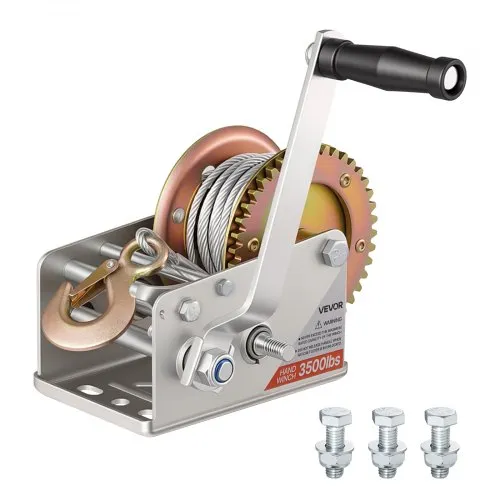
The two-way ratchet and two-speed switchable gear found in most 3500 lb hand winch versions let you crank quickly with light tension and switch to the low, high-force gear when the load begins to pull back. Matching capacity to load involves more than the winch's ability to lift the weight once; it also requires consistent pulling, whether on a muddy trailhead or a wet boat ramp, without the crank binding under stress. Rather than a one-time spec-sheet rating, these hand winches are built for frequent real-world use.
Steel Wire Cable vs. Synthetic Rope Line
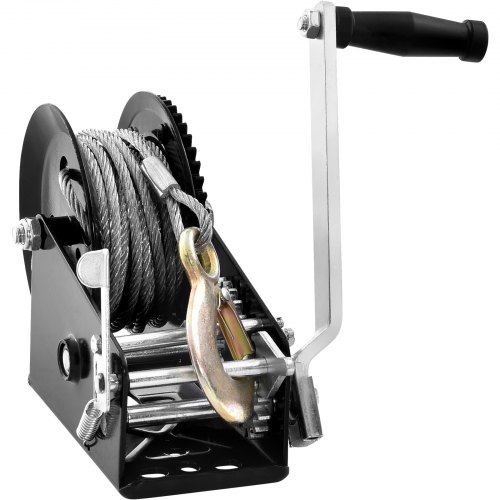
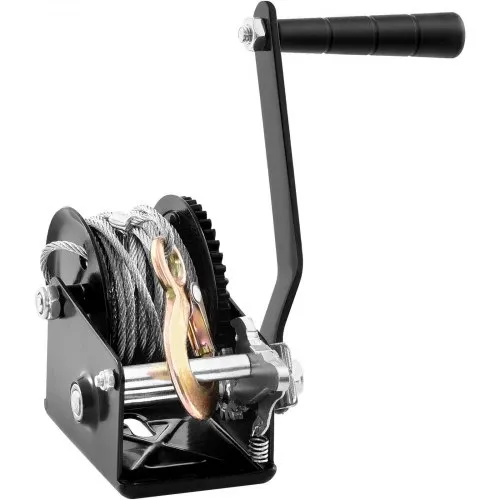
Most VEVOR hand winches come with one of two line types: a steel wire cable winch or a polyester strap version, which is sometimes mistaken for a synthetic rope hand winch even though it is actually made of flat webbing rather than round rope. Steel cable variants are roughly 33 feet long, securely wound on the drum, and more resistant to abrasion on a rocky trail edge, a rough boat ramp, or repetitive contact with a trailer roller. Because steel resists cutting and crushing better than webbing, a hand cable winch built around steel wire can typically withstand more frequent heavy-duty pulling before the line shows wear.
In exchange for less weight, simpler handling with bare hands, and no chance of the frayed wire-strand cuts old steel cable can cause, synthetic strap models give up some of that abrasion resistance. If you're looking specifically for a hand crank winch for rope or a rope hand winch, be aware that VEVOR's synthetic-line models are technically straps rather than round rope. They work similarly for most trailer and boat applications, but you should know whether your application requires a round line through a pulley or snatch block.
Manual, Hand Crank, and Hoist Terminology
The term "manual winch" refers to VEVOR's full range of hand winches: gear-reduced cranks that move a drum without a motor or battery. Depending on the website or listing you're viewing, the same products may be called a hand crank manual winch, a hand hoist winch, or a crank winch; all three terms refer to the same mechanism. Each of the models is a hand winch for lifting and lowering, not just for horizontal pulling.
The ratchet keeps the tension in both directions, so you can lift a load, lock it in place while you are lifting it, and then carefully lower it rather than let gravity take over. The difference between a real winch and a simple pulley is the ratchet’s braking action. The only real differences between models are capacity, cable type, and a few speed and gear-ratio options. Still, the essential mechanism is the same across the manual winch range, beyond terminology. Even the word order changes (crank winch, winch crank, hand winch) between descriptions, but it's the same VEVOR product underneath.
Hand Winches in Action: Application and Features
In theory, capacity and cable type help choose the right winch; in practice, VEVOR's hand winches are useful at the ramp or trailhead because of their features and applications.
Marine, Trailer, and Towing Applications
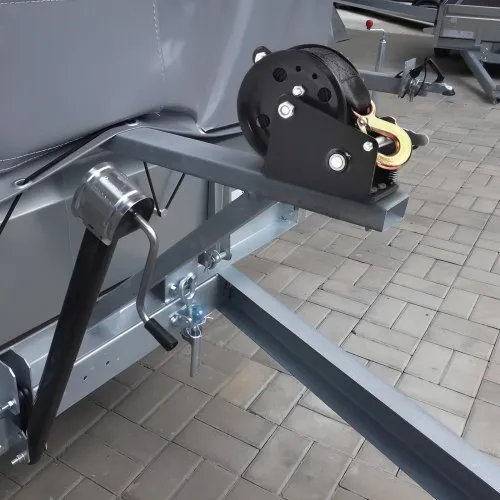
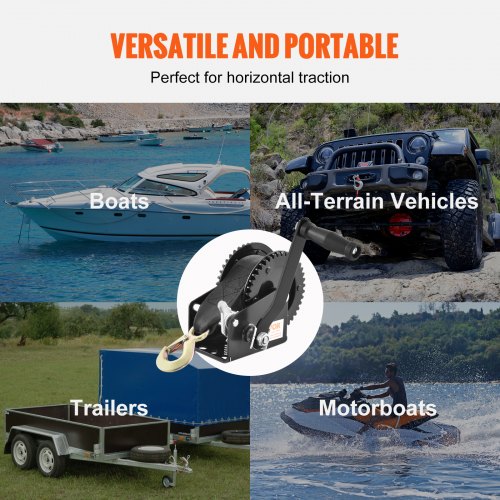
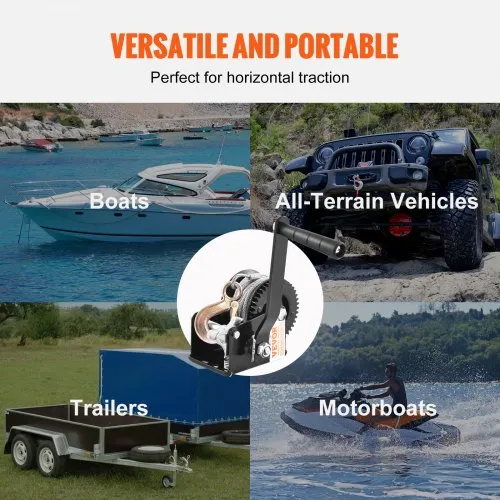
The most common use case in this range is a hand boat winch, which attaches to a trailer tongue and pulls the boat the final few feet up the bunks or rollers while you fasten the tie-downs. Depending on the listing, it may be referred to as a boat trailer winch or a hand crank boat winch, but the function is the same: the controlled, ratcheted drawing of a boat onto a trailer without the need for an electric motor or car battery. Utility trailers, ATV ramps, and equipment trailers (anywhere something has to be pulled up an incline under control rather than dragged) use the same mechanism as a manual trailer winch in a broader sense.
Particularly in saltwater and wet ramps, where corrosion resistance is more important than for a dry-land trailer parked in a garage, a marine hand winch will outlast a winch that never comes into contact with fresh water if the cable and hardware are rinsed after use. Off-road and construction users use the same tool to raise materials on a job site, tension tarps and cables, and recover stalled vehicles. The mechanism solely considers the weight of the object on the other end of the line. VEVOR's hand winches sacrifice speed for control in all of these configurations; they are slower than powered winches but have no chance of a runaway motor in an emergency.
Features That Matter: Handle, Ratchet, and Gear Ratio
Take a closer look at the handle winch, or the crank arm itself, before buying. A short folding handle works well in tight places like next to a bumper on a boat trailer tongue packed tight. A longer handle gives more leverage but takes more room to swing. Folding handles give most VEVOR hand winches full leverage while cranking, with compact storage when not in use. These tools are safe for lifting, not just pulling, thanks to the two-way ratchet, which locks the drum in both directions so the load can't escape if you let go mid-crank.
Another thing to consider is the gear ratio. Capacity tells you what it can move, but three specs determine how much work it will be on your arm: handle length, ratchet direction, and gear ratio. These three specs determine how a winch feels to use day to day. In the same use case, a marine setup near seawater may need the same folding-handle simplicity as a weekend caravan user, but with more emphasis on cleaning and drying the mechanism after use.
Why Choose VEVOR Hand Winches?
Match the tool to the load rather than buying more winch than you need. VEVOR hand winches are rated for 800 to 3500 lb pulling capacity, with steel cable or synthetic strap line depending on the job. Each model is much less expensive than an equivalent electric winch setup with a battery, wiring, and all, and includes the ratchet, handle, and mounting hardware, ready to bolt onto a trailer tongue or stand the same day it arrives. Pick your cable, pick your capacity, then start pulling.
FAQs
Is a steel cable or synthetic strap winch better?
Steel cable is preferred for trails or rocky boat ramps because it resists heat and wear better. In addition to being lighter and easier on the hands, synthetic straps do not eventually break into jagged strands like old steel cables do.
Can a hand winch lift a load vertically, not just pull it sideways?
Yes, it can raise and lower a load under control since the two-way ratchet maintains tension in both directions within its rated weight capability. Before using it for overhead work, always refer to the manufacturer's instructions for vertical lifting.
How long does the cable or strap last on a hand winch?
Steel cables used near saltwater without being rinsed deteriorate faster than those kept dry inland. Before every use, check the line and replace it as soon as you notice any fraying or kinking.