Plastic Grinder


Results for Plastic Grinder
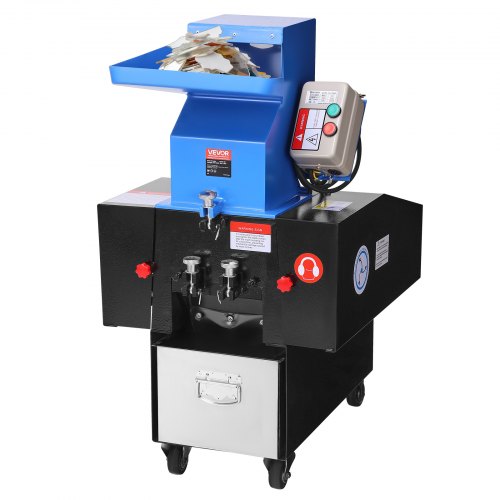
A plastic grinder, often sold as a shredder or granulator, chops plastic scrap into small flakes between spinning and fixed blades so the material can be reused or sold for recycling. A steel screen under the cutting chamber keeps pieces cycling until they pass through at the chosen size. Molders, makerspaces, recycling yards and farms use one to cut waste volume and recover resin. Unlike a paper shredder, it handles rigid parts, pipe offcuts and thick containers.
Compact granulators pair a 2.2 kW motor with a fine screen and a narrow feed slot, which suits small workshops trimming runners, misprints and offcuts. Mid-size granulators step up to 4.0 kW and a wider mouth for regrind beside a molding press. High-output granulators run a 7.5 kW motor with fourteen blades and a coarse screen, and they accept PET bottles that the smaller units refuse. Replacement blade kits supply matched rotating and fixed knives in hardened SKD-11 steel for each frame size, while screen meshes swap in to change flake size without buying a new machine. Every shredder here runs on 220V three-phase power, ships without a plug and rolls on four wheels. Output ranges from about 100 kg to 450 kg an hour. Plastics processors, recycling startups, schools and hobby fabricators choose by scrap volume, part size and the flake size their next step needs.
Five things decide which one fits:
- Hourly output: how much scrap it processes in an hour.
- Power draw: how much motor power the unit needs and on what supply.
- Blade set: how many rotating and fixed knives do the cutting.
- Screen opening: the hole size that sets the finished flake.
- Material range: which plastics and other scrap it is built for.
Browse every plastic grinder here, then explore all grinders.
Plastic Grinder Types and Accessories at a Glance
Each machine and part plays a different role in a recycling line, so the table below shows its role, key spec and what it pairs with.
| Type | Role in the Line | Key Spec | Pairs With |
|---|---|---|---|
| Compact granulator | Grinds small scrap into fine flakes | 2.2 kW, 9 rotating and 2 fixed knives, 6 mm mesh | 220V three-phase supply, hard-wired with no plug |
| Mid-size granulator | Regrinds runners and rejects | 4.0 kW, 6 rotating and 2 fixed knives, 8 mm mesh | 220V three-phase supply, hard-wired with no plug |
| High-output granulator | Handles high volumes, including PET bottles | 7.5 kW, 12 rotating and 2 fixed knives, 10 mm mesh | 220V three-phase supply and a floor rated for 888.5 lb |
| Replacement blade kit | Restores cutting edges | 6 rotating and 2 fixed SKD-11 knives, 50 to 55 HRC | The grinder model named on the product page |
| Replacement screen mesh | Sets the finished flake size | 6 mm perforated steel screen | The grinder model named on the product page |
VEVOR Plastic Shredders: Powerful, Efficient Plastic Waste Reduction
Are you looking for a reliable way to reduce the amount of plastic trash you produce, recover raw materials for further processing, or get your plastic scrap ready for recycling pickup? Customers who run workshops, recycling centers, or factories that need reliable, high-throughput cutting every day can choose from VEVOR's plastic shredders portfolio. VEVOR has the right machine for your needs, whether you need a small plastic shredder for a small business or a large plastic shredder for plastic processing at scale.
How Capacity & Shredding Size Determine the Right Plastic Shredder
Finding the strongest plastic shredders on the market is not the only way to choose the right one. The two main specs that indicate whether a machine can keep up with your production rate and deliver the material output your downstream process needs are its throughput capacity and output particle size. If you choose a shredder that is too small for the amount of material you want to recycle or produces particles too large for the recycling stream, you will lose time, pay more to process again, and shorten the machine's life by overloading it.
Throughput Capacity: Matching Your Shredder's Processing Rate to Your Actual Waste Volume
When looking at a plastic shredders machine, its throughput capacity, how much plastic it can cut in an hour, measured in kilograms or pounds, is the most important factor. Light-duty units designed for small workshops or low-volume recycling tasks can usually handle 50 to 150 kilograms per hour, enough to handle small amounts of packaging trash, rejected parts, and used bottle collections.
Heavy-duty shredders used in factories and large recycling centers can process up to 300 kilograms of plastic per hour. They have reinforced cutting chambers and high-torque motors, allowing them to run continuously without overheating or premature blade wear. When calculating throughput, factor in current waste and its projected growth over the next two to three years. This is because buying a larger plastic shredder later will cost you much more than buying the right-size unit from the start.
Cutting Chamber Size: How Feed Opening Dimensions Affect Material Compatibility
No matter what size plastic pieces you put in your shredder, the cutting chamber feed hole will tell you. A small shredder plastic unit has a narrow feed opening that works well for thin-walled bottles, film packaging, and small injection-molded parts. However, it will reject larger rigid parts, thick-walled containers, and bulky industrial scrap that exceed the inlet dimensions. If you know the typical size and shape of your plastic waste stream before you buy, you can avoid costly problems when your input material doesn't match your machine's physical limits.
Larger plastic shredders machines have wider feed openings that let bulkier items like car bumpers, large crates, and sections of industrial pipes be fed directly without being cut down by hand first. If you handle a variety of waste types and sizes, choosing a machine with the largest feed opening that fits your budget will give you the most operational flexibility. All VEVOR plastic shredders come with clear instructions for measuring the feed openings.
Output Particle Size: Selecting the Right Screen Size for Your Recycling or Reprocessing Needs
Under the cutting rotor is a screen or grate that controls the output particle size. This grate or screen sets the maximum size of the shredded material that exits the cutting chamber. When recycling centers put shredded plastic straight into an extruder or granulator, the output particles must be consistently small, usually 10 to 25 millimeters, so that the equipment further down the line can handle the material without getting stuck or having inconsistent melt flow.
Particle size standards are less strict for operations that only need to reduce volume for disposal or baling. These operations can use coarser screens, which increase throughput by allowing larger fragments to leave the chamber more quickly. A good plastic bottle shredder for recycling drink containers usually uses screens with 15 to 20 millimeter openings. This machine makes uniform flake output that can be washed, dried, and pelletized into recovered resin. You can change the screen configurations on some VEVOR plastic shredders.
Material Type Compatibility: Matching Your Shredder to Hard, Soft, and Mixed Plastics
It's not true that all plastic shredders can handle all types of polymers equally well. Plastics that are soft and bendable, like polyethylene film, foam packaging, and thin PET bottles, require sharp, closely spaced blades to cut easily without wrapping or getting stuck. You can find rigid engineering plastics like ABS, nylon, and polycarbonate in automotive parts, electronic housings, and industrial parts.
To handle different types of plastic trash, a plastic shredder needs blades made of high-alloy tool steel that maintain edge hardness across a range of polymer types and levels of contamination. VEVOR's plastic shredders feature hardened blade sets designed for the type of material they are intended to shred. The product specifications make it clear which kinds of polymers each model works best with.
Which Plastic Grinder Fits Your Operation
With the machines and parts covered, match your scrap and volume to the conditions below to land on one product.
| Confirm Before Purchase | Matching Specification | Recommended Product | Main Limitation |
|---|---|---|---|
| You grind failed prints and small offcuts, not bottles, on a 220V three-phase supply | 2.2 kW, 100 to 150 kg per hour, 6 mm mesh, 7.9 x 4.3 in feed | 2.2 kW compact granulator | Bottles are not suitable |
| You regrind runners and rejects beside a press and can hard-wire three-phase power | 4.0 kW, 150 to 200 kg per hour, 8 mm mesh, 9.8 x 6.5 in feed | 4.0 kW mid-size granulator | 502.7 lb and needs hard-wired power |
| Your yard shreds PET bottles and needs high hourly output | 7.5 kW, 250 to 450 kg per hour, 10 mm mesh, 16.5 x 8.3 in feed | 7.5 kW high-output granulator | Heaviest here at 888.5 lb |
| Your grinder matches the kit's listed model and takes 12 rotating and 2 fixed knives | 12 rotating and 2 fixed SKD-11 knives, 50 to 55 HRC, 36.16 lb | 12-plus-2 SKD-11 blade kit | Mounting bolts not listed |
| Your grinder matches the kit's listed model and takes 6 rotating and 2 fixed knives | 6 rotating and 2 fixed SKD-11 knives, 50 to 55 HRC, 13.45 lb | 6-plus-2 blade kit | Fits one frame size only |
Why Motor Power & Safety Features Make Plastic Shredders More Reliable
The product's sizes and capacities are only part of the story. The motor power that turns the cutting rotor and the safety systems that protect both the operator and the machine itself determine how well a plastic shredder works in real life and how safely staff with different skill levels can use it. These features set a machine apart from one that stalls, jams, or causes needless danger at work, so you can be sure it will work through long shifts.
Motor Power and Torque: Choosing the Right Drive System for Your Material and Volume
The motor power of a plastic shredder unit determines how well it can cut through tough, rigid materials without stopping or overheating. Low-torque motors on underpowered units struggle with thick-walled containers, multi-layer packing, and contaminated plastic scrap with metal fasteners or labels. This causes the motor to overheat and parts to break down early.
With a 1.5 to 3-kilowatt motor and moderate rotor speeds, a plastic bottle shredder designed for PET and HDPE containers with thin walls can operate effectively. Cutting efficiency is determined by blade sharpness rather than brute torque. Heavy-duty shredders used to process rigid industrial polymers need motors with 5 kilowatts or more and high-torque gearbox drives that maintain cutting force even as the rotor slows under load.
Safety Features, Overload Protection, and Access Controls for Secure Shredder Operation
When used in an industrial or workshop setting, a plastic shredder machine generates strong mechanical forces that require robust safety measures to protect both operators and the machine itself. One of the most important safety features is the automatic reverse function.
Every plastic shredder for processing plastic in a professional setting should have extra safety features, such as emergency stop buttons, feed-chamber safety interlocks that stop the rotor when the access panel is opened, and overload-current protection that cuts power before motor damage occurs. VEVOR builds its plastic shredders with multiple safety systems to meet the needs of workshops and light-industrial settings.
Best-Seller Comparison
Before ordering, set the five best sellers side by side on power draw, blade set, screen opening, material range and hourly output.
| Product | Power Draw | Blade Set | Screen Opening | Material Range | Hourly Output |
|---|---|---|---|---|---|
| VEVOR 4.0 kW Plastic Shredder Granulator | 4.0 kW (5.5 HP) on 220V three-phase | 6 rotating, 2 fixed | 8 mm | Rigid and soft plastics, rubber and wood, not bottles | 150 to 200 kg per hour |
| VEVOR 2.2 kW Compact Plastic Granulator | 2.2 kW (3 HP) on 220V three-phase, the lowest here | 9 rotating, 2 fixed | 6 mm, the finest here | Rigid and soft plastics plus rubber, not bottles | 100 to 150 kg per hour, the lowest here |
| VEVOR 12-Plus-2 SKD-11 Shredder Blade Kit | None, blades only | 12 rotating, 2 fixed, hardened to 50 to 55 HRC | None, blades only | ABS, PP, PVC, nylon, PS, PC and fiber-reinforced plastics | None, blades only |
| VEVOR 7.5 kW High-Output Plastic Granulator | 7.5 kW (10 HP) on 220V three-phase, the highest here | 12 rotating, 2 fixed | 10 mm, the coarsest here | Plastics including PET bottles, plus rubber and wood | 250 to 450 kg per hour, the highest here |
| VEVOR 9-Plus-2 SKD-11 Shredder Blade Kit | None, blades only | 9 rotating, 2 fixed, hardened to 50 to 55 HRC | None, blades only | ABS, PP, PVC, nylon, PS, PC and fiber-reinforced plastics | None, blades only |
Why Choose VEVOR Plastic Shredders?
For every recycling and waste-reduction task, VEVOR plastic shredders offer the right mix of throughput, output size control, motor power, and useful safety features. You can choose from small plastic bottle shredders to heavy-duty shredders for processing plastic on an industrial scale. VEVOR has shredders for every business size and material type, at prices hard to beat. Take a look at all of our plastic shredders right now to find the right one for your business.
Frequently Asked Questions
What types of plastic can a VEVOR plastic shredder machine process?
VEVOR plastic shredders handle a wide range of polymers, including PET, HDPE, ABS, polypropylene, and polycarbonate. Material compatibility varies by model; always check the product specification to confirm your specific plastic type is within the machine's rated material class.
Can a plastic bottle shredder handle caps and labels attached to bottles?
Most plastic bottle shredders handle intact bottles with labels effectively. Metal caps should be removed before feeding, as rigid metal components can damage blade edges and increase wear. Check your specific model's contamination tolerance guidelines before processing mixed loads.
How often do shredder blades need to be replaced?
Blade lifespan depends on material hardness, throughput volume, and contamination levels. Soft plastic processing extends blade life significantly compared to rigid engineering polymers. VEVOR replacement blades are available to keep your plastic shredder running at full cutting efficiency.
Is it safe to operate a plastic shredder without special training?
Basic operation is straightforward, but all operators should read the safety manual before use. Key practices include never hand-feeding oversized material, keeping hands clear of the feed opening, and using the emergency stop immediately if unusual sounds or vibrations occur during operation.
Can VEVOR plastic shredders run continuously for extended shifts?
Yes, VEVOR plastic shredder units are designed for sustained operation with thermal overload protection that prevents motor damage during long runs. Recommended duty cycles vary by model; consult your product manual for guidelines on continuous operation and scheduled maintenance intervals.
What are the main differences between plastic shredders and granulators?
Shredders use slow, high-torque shafts to tear bulky scrap into coarse chunks, while granulators spin knives fast against a screen to cut pieces into small, even flakes. Many shops shred first, then granulate. The 7.5 kW granulator sizes output with a 10 mm screen.
How do I choose the right plastic shredder for my home workshop?
Start with your power supply, because these units need 220V three-phase wiring, then size the feed opening to your scraps and pick a screen for the flake size you want. The 3 HP compact granulator has a 200 x 110 mm feed.
How do I choose the right plastic recycling equipment for my business?
Estimate daily volume, plastic types and target flake size, then pair a granulator with washing and drying steps if you plan to sell regrind. Check floor space and three-phase capacity. The 10 HP shredder handles 250 to 450 kg per hour.
How do I choose the right granulator blades for my plastic recycling machine?
Match blade count, size and hole spacing to your machine's model, then look for hardened tool steel around 50 to 55 HRC that can be reground. The 12-plus-2 SKD-11 blade kit fits the 7.5 kW machine.
What maintenance tips are essential for keeping granulator blades sharp?
Keep metal, glass and grit out of the feed, check blade gaps and bolt torque regularly, and regrind edges before they round over. Keeping a spare set cuts downtime. The 9-plus-2 replacement blade kit has stepped edges made for regrinding.
What is a granulator and how does it work?
A granulator cuts plastic between rotating and fixed knives inside a chamber, while a screen below holds pieces back until they are small enough to drop through. The result is uniform regrind ready for reuse. The 4.0 kW granulator uses an 8 mm screen.