
Precision Lathe Chuck


















Results for Precision Lathe Chuck
VEVOR's precision lathe chucks provide precise, consistent workpiece retention for all of your lathe turning, boring, and facing operations. VEVOR provides purpose-matched solutions for every machining application, whether you need a 3 jaw lathe chuck for quick self-centering on round stock, a 4 jaw lathe chuck for independent jaw control on irregular workpieces, a 6 jaw lathe chuck for thin-walled and delicate parts, or a high precision drill chuck for precise hole work. View the entire lineup right now.
VEVOR Precision Lathe Chucks for Turning, Boring, and Facing Operations
Every high-quality machining outcome depends on workpiece holding accuracy; no matter how accurate the lathe is, a chuck that runs out of true introduces inaccuracy into every cut. With reinforced jaws, precision-ground scroll mechanisms, and sturdy body construction that ensures precise workpiece centering over years of frequent workshop and production use, VEVOR precision lathe chucks are made to tight runout tolerances.
Precision Lathe Chucks by Jaw Count and Centering Features
The type of centering mechanism and jaw count dictate which workpiece geometries a lathe chuck can precisely accommodate and how fast the operator can set up each task. With models designed for particular workpiece types and machining workflows, VEVOR's lineup includes every common jaw configuration.
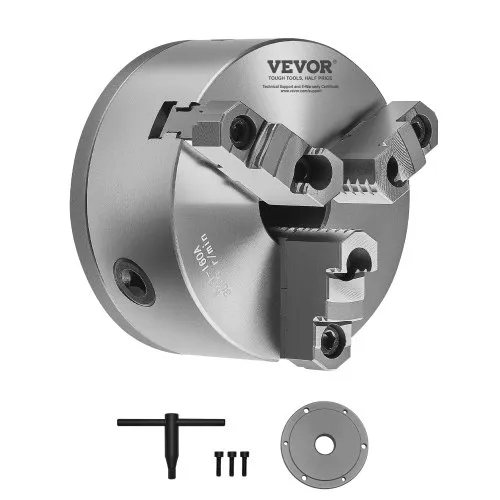
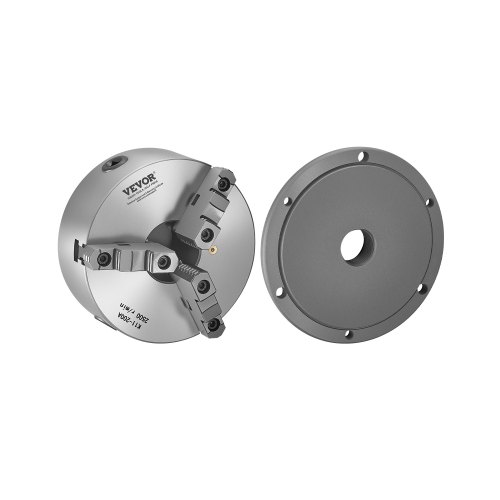
3 Jaw Lathe Chuck: Fast Self Centering for Round and Hex Stock
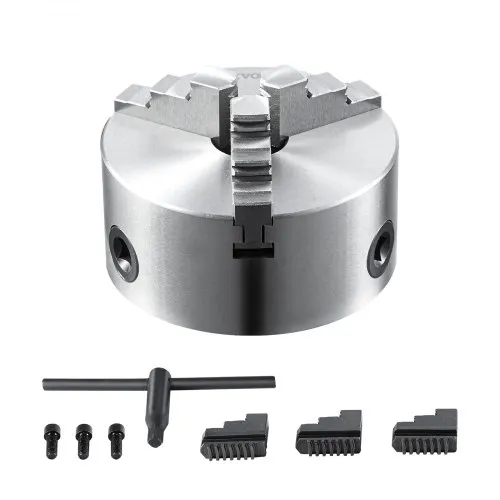
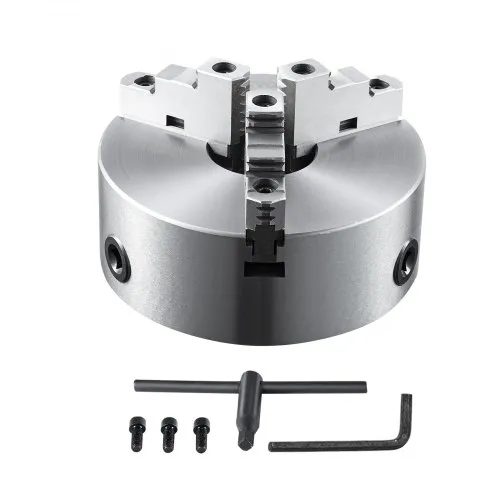
Because its three-jaw scroll mechanism centers round, triangular, and hexagonal workpieces automatically in a single chuck key rotation, a 3 jaw lathe chuck is the most popular chuck configuration for general-purpose turning. This feature eliminates the need for individual jaw adjustment that independent jaw configurations require for each new workpiece. The 3 jaw design is the standard option for production settings and general workshops, where setup time has a direct impact on machining output due to its self-centering speed.
The precision-ground scroll plates used in the production of VEVOR's 3 jaw lathe chuck models engage all three jaws simultaneously, applying a uniform clamping force along the workpiece's circumference. The synchronous jaw movement preserves centering accuracy that manual independent adjustment struggles to recreate across repeated setups during the workday consistently, and this even force distribution minimizes workpiece deformation caused by uneven clamping in softer materials.
Any self-centering lathe chuck's primary performance criterion is the runout specification, and VEVOR discloses runout tolerances for its three-jaw models in total indicator reading values, enabling direct comparison with machining accuracy requirements. For most round bar and tube stock operations, a well-made three-jaw chuck provides centering precision that is adequate for typical turning work. This feature eliminates the need for supplementary indication and adjustment that independent jaw chucks require on every setup.
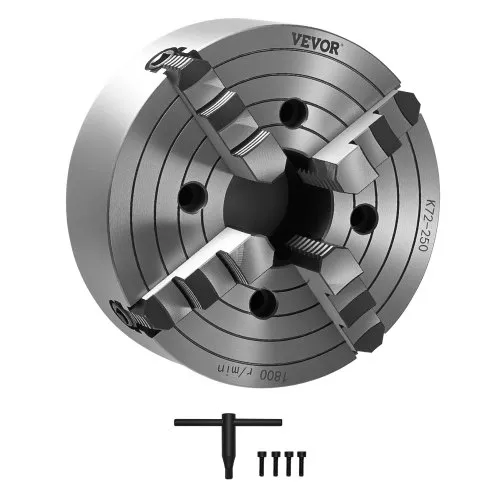
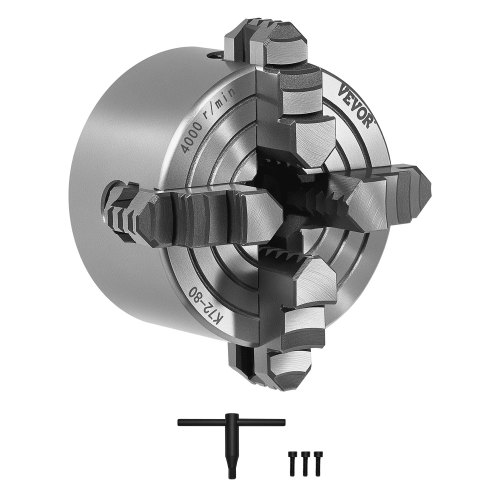
4 Jaw Lathe Chuck: Independent Control for Irregular and Off-Center Work
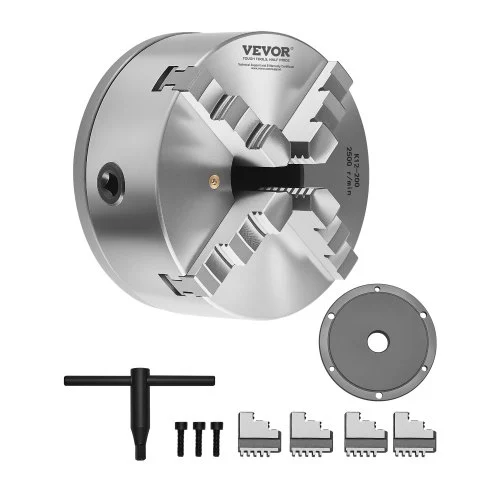
With a 4-jaw lathe chuck, the operator has total control over the workpiece's position regardless of its shape or symmetry, and can deliberately position it off-center for eccentric turning operations, because each of the four jaws moves independently rather than via a shared scroll mechanism. For square stock, rectangular billets, irregular castings, and any workpiece that a self-centering scroll chuck cannot hold precisely due to geometry, the 4 jaw configuration is the best option because of its independent adjustment capability.
The four-jaw lathe chuck models from VEVOR have individually adjustable jaws with precisely ground jaw slots that preserve precise jaw-to-jaw geometry throughout the whole adjustment range without the positional ambiguity and jaw movement caused by worn or ill-fitting jaws. Without the scroll mechanism limiting jaw positions to a fixed geometric relationship, the operator may precisely center irregular workpieces using a dial indicator, thanks to each jaw's independent lead screw adjustment.
The independent jaw control that only a four-jaw chuck can give is necessary for eccentric turning, which produces cam profiles, crankshaft throws, and purposefully offset characteristics. This sophisticated machining capability is supported by VEVOR's 4 jaw models, which have sufficient jaw travel to accommodate substantial workpiece offsets while ensuring safe clamping throughout the cut. A 4 jaw lathe chuck is a necessary addition to the self-centering 3 jaw variant in any well-equipped workplace for machinists who work with a variety of materials and non-standard workpiece shapes.
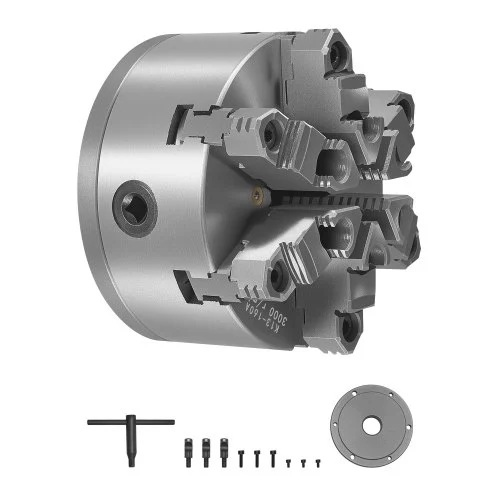
6 Jaw Lathe Chuck: Superior Grip for Thin-Walled and Precision Parts
Instead of distributing clamping force across the three contact points of a traditional chuck, a six-jaw lathe chuck uses six jaws, usually in a self-centering scroll configuration. The 6 jaw configuration is the best option for thin-walled tubing, hollow sections, precision ground shafts, and finished surfaces where the higher per-contact force of a 3 jaw chuck would result in deformation, marking, or dimensional distortion because of the doubled contact point count, which lowers the unit clamping force at each jaw contact area.
The six-jaw lathe chuck models from VEVOR are expertly constructed with matching jaw sets machined to uniform geometry, distributing stress evenly across all six contact points. The hexagonal distortion that three jaw chucks imprint on soft or thin-walled round workpieces when clamping force is concentrated at just three points is prevented by this even distribution. This deformation mode destroys the dimensional precision of finished parts and necessitates corrections that increase machining time and material waste.
VEVOR's 6 jaw lathe chuck offers the holding security of a self-centering mechanism with the surface protection of distributed low-contact-force clamping that the application requires for precision machining of aerospace components, hydraulic fittings, medical device parts, and any application where thin walls or finished surfaces must not be marked or distorted during secondary operations.
Self Centering Lathe Chuck: Speed and Repeatability for Production Use
A self-centering lathe chuck centers the workpiece automatically, without requiring individual jaw adjustments, thanks to a scroll plate mechanism that rotates all jaws concurrently with a single chuck key. In production settings where the same operation is repeated on numerous identical workpieces throughout the day, with no tolerance for the setup time required by independent jaw adjustment, this self-centering action ensures consistent workpiece positioning across every setup, making it the ideal configuration.
The whole spectrum of workpiece geometries that benefit from automatic centering is covered by VEVOR's self-centering lathe chuck models, which come in both 3 jaw and 6 jaw variants. Without the centering error that builds up in worn scroll mechanisms where scroll-to-jaw engagement has developed play, the precision-ground scroll mechanism provides repeatable centering accuracy across the entire jaw travel range, from small diameter bar stock to large diameter workpieces at the chuck's capacity limit.
Some VEVOR self-centering versions have interchangeable jaw sets that extend the chuck's workpiece diameter range beyond what a single jaw set can handle. The outer jaws are used to grasp the outside of large-diameter workpieces, while the interior jaws are used to expand against the bore of tubular and ring-shaped parts. Because of the jaw set's adaptability, a single self-centering chuck can handle a variety of workpiece types without requiring separate chuck purchases for each.
Precision and Application Considerations in Lathe Chucks
The precision specifications and intended machining application of a lathe chuck determine whether it provides the accuracy and performance your particular work requires, going beyond jaw count and centering mechanism.
High Precision Drill Chuck: Accurate Hole Work on the Lathe
To accommodate twist drills, reamers, and boring tools for axial hole operations performed on the lathe, in addition to turning work, a high-precision drill chuck is mounted on the lathe tailstock. Hole diameter accuracy, hole straightness, and reamer finish quality are all directly affected by drill chuck runout; a high-runout chuck introduces positional error that results in oversized holes, poor surface finish, and early cutting tool wear due to the lateral loading induced by misalignment.
The precise runout tolerances of VEVOR's high precision drill chuck models ensure accurate drill tip location across the full range of shank diameters the chuck accommodates. Instead of degrading the lathe's precision through imprecise toolholding at the tailstock, the precision jaw mechanism grips drill shanks concentrically, eliminating the jaw-induced runout that standard-grade drill chucks introduce. This results in hole diameter and positional accuracy consistent with the lathe's own precision capability.
Keyless and keyed versions of VEVOR's drill chuck models accommodate different workflow preferences. Keyless chucks allow for quicker bit changes in multi-operation setups, where drilling is one step in a series of tailstock-mounted operations carried out without pausing to find a chuck key between tool changes. In contrast, keyed chucks offer maximum clamping force for large-diameter drills in tough materials.
Matching Chuck Size and Accuracy to Your Lathe and Application
The dimensions of the workpiece you frequently machine and the spindle size of your lathe must coincide with the chuck body diameter, mounting thread or taper specification, and jaw capacity range. A chuck that is too small for the workpiece diameter cannot hold the material firmly for a safe cutting operation. At the same time, a chuck that is too big for the lathe causes spindle rating issues, leading to overhang and dynamic imbalance that add vibration and centering errors to turning operations.
From small benchtop hobby lathes to mid-size manual engine lathes used in production and toolroom settings, VEVOR's precision lathe chuck models come in body diameter sizes that match typical lathe spindle diameters. Each model features a clear list of mounting characteristics, such as threaded spindle nose, D-series cam-lock, or L-series long taper, which allows easy matching to the spindle nose type on your lathe without needing to measure and confirm compatibility after purchase.
The easiest way for machinists to upgrade from a worn-out original chuck to a quality replacement is to match the original chuck's body diameter and mounting specifications. The most popular size and mounting combinations from leading lathe brands are covered by VEVOR's precision lathe chuck portfolio, making it easy to choose a high-quality replacement without waiting for custom or special-order procurement.
Why Choose VEVOR Precision Lathe Chucks?
With tight runout tolerances and sturdy construction that preserves accuracy over years of frequent use, VEVOR precision lathe chucks come in every jaw configuration, including a 3-jaw lathe chuck for quick self-centering production work, a 4-jaw lathe chuck for independent control on complex geometries, a 6-jaw lathe chuck for thin-walled precision parts, and a high-precision drill chuck for precise tailstock hole operations. Precision workholding is affordable for all workshops. Browse the entire collection right now.
FAQs
When should I choose a 4 jaw lathe chuck over a 3 jaw model?
Select a 4 jaw lathe chuck for eccentric turning tasks that call for intentional workpiece offset, as well as for square, rectangular, and irregular workpieces that a 3 jaw scroll chuck cannot center precisely. A three-jaw self-centering variant is quicker and just as precise for typical round and hex stock manufacturing tasks.
What runout should I expect from a VEVOR precision lathe chuck?
Each product specification includes runout tolerance as a total indicator reading value, which varies by model. The precision lathe chuck models from VEVOR are made to runout tolerances suitable for both general and precision turning applications. These tolerances are clearly marked to enable direct comparison with your machining accuracy needs before purchase.
Can a 6 jaw lathe chuck hold the same workpiece diameters as a 3 jaw chuck?
Indeed. An equivalent-size 3 jaw type and a 6 jaw lathe chuck span a similar range of workpiece diameters. Reduced clamping deformation on soft and thin-walled workpieces is the main benefit of the six-jaw design, not an increased diameter range beyond what the chuck body size and jaw travel naturally allow.
What is the difference between a keyed and a keyless high precision drill chuck?
For optimum grip force on large drills in hard materials, a keyed high-precision drill chuck tightens its jaws with a chuck key. For quicker bit shifts during multi-step procedures, a keyless model is tightened by hand. Keyless types are better suited for lighter drilling and frequent tool changes, while keyed models offer a more secure grip for heavy drilling.
