Routers & Bits & Accessories












Results for Routers & Bits & Accessories
A router is a handheld or table-mounted power tool that spins a cutting bit at high speed to remove wood along an edge or across a surface. The motor drives a collet, a precision clamp that grips the shank of the bit, while a flat base rides on the workpiece and sets how deep the bit cuts. Router bits are the interchangeable cutters that give each pass its shape. A straight bit cuts a flat groove, while a profiled bit carves a rounded, angled or decorative edge. Together, the router and its bits shape edges, cut grooves and form joints in wood and wood composites.
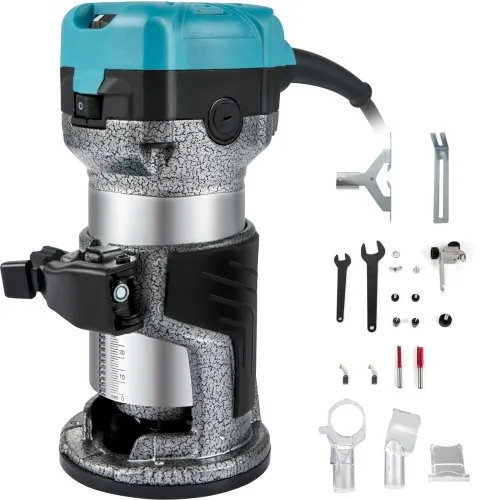
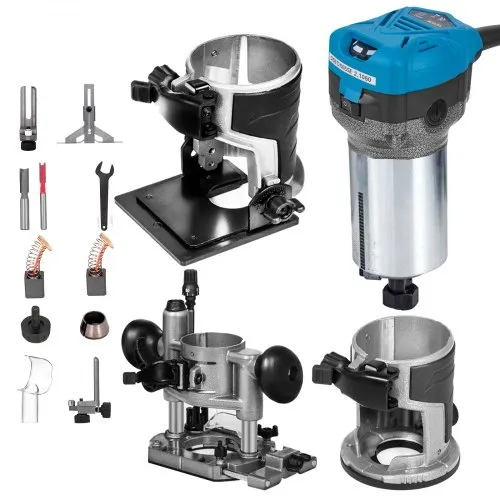
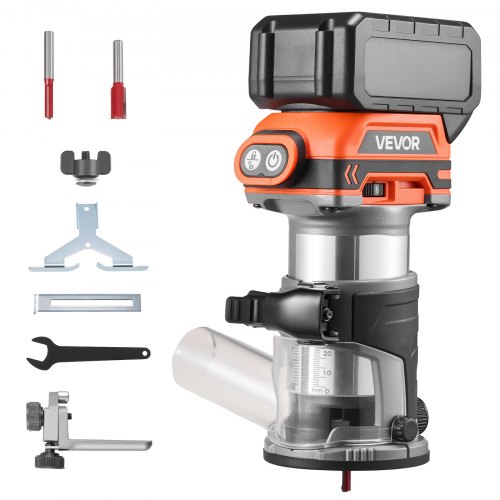
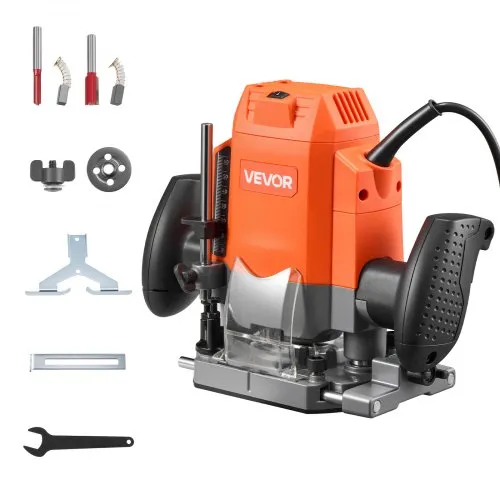
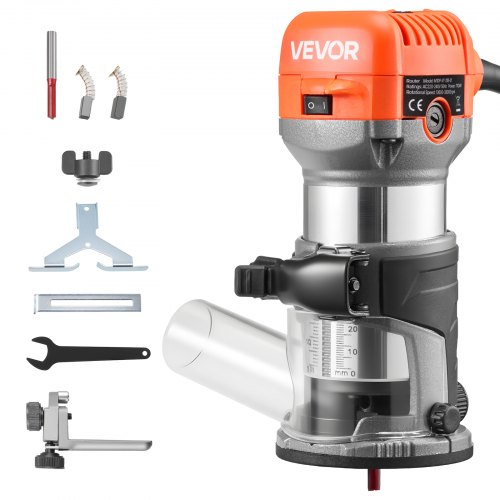
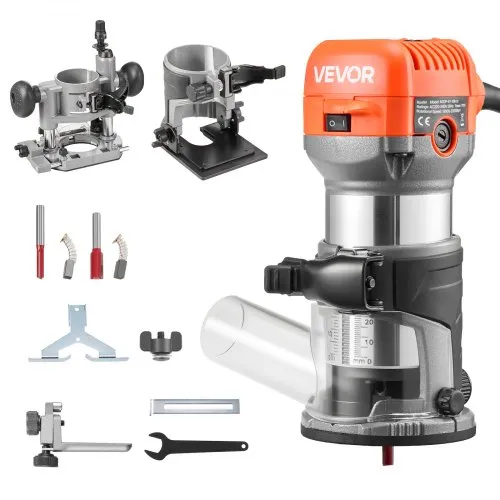
Routers fall into three main groups. Full-size wood routers run 1.75 to 3.25 HP with 1/4 and 1/2 in collets, and plunge models lower the bit up to 50 mm into the stock for stopped grooves and mortises. Compact routers (also called palm or trim routers) run 1 to 1.25 HP at 10,000 to 32,000 RPM on a 1/4 in collet, and kits add plunge and tilt bases for slots and bevels. Cordless compact routers use an 18 V brushless motor for trim work away from outlets. VEVOR router bits come singly or in 3 to 15 piece carbide sets with 1/4 in shanks, covering straight, roundover, chamfer and decorative profiles. Typical uses are edge profiling, laminate trimming, hinge mortises, dadoes, rabbets and decorative molding on cabinets, furniture and trim.
Four things decide what you need:
- Material and cut depth: dense hardwood and deep passes call for more horsepower and a 1/2 in collet, while softwood edging runs well on 1 HP.
- Base type: a fixed base suits edge work, a plunge base starts cuts in the middle of a panel, and a tilt base angles the bit for bevels.
- Power source: corded routers hold full power for long sessions, while cordless models trade run time for freedom from outlets.
- Collet and shank size: buy bits whose shank matches your collet, 1/4 in for compact routers and 1/2 in where a full-size router accepts it.
Explore the complete wood router range for every base and power option, or browse the wider woodworking tools collection to round out your shop.
Router and Bits Types at a Glance
Use this overview to match each router and bit type to the way you plan to work.
| Type | Power Source | Collet or Shank Size | Best-Suited Cuts | Trade-offs |
|---|---|---|---|---|
| Full-size plunge router | Corded mains | 1/4 and 1/2 in | Deep mortises, stopped grooves, raised panels | Most power and depth, but heavier and needs two hands |
| Multi-base compact router kit | Corded mains | 1/4 in, some kits add 3/8 in | Edging, plunged slots and bevels from one motor | Versatile for its size; base swaps add setup time |
| Fixed-base palm router | Corded mains | 1/4 in | Edge profiles, laminate trimming, small roundovers | Lightest and simplest, but cannot start cuts mid-panel |
| Cordless compact router | 18 V lithium battery | 1/4 in | Site trimming, installed cabinets, edges far from outlets | No cord to manage; run time limited by battery |
| Router bit set | Driven by the router | 1/4 or 1/2 in shank | Straight, roundover, chamfer and decorative profiles | Many profiles in one box; specialty shapes bought singly |
VEVOR Router and Bits: Wood Routers, Compact Models, and Complete Bit Sets
Want a reliable wood router for your next project? Maybe you want to build some furniture, make cabinets, or put up some trim. This is because picking the right router body and cutting bits affects the quality, speed, and safety of each pass. You can find all kinds of routers and bits in VEVOR's router and bits catalog. There are full-size fixed-base routers for production work and cordless compact routers for one-handed trimming.
Choosing the Right Router Type & Power Source
There are different kinds of routers for different jobs. To choose the right one, you need to know how the motor size, base setup, and power source affect cutting performance in the real world. If the tool is too big, it's hard to use for small details, and if it's too small, it gets slow when cutting hardwood.
Full-Size Wood Routers for Heavy-Duty Shaping and Joinery
Any serious woodworking shop needs a full-size wood router because it has the motor torque and depth capacity to do tough jobs like cutting raised panels, big mortise routing, and through-dado joinery in thick hardwood stock. Usually, these routers have between 1.75 and 3.25 horsepower, and they have speed controls that let the operator match RPM to the bit diameter and the material's hardness. Fixed-base models are the most stable for edge work and table-mounted uses, while plunge-base models let you lower the bit into the workpiece in the middle of the cut, which is necessary for stopped grooves and holes inside the workpiece.
Coupled with a good router bit set, a full-size wood router is the most useful tool for woodworkers who are making cabinets, furniture, or architectural metalwork. For long-term use without fatigue, VEVOR's full-size wood routers feature ergonomic handles, smooth depth-adjustment mechanisms, and precisely machined collets available in ¼-inch and ½-inch sizes. When switching between softwood and hardwood in the same job, variable-speed electronics keep the RPM constant even under load. This keeps the bit from burning out or tearing out.
Compact Router for One-Handed Trimming and Detail Work
A compact router, also known as a trim router, is between a full-size wood router and a handheld rotary tool. A compact router is designed for tasks where accuracy is more important than speed, like edge profiling, laminate trimming, small hinge mortises, and artistic detailing. It usually weighs between 3 and 5 pounds and has motors with 1 to 1.25 horsepower. It's easy to move along narrow edges, around tight curves, and into corners that a bigger router just can't reach. This is because the body width is smaller.
The small wood router models from VEVOR are designed with a low center of gravity for steady one-handed operation, a clear sub-base for precise bit placement, and tool-free depth adjustment for quick changes in cutting depth during detailed work. Because it fits standard ¼-inch shank router bits, the collet is instantly compatible with straight, roundover, chamfer, and flush-trim router bits.
Cordless Compact Router for Job Site Flexibility and Portability
Because it doesn't require a power line, a cordless compact router is the best choice for carpentry on the job site, installing cabinets on the job site, and any workshop where outlet placement makes it hard to move around. Modern cordless compact routers use lithium-ion batteries, offering performance similar to corded models for most trim and detail routing jobs. They can often run for many hours of intermittent use on a single charge.
Its brushless motor architecture makes the VEVOR cordless compact router as energy-efficient as possible while maintaining a constant cutting speed. Electronic speed control keeps the bit from stopping when cutting along narrow sides or into the end grain of a hardwood. The tool works with standard ¼-inch shank router bits, so you don't need adapters to use VEVOR's router bit sets or straight router bits.
Router Bit Sets for Complete Cutting Geometry Coverage
The right bit geometry, shank size, and carbide grade decide the quality of the cut, the finish on the edges, and the long-term durability of the bits in every routing application. A complete router bit set is just as important as the router itself. Straight bits for dadoes and grooves, roundover bits for softening edges, chamfer bits for angled profiles, cove bits for concave molding details, and rabbeting bits for joinery are some of the most popular router bit sets. They usually have 15 to 30 pieces. Professional sets come with at least 50 pieces, including ogee, Roman ogee, dovetail, and beading bits.
When VEVOR makes router bit sets, they use C3 micrograin carbide for the cutting edges and anti-kickback body designs that limit the depth of cut per pass to prevent hardwood from getting stuck. You can choose between ¼-inch and ½-inch shanks. ½-inch shanks are much more rigid and vibration-resistant, which is why they are best for full-size wood routers and production routing tasks. Precision-ground to tight tolerances, all of VEVOR's bits ensure a clean entry, minimal tear-out, and consistent geometry from the first pass to the last.
Choosing Router Bits by Profile
Once the router is chosen, the bit profile decides how each pass is guided and which router setup handles it best.
| Bit Profile | Guide Method | Pass Strategy | Router to Pair | What to Watch For |
|---|---|---|---|---|
| Straight or spiral | Edge guide, fence or template | Several shallow passes for deep dadoes | Any router; plunge base for stopped grooves | Match bit diameter to the groove width before the first cut |
| Roundover | Pilot bearing on the workpiece edge | One pass for small radii, two for large | Palm or compact router | The bearing follows every bump, so smooth the edge first |
| Chamfer | Pilot bearing on the workpiece edge | Raise depth in steps to widen the bevel | Palm or compact router | Bevel width grows with depth, so test on scrap first |
| Rabbeting | Swappable bearings set the width | One or two passes depending on depth | Any router with a matching collet | Bearing diameter sets rabbet width; check which sizes are included |
| Cove, ogee and beading | Pilot bearing or router table fence | Several light passes to final depth | Full-size router, ideally table mounted | Large diameter profiles need a lower speed to avoid burning |
| Dovetail | Dovetail jig or fence, no bearing | One full depth pass after clearing waste | Plunge or table mounted router | Rough out waste with a straight bit to ease the load |
Selecting the Right Router Bit Configuration & Features
Matching the cutting geometry, shank diameter, and carbide specification to your particular materials and joinery requirements is necessary when selecting individual router bits or a full router bit set. Using the wrong bit for the job leads to a rough surface, too much heat buildup, and early edge loss, all of which cost time and money.
Straight Router Bits: Core Joinery and Groove Cutting Performance
You can use straight router bits to cut dadoes, grooves, mortises, rabbets, and edges on almost any woodworking project. They are the most basic cutting tools in any router, and bit sets with one flute are designed to remove chips quickly in softwood and MDF. In contrast, bits with two flutes produce a better cut surface in hardwood, where finish quality is important. Upcut spirals pull chips out of the cut, leaving the bottoms of deep grooves clean. Downcut spirals push chips down, making the tops of veneered panels tear-free.
There are different carbide types for VEVOR's straight router bits, so you can buy them separately or as part of a full router bit set. Standard C2 carbide is hard enough and holds its edges well for basic joinery in pine, poplar, and MDF. For production cutting in rough materials like MDF and melamine or hardwoods like oak, maple, and walnut, C3 micrograin carbide keeps its edge sharper longer and doesn't chip or wear down as quickly as standard carbide.
Router Bit Features That Affect Cut Quality and Long-Term Value
Beyond basic cutting geometry, there are a few other design features that set high-performance router bits apart from cheaper ones that wear out quickly and don't work as well. The anti-kickback body design limits the maximum cut depth achievable in a single pass. This keeps cuts under control even at higher feed rates and reduces the risk of the bit grabbing in thick hardwood. Tight radial runout tolerances and precision-ground cutting edges keep vibrations to a minimum, reduce chatter marks on cut surfaces, and increase the life of bearings in guided bits.
Woodworkers who want to buy router bit sets for the long term should consider both the base's quality and the cutting edge's quality. The shanks of VEVOR router bits are made of hardened steel and have precision-ground diameters that fit tightly in both 14-inch and 12-inch collets and won't slip during use. Protecting cutting edges from damage, storage boxes with individual bit slots make it easy to find the right profile without digging through a bunch of loose bits.
Best-Seller Comparison
Here is how the top VEVOR routers compare on the specs that set them apart.
| Product | Power | Speed Range | Collet Size | Bases Included | Max Depth | Power Source | Best For |
|---|---|---|---|---|---|---|---|
| Compact Router 1.25HP, 3 Bases | 1.25 HP, 800 W | 10,000 to 30,000 RPM | 1/4 and 3/8 in | Fixed, plunge, tilt | About 20 mm | Corded, 110 V | Only 3/8 in collet here; one kit for edges, slots and bevels |
| Wood Router 1 HP, 3 Bases | 1 HP, 710 W | 10,000 to 32,000 RPM | 1/4 in | Fixed, plunge, tilt | 20 mm fixed, 35 mm plunge | Corded | Fastest kit with three bases; fine plunged profiles in hardwood |
| Palm Router 1 HP, Fixed Base | 1 HP, 710 W | 10,000 to 32,000 RPM | 1/4 in | Fixed | 20 mm | Corded | Simplest single base setup; dedicated edge trimming and laminate |
| Cordless Router 18V Brushless | / | 10,000 to 30,000 RPM | 1/4 in | Fixed, with trim base | 20 mm | 18 V battery, not included | Only cordless option; trim work far from any outlet |
| Plunge Router 3-1/4 HP, 120V | 3.25 HP | 12,000 to 23,000 RPM | 1/4 and 1/2 in | Plunge | 50 mm | Corded, 120 V | Most power and deepest plunge; 1/2 in bits in dense hardwood |
Shop VEVOR Router and Bits for Precision, Power, and Complete Cutting Coverage
VEVOR's router and bits lineup covers woodworking needs, from full-size routers for heavy joinery to cordless compact routers for trim work, backed by complete bit sets with matching geometry and carbide quality. Every product is competitively priced, built to verified specifications, and supported by reliable service. Whether setting up a new workshop or upgrading tools, VEVOR has the right router and bit combination ready to ship. Browse the collection today and cut with confidence.
FAQs
What is the difference between a compact router and a full-size wood router?
A compact router weighs 3–5 lbs and handles edge profiling, laminate trimming, and light detail work. A full-size wood router delivers 1.75–3.25 HP for heavy joinery, raised panels, and production routing. Choose based on your most common cutting tasks and material thickness.
Should I buy a router bit set or individual router bits?
A router bit set offers better value for general woodworking, covering the most common profiles in one purchase. Buy individual bits when you need a specialty profile not included in a standard set, or when you need a higher-grade carbide for a specific production application.
Are cordless compact routers powerful enough for hardwood routing?
Yes, for most trim-and-detail applications. Modern brushless cordless compact routers maintain consistent speed in hardwood for edge profiling and shallow mortises. For deep passes in dense hardwoods or extended production runs, a corded compact wood router or full-size router is more reliable.
What shank size should I choose, ¼-inch or ½-inch router bits?
Use ½-inch shank bits in full-size wood routers whenever possible; they're more rigid, vibrate less, and last longer. Reserve ¼-inch shank bits for compact routers with a smaller collet; use ¼-inch shank bits only.
How do I know routers need replacing?
Signs include burning on cut surfaces, increased feed resistance, visible edge chipping under magnification, or a rough rather than smooth cut finish. Carbide bits can be resharpened professionally, but heavily worn bits from a router bit set are typically more cost-effective to replace entirely.
What is the difference between a wood router and a router bit?
A wood router is the powered tool that spins and guides the cut, while a router bit is the interchangeable cutter clamped in its collet. The router supplies speed and depth control, and the profile of the bit decides the final shape. Browse wood routers to pair with your bits.
What are the best quality router bits?
The best router bits combine carbide cutting edges, precision ground shanks and a body that limits how much wood each pass removes. C3 micrograin carbide stays sharp longest in hardwood, MDF and melamine, while C2 suits softwood joinery. Compare carbide sets in the router bits collection.
What features should I look for in a compact router?
Look for variable speed, soft start, a clear sub-base and fine depth adjustment. A 1/4 in collet covers most bits, and a multi-base compact router kit adds plunge and tilt bases for slots and bevels. A dust hood that connects to a vacuum keeps the cut line visible.
Can you recommend the best handheld router for detailed woodworking?
For detailed work, a 1 HP palm router with variable speed and a 1/4 in collet is the easiest to control. The VEVOR 1 HP palm router with three bases reaches 32,000 RPM and 35 mm of plunge depth. Choose a fixed base model if you only trim edges.
Which router bits are best for detailed profile work?
Roundover, chamfer, cove, ogee and beading bits handle most detailed profile work. Bearing guided versions follow the edge without a fence, which suits curves and small parts. Take several light passes, and lower the speed for large diameter profiles to avoid burning hardwood.