Variable Frequency Drive




Results for Variable Frequency Drive
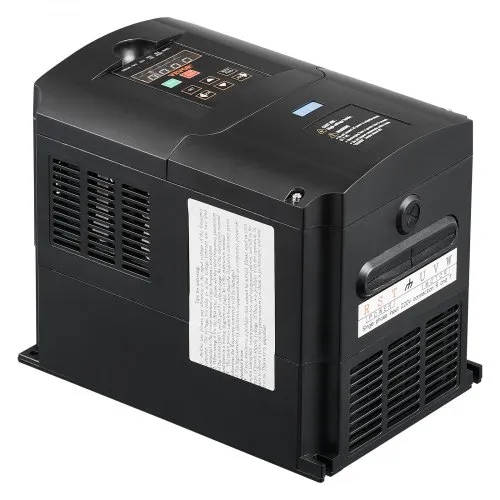
Explore a full selection of variable frequency drives for CNC spindles, pumps, compressors, conveyors, and workplace equipment. VEVOR has units ranging from 1.5 kW to 7.5 kW in stock. These units can accept both single-phase and three-phase inputs and have output ranges of 0–400Hz. They also include built-in overload, overvoltage, and temperature protection. A drive that works with your motor and power source, whether you are changing the speed of a home shop machine, running a spindle on home power, or improving an industrial pump line.
VEVOR Variable Frequency Drives for CNC, Pump, and Industrial Motor Control
Using a single-phase garage outlet to power a three-phase motor? Spending money on a pump that does not need to work at full capacity? Variable frequency drives fix both issues: they change the power source, electronically manage motor speed, and lower stress on belts, bearings, and couplings during startup. VEVOR's tried-and-true models make it easy to match power, voltage, and frequency to your equipment with clear specs.
Matching Power Rating and Phase Configuration to Your Motor
Putting HP, kW, and phase at the beginning helps prevent unnecessary trips, burning, and drive failures. Here's how the tiers look.
Small-Shop Drives: 2HP and 3HP Units for Light Machinery
For hobby cutters, small engraving spindles, benchtop lathes, and light fans, a 2HP 1.5KW CNC Spindle Motor VFD is a good place to start. Its small size means it can fit inside a standard control cabinet without leaving room for too many contactors and terminal blocks.
Get a 3HP 2.2KW VFD Motor Speed Controller for a 3–4 kW water-cooled wheel, a small mill, or a fan for collecting dust. More than the nameplate rating, extra headroom matters. Drives run cooler and last longer when they are sized slightly above the constant load.
A good rule of thumb is to match or beat the motor's KW rating; never go too small. Running a drive at 95% capacity all day generates much more heat than running it at 70%. VEVOR's variable frequency drives can be used in garages and small workshops without three-phase service at the panel, as they can handle single-phase input.
Mid-Range 4HP and 5HP Drives for Serious Workshop Loads
A 4HP, 3KW CNC variable-frequency drive inverter can easily handle medium-sized routers, 3KW spindles, and light pump work. It is ideal for makers who want to run longer hours without cutting back on production.
The 5HP 4KW 220V Single-Phase Input VFD might be the most useful one in the group. It draws power from a standard 220V–240V home outlet and outputs true three-phase power. This lets you power things that would otherwise need an expensive service upgrade or a rotary phase converter.
What would happen in real life? A maker would have a 4KW three-phase spindle but only single-phase power at the shop. One drive can replace a phase converter, give you full speed control, and cost much less than installing new wiring.
If your duty cycle is high or your shop gets hot in the summer, you might want to choose a 5.5HP 4KW CNC motor inverter converter, which can handle similar loads with a little more thermal margin.
10HP Industrial Drives for Three-Phase Systems
Large pumps, HVAC air movers, compressors, conveyor lines, and heavy machine tools are all real industrial applications for which the 10HP 7.5KW VFD 3-Phase Motor Controller is designed. At this power level, the input is three-phase because a single-phase supply cannot deliver 7.5KW of continuous output.
The "soft-start" option is very useful in this case. When you start a 10HP motor directly from the line, it draws 6 to 8 times its rated current. This damages the contactors and dims the lights throughout the building. An alternative is a drive that gradually speeds up over a set amount of time.
Power savings go up as energy savings do. If you slow down rotary pumps and fans by 20%, they will use about half as much power. This saves a lot of money for motors that work multiple shifts.
Plan the enclosure's airflow carefully at this stage. If you mount a bigger drive in a sealed box, it needs a cabinet fan and clear airflow from above and below.
Understanding Single-Phase Input Versus Three-Phase Output
This is the part that most first-time buyers do not understand. You only need two wires from the wall for a 220V–240V Input to 3-Phase Output VFD Inverter to make three balanced phases for the motor. It doesn't need a three-phase supply to produce a three-phase output.
Derating is the trade-off. Because the incoming current per leg is higher, a single-phase drive can usually handle a smaller motor than a three-phase drive of the same size. Instead of just looking at the model name, always check the spec sheet for the single-phase grade.
Just connect the line to L1 and L2 (or L/N if the instructions say so), and the motor leads to U, V, and W. Connecting inbound power to the output terminals will destroy the drive immediately.
Use shielded motor wire for longer runs, and ensure the ground is correct to keep electrical noise away from CNC controllers and nearby sensors.
Frequency Range and Application Fit for Variable Frequency Drives
The power number tells you what you can run. The frequency range tells you how well it can run. Check these things out.
Why 0–400Hz Output Matters for CNC Spindles?
For water-cooled and air-cooled CNC machines designed to work at high speeds, a 0–400Hz high frequency AC motor VFD is a must. A standard 50/60Hz drive can only reach 3,600 RPM with a 24,000 RPM spindle. It needs 400Hz to hit its full speed.
Use the nameplate on your spindle to match the base frequency and maximum frequency. Do not use the drive's highest frequency. Overspeeding a spindle can cause bearings to fail and rotor stress to rise to dangerous levels.
The useful range for regular induction motors in fans and pumps is about 20Hz to 60Hz. Running standard motors at low speeds for extended periods can damage the windings by reducing the cooling fan's effectiveness.
As a separate setting, carrier frequency is worth changing. Motors run more quietly at lower values, and they run cooler with less electromagnetic interference.
Application Matching and Setup Best Practices
Loads with constant torque, such as positive-displacement pumps, lathes, and conveyors, require full torque across the speed range. Make sure the drive is the right size and allows for the right torque boost.
Variable-torque loads, such as rotary pumps, fans, and blowers, require much less power at low speeds. This is where variable frequency drives save the most energy.
Before the first run, set the maximum voltage, current, frequency, and RPM to the motor's nameplate rating. Then set up ramps to speed up and slow down. Overcurrent or overvoltage faults happen when ramps are too fast; five to ten seconds is a good range for most shop equipment.
If you need to stop high-inertia loads quickly, add a braking resistor and mount the drive vertically to allow space above and below it. It takes 20 minutes to follow these steps, but they eliminate most of the fault codes new users see.
Why Choose VEVOR Variable Frequency Drives?
VEVOR has honest reviews and clear specifications for everything from 1.5KW spindle controllers to 7.5KW three-phase industrial units. Keypad programming, built-in protection circuits, RS-485 communication on some models, and single-phase input options are all common features at no extra cost. It has never been cheaper to upgrade your motor control thanks to low prices and quick after-sales customer service. Browse the list to find the right drive for your application.
FAQs
Can a VFD run a three-phase motor on single-phase power?
Yes. Single-phase input models take a household supply of 220V–240V and convert it to a three-phase output. Check the drive's single-phase rating, as it typically has lower capacity when used with a three-phase input.
How do I size a VFD for my motor?
Meet or beat the motor's listed KW and full-load amps. Increasing the size by one step improves thermal margin and reliability, especially for loads with steady torque or duty cycles that run extended periods.
Why does my drive trip on overcurrent at startup?
Most likely, the acceleration ramp is too fast. Make it last five to ten seconds longer, check that the motor parameters are entered correctly, and make sure the drive is not too small for the load it is connected to.
Do I need a braking resistor?
Only for heavy loads that need to stop quickly, like big flywheels or spindles. If you don't have one, fast deceleration sends energy back to the drive, causing overvoltage problems.